

Single-Core vs Twin Solar Cable
What Does 'Twin' Mean and Which Construction Fits Your PV Route?
SUMMARY: A single-core solar cable contains one current-carrying conductor in its own insulation and sheath. 'Twin solar cable' is a market term that can describe two separately insulated and sheathed PV cables bonded side by side, or a different two-core construction under a shared outer covering. Those are not automatically equivalent. Choose twin only when the positive and negative conductors follow the same route, the exact assembly is accepted for the project, thermal corrections are verified, and each end can be separated and terminated without damaging the individual PV cables. Choose separate single-core cables when the polarities diverge, connector tails need independent routing, larger sizes or special routes are required, or the project evidence covers only the individual single-core product.
For the broader sequence of standard, voltage, current, length, environment and supplier checks, start with the solar DC cable selection guide. This article answers one narrower question: how should an EPC or buyer choose the physical one-core or twin arrangement after the electrical design inputs are known?
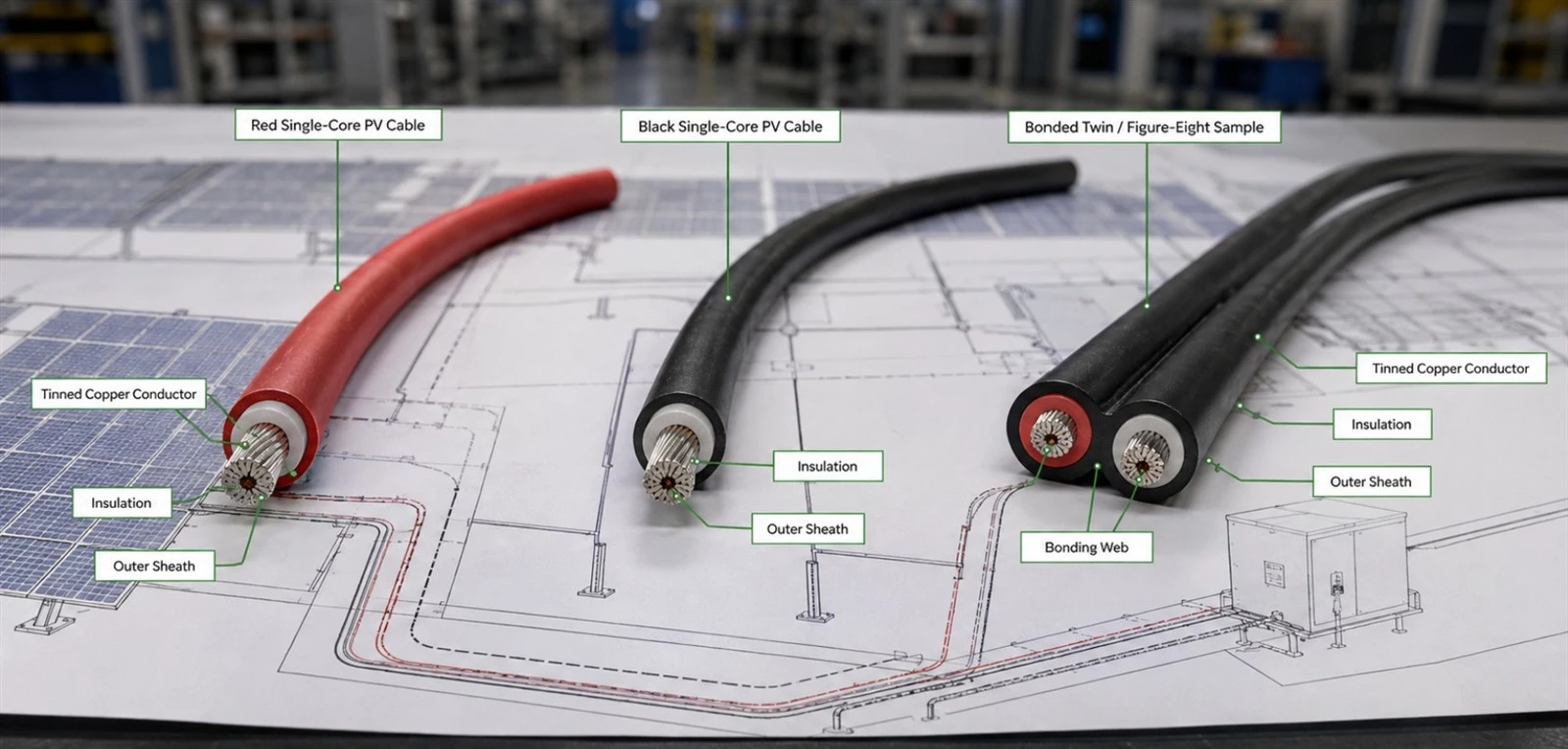
What Does Single-Core Solar Cable Mean?
A single-core PV cable has one conductor surrounded by its specified insulation and sheath system. A complete two-pole DC circuit normally uses at least one positive and one negative conductor, so two single-core cables may travel together for all or part of the route. They can also separate where the array layout, module leads, combiner inputs, inverter entries or protective devices require different paths.
EN 50618 describes flexible, halogen-free, single-core PV power cables with cross-linked insulation and sheath. IEC 62930 also applies to single-core cross-linked insulated and sheathed power cables for the DC side of PV systems up to 1.5 kV DC within its stated scope. These scope statements are central to reading a twin product claim correctly.
What Does Twin Solar Cable Mean?
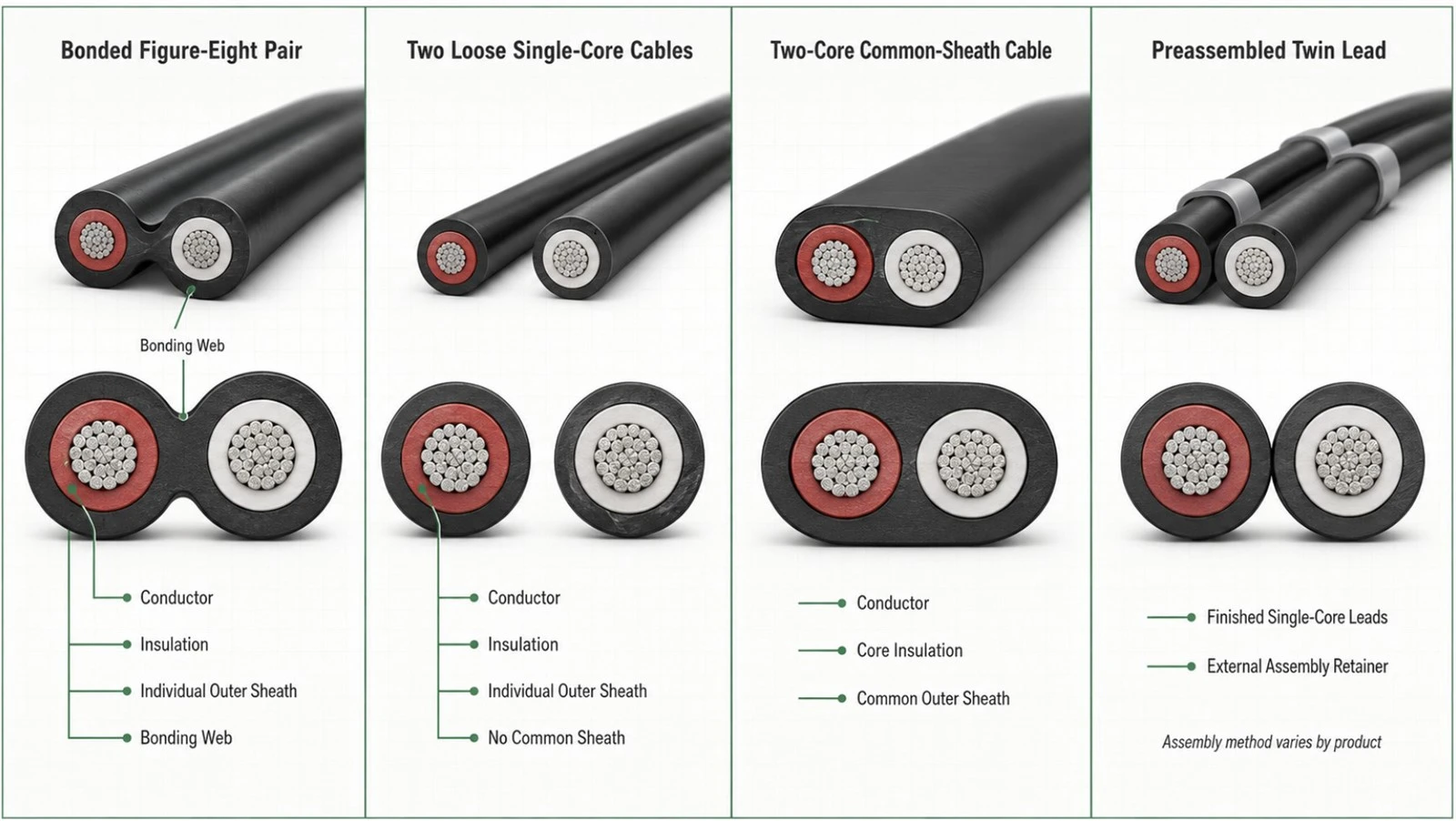
'Twin solar cable,' 'twin-core solar cable,' 'duplex PV cable' and 'figure-eight solar cable' are not safe substitutes for a construction drawing. Suppliers may use the words differently. Before comparing quotations, classify the offered product into one of the following constructions.
|
Construction offered |
How it is built |
What must be verified |
|
Bonded pair / figure-eight |
Two complete round PV cable members joined by a web or bonded side by side |
Individual marking, web material, separation method, thermal rating, bend and route approval |
|
Two cables supplied in parallel |
Two independent single-core cables packaged or reeled together without a permanent bond |
Length matching, polarity identification, reel method and installation controls |
|
True two-core cable |
Two insulated conductors within one overall cable construction |
The exact product standard, voltage, sheath, test evidence, ampacity, gland and permitted use |
|
Preassembled twin lead |
A defined cable assembly with connectors or terminals fitted |
Cable model, connector family, mating compatibility, assembly listing/certificate and traceability |
A bonded pair may preserve two fully sheathed single-core members; a true two-core cable may not. The marketing word 'twin' does not prove double insulation, 1.5 kV DC suitability, outdoor use, connector compatibility or conformity to EN 50618/IEC 62930.
Is H1Z2Z2-K Twin Solar Cable Covered by EN 50618?
EN 50618's published scope is for flexible single-core PV cables. Therefore, a supplier name such as 'H1Z2Z2-K Twin Solar Cable' needs a product-specific explanation. One possible construction is two H1Z2Z2-K single-core members bonded into a parallel assembly. In that case, request evidence for each member and additional evidence or instructions for the bonding, separation, thermal behavior and intended installation. Do not assume the twin assembly itself appears as a separate standardized H1Z2Z2-K cable designation.
Use the live EN 50618 H1Z2Z2-K solar cable page to compare the underlying single-core construction, then request the drawing and evidence package for the exact twin assembly.
Before publishing or purchasing, apply how to verify a solar cable certificate to the exact manufacturer, product designation, conductor size and certificate database entry. A single-core certificate should not be silently presented as a certificate for a different two-core construction.
TÜV Rheinland stated in 2018 that 2 PfG 1169 and 2 PfG 1990 were withdrawn in October 2017 and that tenders should transition to EN 50618 or IEC 62930. Phrase this as TÜV Rheinland's published transition guidance, not as a universal legal conclusion for every country or legacy installation. TÜV Rheinland's transition guidance
What Does 2×4 mm² or 2×6 mm² Mean?
When a datasheet clearly uses 2×4 mm², it normally means two conductors and each conductor has a nominal cross-sectional area of 4 mm². It does not mean one 8 mm² conductor. Likewise, 2×6 mm² normally means two 6 mm² conductors, not one 12 mm² conductor. Confirm the supplier's notation, conductor count and drawing rather than relying on a marketplace title.
A twin arrangement does not automatically double circuit ampacity. In a two-wire DC loop, the positive and negative conductors carry the circuit current in opposite directions. Allowable current depends on the exact cable construction, installation method, ambient temperature, grouping, heat dissipation and applicable design method.
If the unresolved question is whether each conductor should be 4 mm² or 6 mm², move to 4mm² vs 6mm² solar cable. Keep that electrical sizing decision separate from the later choice between two loose cables and a bonded twin arrangement.
Single-Core vs Twin Solar Cable: Route-Level Comparison
|
Decision factor |
Separate single-core cables |
Twin arrangement |
Approval question |
|
Route geometry |
Each polarity can diverge or take a different entry |
Best suited when both members share the same route |
Where must the pair split? |
|
Cable management |
Two cables must be paired, supported and identified |
One flat/bonded run may simplify handling |
Are approved clips, trays and supports available? |
|
Bending and movement |
Independent round cables can be routed separately |
Flat or bonded construction may have directional bend limits |
What are the minimum bend and movement limits? |
|
Heat and grouping |
Spacing and grouping are design inputs |
Adjacent members may affect heat dissipation |
What rating/correction applies to this exact assembly? |
|
Termination |
Each cable reaches its own connector or gland |
The pair usually must be separated before individual terminations |
How much separation is permitted without sheath damage? |
|
Maintenance |
One polarity/member can be replaced independently |
Bonded length may require paired removal or controlled separation |
Can the damaged member be repaired/replaced as approved? |
|
Procurement |
Standard cable reels and broad size options may be available |
Can reduce separate handling where the route fits |
Is the assembly MOQ, reel length and documentation acceptable? |
Map the Complete Route Before Choosing Twin Cable
- Mark the positive and negative connection points at the module, junction box, combiner, disconnect and inverter.
- Measure the common route where both conductors genuinely travel together; do not count sections where the polarities diverge.
- Mark every split point, bend, penetration, tray/conduit transition, connector tail, gland and terminal chamber.
- Confirm the twin construction can be separated for the required length without cutting or weakening either member's sheath.
- Check support geometry, clip dimensions, directional bend limits, pulling method, movement and service access.
- Apply the exact ampacity and temperature/grouping corrections for the installed arrangement.
- Verify environmental and fire requirements for the complete assembly, including the joining web or common outer sheath.
- Confirm certificate scope, product marking, reel identification and installation instructions before the purchase order.
This route map often reveals a hybrid answer: separate single-core module tails and termination zones, with a defined twin section only on a straight shared home run. That is a project design outcome, not a universal recommendation.
Does Twin Solar Cable Need Ampacity Derating?
Do not use a universal percentage. Two adjacent loaded conductors can dissipate heat differently from two single-core cables installed with another spacing or method. A bonded web, common covering, conduit, tray, roof surface, ambient temperature and nearby circuits can all change the thermal result. Use the exact product data and the locally applicable calculation or table for the actual installation.
The most reliable RFQ asks the supplier to state the ampacity basis and installation condition rather than advertising one current number. The project designer then checks that basis against the real route. If a supplier says twin and single-core ampacity are always identical, request the supporting test or calculation and its conditions.
How Is Twin Solar Cable Connected to PV Connectors and Inverters?
Positive and negative conductors normally terminate separately. A bonded twin pair therefore needs a controlled split before two individual PV connectors, glands or terminals. The separated member must retain the round outside diameter, sheath integrity and length needed by the selected component. A flat twin profile should not be forced into one round connector seal unless that exact component is designed and approved for it.
Connector instructions are product-specific. For example, Stäubli assembly documentation identifies permitted conductor cross-sections and cable outside-diameter ranges for particular connector configurations. Use the instruction for the exact connector model; do not transfer its values to another family or brand.
Use solar cable and connector compatibility for the complete conductor-size, strand, outer-diameter, contact, seal, tool and mating-family review. This article only adds the twin-specific separation and split-length questions.
- Module leads and short inter-module connections already terminate as individual positive and negative cables.
- The positive and negative paths diverge or enter different sides of equipment.
- The route needs larger or less commonly available conductor sizes.
- Tight termination chambers require independent bend control and cable entry.
- The project documentation or certificate scope clearly covers the single-core product but not the twin assembly.
- Future replacement, troubleshooting or route modification favors independent members.
.
- Both polarities follow the same continuous home-run route for most of the distance.
- The pair's size, thermal basis, bend limits, support system and environment are documented.
- The installer has a defined, approved method to split the web and terminate each member.
- Reel length and polarity identification reduce handling or pairing errors for repeatable routes.
- The destination market, EPC specification and inspection authority accept the exact construction and evidence.

Installation convenience is a valid factor only after electrical and compliance suitability. Twin cable is not automatically faster on a route with many branches, short split sections, tight bends or incompatible glands.
For underground or wet routes, consult direct burial vs conduit for solar cable. Neither a twin format nor an H1Z2Z2-K-style name alone proves direct-burial or permanent-wet suitability.
If the project proposes aluminum conductors inside a twin or duplex assembly, review copper vs aluminum solar cable separately; conductor material changes resistance, size, terminations and transition requirements.
Common Twin Solar Cable Buying Mistakes
|
Mistake |
Why it creates risk |
Better procurement control |
|
Assume 'twin' always means two certified H1Z2Z2-K members |
The market term can describe different constructions |
Request cross-section drawing, member marking and exact certificate scope |
|
Read 2×6 mm² as 12 mm² capacity |
Each conductor remains 6 mm² and carries the circuit current |
Record conductor count and area per conductor |
|
Assume twin automatically carries more current |
Thermal behavior depends on construction and installation |
Use product-specific ampacity and project corrections |
|
Put a flat pair into one round cable seal |
The seal may not grip or exclude moisture correctly |
Separate into approved individual entries or use a designed component |
|
Split the web with an uncontrolled knife cut |
The individual sheath can be nicked or weakened |
Follow the manufacturer's separation method and inspection criteria |
|
Treat twin PV cable as twin-and-earth building cable |
Construction, voltage, environment and product standard differ |
Specify PV cable by exact designation and evidence |
|
Use color as the compliance proof |
Red/black identification does not establish rating or certification |
Verify marking, reel label, database and datasheet |
|
Buy from a product-page photo |
The delivered construction, size or marking may differ |
Approve samples and batch/reel traceability before shipment |
Single-Core vs Twin Solar Cable RFQ Checklist
- Destination country, project specification, system voltage and applicable cable standard.
- Circuit current, one-way length, conductor size, voltage-drop target and thermal assumptions.
- Exact construction: bonded pair, loose parallel pair, true two-core cable or preassembled lead.
- Cross-section drawing, conductor count, area per conductor, material, strand class and resistance.
- Individual member insulation/sheath, overall dimensions, web/common sheath material and cable weight.
- Ampacity basis, ambient/grouping correction, bend radius, pulling method and supported installation.
- Required split length, separation method, connector/gland/terminal model and cable-diameter range.
- UV, water, chemical, fire, burial/conduit and movement requirements for the exact route.
- Certificate/listing, model and size scope, cable marking, factory test, reel length and traceability.
- Samples, packing, MOQ, delivery schedule, warranty and change-control requirements.
Compare SINELINK's current commercial options beginning with H1Z2Z2-K Twin Solar Cable and request the exact product URL, drawing and current evidence before publication.
For legacy-design enquiries, review the offered PV1-F Twin Solar Cable only after confirming the destination market's current acceptance and the applicable certification basis.
For projects that combine module leads, string home runs, combiner outputs and inverter-side routes, align the architecture through the PV power station cable solution.
For replacement work, document the old route and failure condition using the solar cable lifespan and replacement guide before changing from independent single-core cable to a twin assembly.
Request a Single-Core vs Twin Solar Cable Review
Send the project country, route drawing, common-run and split lengths, current, voltage, proposed conductor size, installation method, connector/gland models and required standard. SINELINK can organize the available product data and quotation scope for comparison. Final design, compliance and installation approval remain with the project's qualified professionals and applicable authority.
Request a Single-Core vs Twin Solar Cable Review
Frequently Asked Questions
What is twin solar cable?
It is a market term for a two-member PV cable arrangement. It may be two complete single-core cables bonded side by side, two loose cables supplied together, a true two-core cable or a preassembled twin lead. Ask for the drawing.
Is twin solar cable the same as two-core cable?
Not always. A bonded figure-eight pair can contain two individually sheathed single-core members, while a true two-core cable uses a different overall construction.
What does 2×6 mm² solar cable mean?
It normally means two conductors, each with a nominal area of 6 mm². Confirm the supplier notation and drawing; it is not one 12 mm² conductor.
Does twin solar cable carry twice the current of single-core cable?
No. Positive and negative conductors in the circuit carry the circuit current. Ampacity must be checked for the exact construction and installation.
Is H1Z2Z2-K twin cable certified to EN 50618?
EN 50618's published scope is for single-core cables. Verify whether the product is two compliant single-core members in an assembly and what evidence covers the complete offered construction.
Can twin solar cable use MC4-type connectors?
Each separated cable end must match the exact connector's conductor, strand, outside-diameter, seal, contact and tool requirements. Do not insert a flat twin profile into one round seal unless approved.
Can twin solar cable be installed in conduit?
Only after checking the complete cable dimensions, fill, pulling, bend, heat/grouping correction, wet-location suitability and local rules for the route.
Can twin solar cable be buried directly?
The twin format does not prove burial suitability. Confirm the exact finished product's certificate, datasheet, sheath construction and installation instructions.
Is twin solar cable better for rooftops?
It may simplify a long shared route, but separate single-core cables can be easier around module leads, branches, tight bends and individual equipment entries. Use the route map.
Is twin solar cable the same as twin-and-earth cable?
No. Twin-and-earth is a building-wiring construction and should not be treated as PV cable without the exact PV rating, environmental suitability and project acceptance.
Should I buy PV1-F twin or H1Z2Z2-K twin cable?
Start with the target market and current project requirements. TÜV Rheinland published that 2 PfG 1169 was withdrawn in 2017; verify any PV1-F offer and use EN 50618/IEC 62930 evidence where required.
Technical References
IEC 62930:2017 - Electric cables for photovoltaic systems with a voltage rating of 1.5 kV DC - Official IEC record; published scope is single-core PV cable.
DIN EN 50618:2015-11 - Electric cables for photovoltaic systems - Official standards-publisher record; scope summary describes flexible single-core cables.
IEC 62548-1:2023 - Photovoltaic arrays - Design requirements - Official IEC record covering PV array design and DC wiring requirements.
TÜV Rheinland - New International Requirements for Manufacturers of PV Cables - Official transition notice regarding 2 PfG 1169/1990 and EN 50618/IEC 62930.
Stäubli MA231 - MC4 connector assembly instructions - Manufacturer example showing product-specific conductor cross-section and cable-diameter ranges.