

SINELINK CHARGER CONTROL INTERFACE
Multi-Brand
EV Charger Control
& Integration
Connect charging hardware to the systems your project needs.
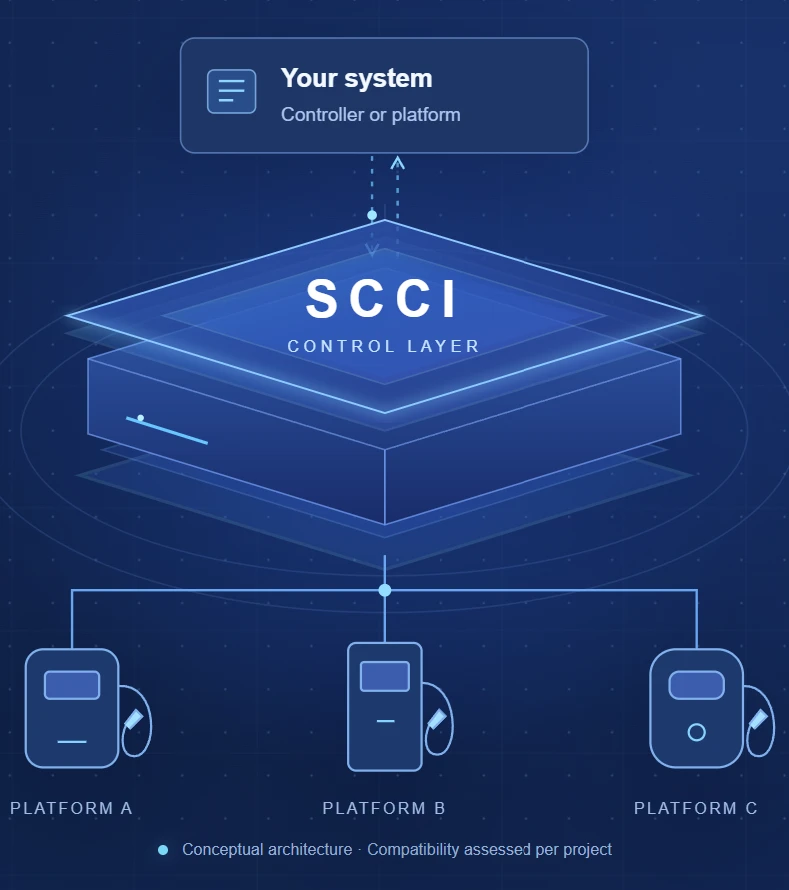
SINELINK Charger Control Interface (SCCI) is a control-layer integration framework designed to reduce the dependence between your application and a single charger brand.
01 / THE INTEGRATION CHALLENGE
Different chargers. Repeated integration work.
Connecting EV chargers to an external system involves more than establishing communication. Different charger platforms can use different commands, data formats and control behaviours.
Different brands, different interfaces
A system developed for one charger may need additional adaptation before it can control another. Proprietary communication interfaces can further limit hardware choices.
Hardware changes can mean redevelopment
When charger-specific commands are built directly into an application, adding or replacing hardware can require changes to the application itself.
Your system needs consistent control
Whether your project needs charging limits, session commands or operating data, the upper-level system needs a clear way to request actions and interpret charger feedback.
SCCI addresses these challenges by separating project-side control requirements from charger-specific implementation.
02 / OUR CURRENT FOCUS
Load balancing. More flexibility in charger choice.
A dynamic load balancing controller may communicate only with chargers from the same manufacturer. This can restrict charger selection even when another charging platform provides the control functions the project needs.
Our current development focus is adapting communication between a load balancing controller and a compatible charger.
Discuss Your Controller and Charger ↗Load balancing controller
Determines the charging allocation.
SCCI control layer
Maps agreed requests and required feedback.
Compatible EV charger
Applies supported charging limits.
Implementation depends on the interfaces available on both devices, including access to any required proprietary protocol documentation.
Use a selected charger with a load balancing controller by adapting charging-limit commands and relevant status feedback.
03 / THE CONTROL LAYER
Your requirements. A charger-specific connection.
SCCI provides an intermediate control layer between the customer's system and the selected charging hardware.
Load balancing controller
Determines the charging allocation and required feedback.
SCCI control layer
Maps project requirements to agreed commands, charging limits and operating data.
Charger-specific adaptation
Implements the connection using the available charger protocol and supported functions.
Compatible EV charger
Executes supported commands and provides operating feedback.
Current focus: load balancing controller integration. Further development: control layers for other platforms, based on available protocols and supported functions.
Conceptual architectureInterfaces, deployment format and available functions are defined for each project. This separation is intended to make charger-specific changes easier to manage while preserving the customer's application logic where practical.
04 / CONTROL FUNCTIONS
Built around what your project needs.
The control layer is developed around the functions exposed by the selected charger and required by the customer's system.
Charging current or power limits
Map external control requests to the charging-limit settings supported by the hardware.
For load balancing projects, this includes assessing the available adjustment range, resolution and update frequency.
Charging session commands
Integrate start, stop, pause or resume commands where supported and required by the application.
Charger status and operating data
Read and map available information such as charging status, current, power, energy and fault indications.
Application-specific mapping
Adapt the project-side interface to the selected charger protocol, including the command format, data fields and responses needed by the customer's platform.
The supported function set is confirmed during technical assessment and validation.
05 / FURTHER DEVELOPMENT
A framework for your next integration.
The same control-layer approach can be extended beyond load balancing controllers.
Where charger protocol documentation and suitable device functions are available, SINELINK can assess and develop an integration for a different customer platform.
These are project-specific development options. Each integration begins with a review of the platform requirements, charger protocol and available control functions.
Energy management systems
Connecting charging limits and operating data to external energy-control logic.
IoT platforms and gateways
Exposing selected charger functions through the project's communication architecture.
Site controllers
Integrating charging actions with site-specific operating requirements.
Custom applications
Developing command and data mappings for a defined charging workflow.
06 / PROJECT DEVELOPMENT
From protocol review to pilot.
Protocol documentation provides the basis for development. Device testing confirms how the integration behaves in practice.
- 01
Review the requirements
Understand the customer platform, selected charger and intended control behaviour.
- 02
Assess protocols and functions
Review the available interfaces on both sides and identify the commands and data that can support the project.
- 03
Develop the control layer
Implement the agreed mappings and any required project-side interface adaptation.
- 04
Validate the integration
Test control commands, charging-limit behaviour and operating feedback. Check communication-loss behaviour and control interactions relevant to the project.
- 05
Run a pilot
Evaluate the selected configuration in a representative environment before confirming the deployment scope.
BEFORE WE START
What we need to assess your integration
07 / COMMON QUESTIONS
A clearer path to integration.
That is the integration objective. Support is developed and validated for selected charger models using their available protocols and control functions.
Yes. Our current focus is the connection between load balancing controllers and compatible chargers. We can also assess control-layer development for other platforms and applications.
Charger protocol documentation is a key starting point. We also review the required functions, the customer-side interface and access to hardware for testing. This allows us to define a practical development scope.
Where its interface supports the required integration, the control layer can be designed around the existing system. If the interface is closed or undocumented, suitable access or a supported integration path will need to be established.
In the current integration approach, the load balancing controller determines charging allocation. SCCI maps those control requirements to the selected charger's supported functions.
Depending on the project, the scope can include protocol assessment, control-layer development, interface configuration, integration testing and pilot support. The implementation format and deliverables are agreed following the technical review.
08 / LET'S CONNECT
Discuss your charger integration.
Tell us which controller or platform you want to connect, which chargers you plan to use, and what you need them to do.
Whether your project involves load balancing or a different control application, SINELINK can review the available interfaces and define the next development steps.
Your controller.
Your charger.
Your required functions.
Tell Us About Your Project
Include the following details when you contact SINELINK:
Name, company and work email.
The controller or platform, plus charger brand and model.
Available protocol documentation and the control functions you require.
Project country, estimated quantities and any additional requirements.
Continue to our contact page to discuss your integration.