

Solar Cable for High-Temperature Rooftops
How to Apply Derating, Routing and Installation Controls
SUMMARY: A hot-roof PV cable design cannot be approved from a cable's headline temperature alone. IEC 62930 states a 90°C normal continuous maximum conductor temperature; that is not permission to install the cable in 90°C ambient air. The designer must estimate the cable's real thermal environment, apply the required current-rating corrections, keep the route away from damaging hot or abrasive surfaces, account for grouping and enclosure, and check every connector, junction and equipment entry. The allowable circuit current is governed by the lowest-rated part under the actual conditions.
Use the solar DC cable selection guide for the full project sequence. This article isolates the high-temperature rooftop decision so engineers and buyers can document it without duplicating the broader guide.
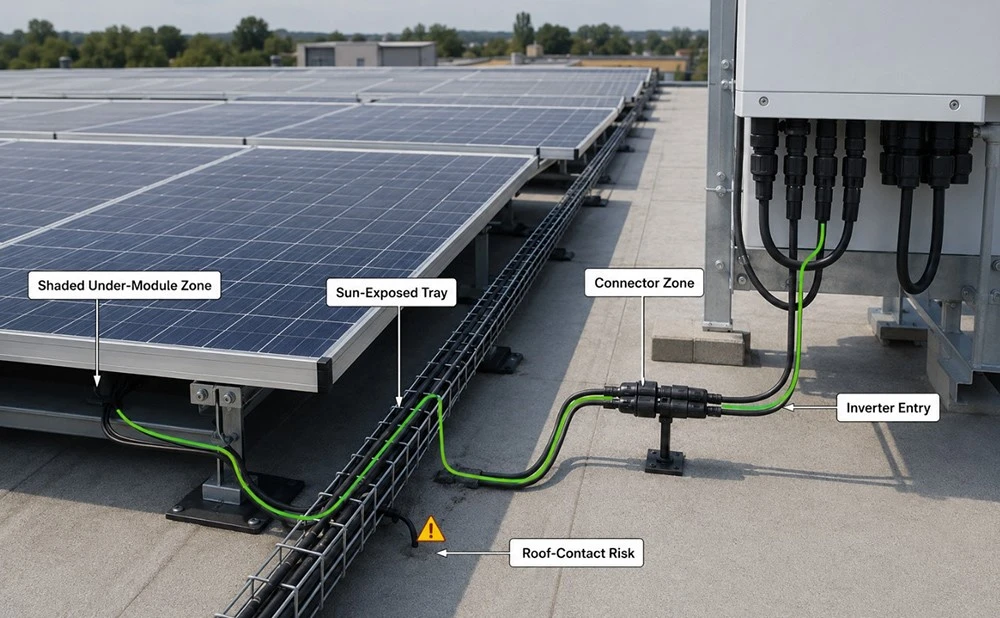
Does a 90°C Solar Cable Rating Mean 90°C Ambient Temperature?
No. Ambient temperature is the temperature of the surrounding air used by the applicable rating method. Conductor temperature is produced by ambient conditions plus electrical losses and the route's heat-transfer conditions. Roof-surface temperature, cable-surface temperature, module temperature and connector internal temperature are also different measurements. Substituting one for another can create a false margin.
IEC 62930's public scope gives 90°C as the normal continuous maximum conductor temperature. It also mentions 120°C for a limited total period of 20,000 hours. The latter is not a continuous design target and should not be converted into a simple ambient rating. Product evidence, installation rules and the complete system design still apply.
Why Rooftop PV Cable Runs Hotter Than the Weather Report
A weather station describes regional air conditions, while a cable experiences a local microclimate. Solar radiation can heat roof membranes, metal sheets, trays and nearby equipment. An under-module route may be shaded yet poorly ventilated; an open route may have airflow but absorb direct sun; a conduit can protect against abrasion while restricting heat dissipation. Wind, roof color, mounting height and the number of neighboring circuits can change during the route.
NREL research on close-roof-mounted PV systems shows that module temperature depends on location and mounting and can exceed 70°C when airflow is insufficient. That evidence is useful context, but module temperature is not a substitute for cable conductor temperature. The cable calculation needs its own assumptions and verification.
|
Temperature term |
What it describes |
Why it matters |
|
Ambient air |
Air surrounding the cable for the chosen rating method |
Starting condition for the applicable correction |
|
Roof surface |
Membrane, tile or metal temperature near the route |
Can add radiant/conductive heating and damage risk |
|
Cable surface |
Measured outside-sheath temperature |
Useful observation, but not automatically conductor temperature |
|
Conductor |
Temperature of the current-carrying metal |
Must stay within the cable's applicable operating limit |
|
Component |
Contact, connector, junction, gland or terminal temperature |
May set a lower circuit limit than the cable |
Build a Rooftop Thermal Route Map Before Selecting Ampacity
- Divide the DC route into physical zones: module lead, shaded free-air run, sun-exposed run, tray, conduit, roof crossing, penetration, junction, combiner and inverter entry.
- Record the design climate data and the project-defined worst credible operating condition; do not use the daily average temperature.
- Identify heat sources, reflective or absorptive surfaces, restricted airflow, cable grouping and transitions between installation methods.
- Record circuit current, conductor size and resistance, route length, number of loaded conductors and the cable manufacturer's stated rating basis.
- List every connector, fuse holder, terminal, gland and enclosure with its own current/temperature limits and installation instruction.
- Apply the locally accepted calculation or tables to each critical zone, then design to the most restrictive verified result.
- Capture drawings, assumptions, data sheets and approvals in the project file for commissioning and future changes.
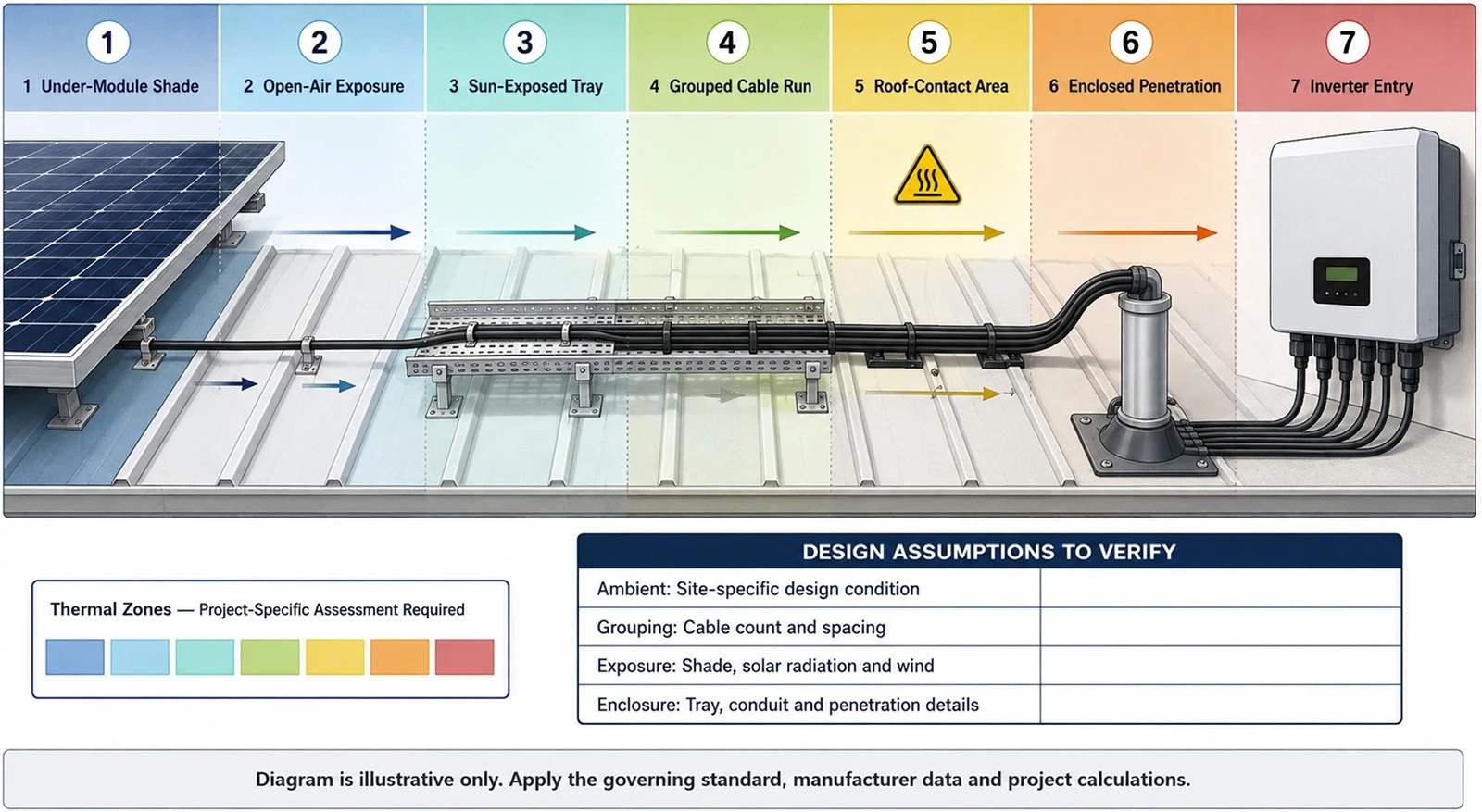
Does Rooftop Solar Cable Need Derating?
Often, the installed current rating must be corrected from a reference condition, but there is no valid global percentage. Ambient temperature, installation method, grouping, solar exposure and local electrical rules determine the treatment. IEC 60364-5-52 covers selection and erection of wiring systems, while the IEC 60287 series provides current-rating calculation methods. IEC 60287-3-1 warns that its reference operating conditions may be superseded by national conditions.
A useful supplier answer states the test or calculation basis, conductor temperature limit, ambient/reference condition, installation method and cable size. A bare number such as '70 A' without those conditions cannot be transferred safely to a hot roof.
If the remaining decision is conductor area, use 4mm² vs 6mm² solar cable after the thermal assumptions are defined. Cable size cannot be finalized from route length or a catalogue current number alone.
|
Input |
Risk if omitted |
Evidence to retain |
|
Design ambient / microclimate |
Reference ampacity may be overstated |
Weather basis, route zone and correction method |
|
Grouping and spacing |
Mutual heating may be missed |
Circuit count, support/tray drawing and correction |
|
Conduit or enclosed section |
Restricted heat dissipation may be ignored |
Fill, material, length and calculation basis |
|
Roof contact / solar exposure |
Local heating and sheath damage may be missed |
Route photograph, support detail and approved method |
|
Connector and terminal data |
The cable may pass while a component overheats |
Exact model instruction and derating curve |
The Weakest Component Sets the High-Temperature Limit
A DC cable run is an assembly, not an isolated length of polymer. Connector contacts, seals, branch components, fuse holders, terminals and equipment entries have their own limits. A manufacturer derating diagram is only valid for the named product and test conditions. Stäubli's published LVDC guidance, for example, shows temperature-dependent connector behavior and states that a lead is limited by its lowest-rated component. It is an example of the method, not a universal curve for all PV connectors.
Complete the product-specific review with the solar cable and connector compatibility guide. On a hot roof, matching the conductor and outside diameter is necessary but does not replace the connector's current-temperature assessment.
Rooftop Routing and Support Controls
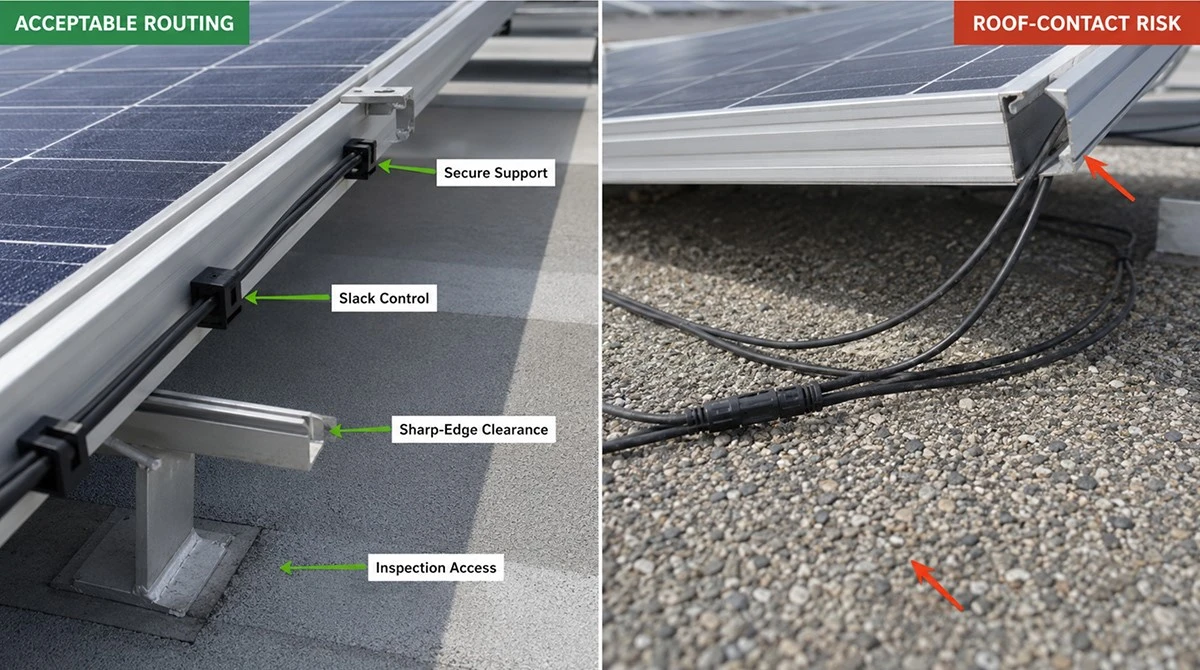
- Keep cable off sharp or abrasive roof surfaces and away from moving hardware, drainage paths and locations where standing water or debris can collect.
- Use durable, UV- and temperature-suitable supports approved for the cable and structure; ordinary plastic ties may degrade under rooftop heat and ultraviolet exposure.
- Control slack so cable cannot rub, sag onto the roof or move repeatedly in wind. Preserve the manufacturer's bend requirements and avoid crushing.
- Where conduit or tray is used, verify heat, fill, drainage, material compatibility, pulling tension, edges and entry protection for that zone.
- Separate DC conductors and other circuits only as required by the design and local rules; record any grouping that affects current rating.
- Protect penetrations and equipment entries against water and mechanical damage without creating an unassessed hot enclosure.
The U.S. Department of Energy's PV cable-management guidance recommends routing that prevents damage and highlights heat, UV, chemical exposure, bend radius, insulation and support. Project-specific codes and manufacturer instructions remain controlling.
Where the route enters a trench or remains wet, continue with direct burial vs conduit for solar cable; a rooftop temperature rating does not establish underground suitability.
For a bonded pair or shared route, review single-core vs twin solar cable because grouping, directional bending and separation zones must match the exact construction.
Can H1Z2Z2-K Be Installed on a Hot Roof?
H1Z2Z2-K is commonly specified for PV DC service, but the designation alone is not an installation approval for every roof condition. Verify the exact cable's certificate and datasheet, conductor size, current-rating basis, UV/weather performance, route method, accessories and local requirements. Then calculate or select the installed rating for the actual zones.
Review the available EN 50618 H1Z2Z2-K solar cable as a product starting point, then request the current size-specific technical evidence rather than copying one catalogue value across the project.
Use how to verify a solar cable certificate to match the manufacturer, model, standard, conductor size and validity before procurement.
Commissioning and Heat-Focused Inspection
Commissioning should prove that the installed route matches the reviewed design. IEC 62446-1 addresses documentation, commissioning tests and inspection for grid-connected PV systems. For high-temperature risk, retain route photographs, support details, equipment identifiers, load and weather context, test results, exceptions and corrective actions.
- Inspect for roof contact, unsupported loops, crushed cable, tight bends, sharp-edge exposure, crowded entries and connector strain.
- Confirm circuit labels and route drawings correspond to the installed strings and equipment.
- Use thermography only with trained interpretation and a recorded load/environment. A surface image alone does not prove conductor temperature or ampacity.
- Investigate abnormal hot spots, discoloration, odor, nuisance trips or insulation alarms; do not normalize them as expected rooftop heat.
- Repeat inspection after material route changes, added circuits, reroofing, storm damage or connector replacement.
- For the ongoing condition-based program, use the solar cable lifespan and replacement guide. Child 09 supplies the heat-risk inputs; Child 06 owns inspection intervals and replacement decisions.
High-Temperature Solar Cable RFQ Checklist
- Project country, governing rules, rooftop type, altitude/climate basis and planned service life.
- System voltage, circuit current, one-way length, conductor size proposal and voltage-drop criterion.
- Route-zone drawing covering exposure, shading, airflow, roof contact, tray, conduit, penetrations and equipment entries.
- Cable designation, conductor resistance, maximum conductor temperature, reference ampacity conditions and correction data.
- Number of loaded conductors/circuits, grouping, spacing, support and enclosure details.
- Exact connector, branch, fuse, gland and terminal models with current-temperature limits.
- Certificate scope, product marking, size-specific datasheet, batch/reel traceability and change control.
- Commissioning deliverables, inspection access, thermal record requirements and warranty boundary.
For multi-zone plants, coordinate cable, connector and equipment interfaces through the PV power station cable solution.
Request a High-Temperature PV Cable Review
Send the destination country, route drawing, design current, proposed cable size, climate basis, grouping/enclosure conditions, connector models and required evidence. SINELINK can organize product data and quotation inputs for engineering review. Final current rating, code compliance and installation approval remain with the project's qualified professionals and authority.
Request a High-Temperature PV Cable Review
Frequently Asked Questions
Does 90°C solar cable mean 90°C ambient?
No. In IEC 62930, 90°C is the normal continuous maximum conductor temperature. Ambient air, roof surface, cable surface and conductor temperatures are different inputs or results.
Is 120°C a continuous solar cable rating?
No. IEC 62930's public scope limits 120°C operation to a cumulative 20,000 hours. It should not be treated as a continuous design target or an ambient rating.
Does rooftop solar cable need derating?
The installed current rating often requires corrections for temperature, installation method, grouping and enclosure. Use the applicable design method and exact product data; there is no universal rooftop percentage.
Can solar cable touch a metal roof?
Do not assume direct roof contact is acceptable. A hot or abrasive surface can increase thermal and mechanical risk. Use an approved support and routing method that preserves the cable and inspection access.
Can H1Z2Z2-K be installed in conduit on a hot roof?
Potentially, if the exact product, conduit fill, pulling, wet conditions, heat dissipation, corrections and local rules are verified. The designation alone does not approve the installation.
Can 4 mm² solar cable be used in hot climates?
Only if voltage drop, current rating and all thermal corrections are acceptable for the real route. Climate alone cannot determine a conductor size.
Does bundling solar cables reduce ampacity?
Grouping can reduce heat dissipation and may require correction. The result depends on circuit count, spacing, installation method, ambient conditions and the applicable rules.
How do connectors affect high-temperature current?
Each connector/contact system has product-specific limits and derating behavior. The complete lead or circuit must respect the lowest-rated component under actual conditions.
What rooftop temperature should a designer use?
Use the project-approved climate and microclimate basis for each route zone, not a generic weather average. Document solar exposure, airflow, surface effects and enclosure.
Does thermography prove cable ampacity?
No. Thermography can reveal relative hot spots when load and conditions are recorded, but a surface image alone does not establish conductor temperature, current rating or long-term compliance.
Technical References
IEC 62930:2017 - Electric cables for photovoltaic systems - Official scope and conductor-temperature boundary.
IEC 60364-5-52 consolidated edition - Official wiring-system selection and erection record.
IEC 60287 series and IEC 60287-3-1 - Official current-rating calculation family and reference conditions.
U.S. Department of Energy - PV Cable Management Best Practices - Routing, support, heat/UV and mechanical-damage guidance.
IEC 62446-1 - PV system documentation, commissioning tests and inspection - Official commissioning framework.
Stäubli SOL-LVDC assembly instructions - Manufacturer-specific component derating example.
NREL - Close-Roof-Mounted System Temperature Estimation - Research context for rooftop PV thermal conditions.