

EV Charging Knowledge Hub / A1.1
Is Level 2 Charging AC or DC? What Buyers Need to Know Before Choosing an EV Charger
A focused answer for drivers, property owners, fleet teams and commercial EV charging buyers
SINELINK | EV Charging Buyer Guide
Quick answer: Level 2 charging is AC
Level 2 charging supplies alternating current (AC) to the vehicle. The vehicle's onboard charger then converts that AC electricity into direct current (DC) before the energy reaches the battery.
This distinction matters to buyers because a Level 2 wallbox rating does not automatically equal the power the vehicle will accept. The actual charging rate is limited by the electrical supply, charging equipment, cable/current setting and the vehicle's onboard AC charger.
If you want the complete overview of Level 1, Level 2 and DC fast charging, start with how the main EV charging levels differ. If your question is which charging type fits a commercial site, continue to how to choose between AC and DC for a real parking or fleet application.
The easiest way to remember Level 2 vs DC fast charging
| Buyer question | Level 2 | DC fast charging | Why it matters |
|---|---|---|---|
| What leaves the charger? | AC | DC | The conversion location is different. |
| Where is AC converted to DC? | Inside the vehicle | Inside the charging station | This changes hardware size, site power and vehicle limits. |
| What limits charging power? | Supply + EVSE + onboard charger | Station + vehicle DC acceptance + battery conditions | Nameplate power is not guaranteed vehicle power. |
| Typical parking pattern | Hours | Shorter turnaround | Dwell time should guide the technology choice. |
| Typical commercial role | Workplace, hotel, apartment, destination | Public fast charging, high-turnover sites, tight fleet windows | Use case matters more than the biggest kW number. |
Why Level 2 is AC even though the battery stores DC
EV batteries store energy as DC. But that does not mean every charger must supply DC directly. With Level 2 charging, the wallbox or pedestal controls and safely delivers AC power to the vehicle. The vehicle then uses its onboard charger to convert the incoming AC into DC at the voltage and current the battery system can accept.
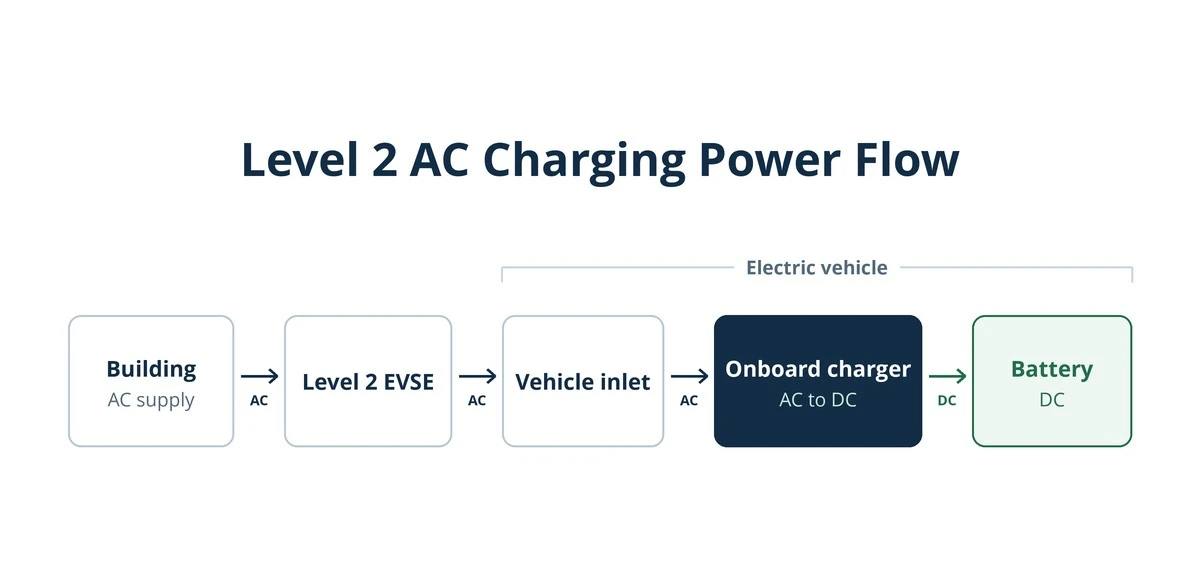
EV batteries store energy as DC. But that does not mean every charger must supply DC directly. With Level 2 charging, the wallbox or pedestal controls and safely delivers AC power to the vehicle. The vehicle then uses its onboard charger to convert the incoming AC into DC at the voltage and current the battery system can accept.
Why a 22 kW Level 2 charger may not charge a car at 22 kW
This is one of the most important points for commercial buyers. The charger can only offer power. The vehicle decides how much AC power its onboard charger can accept within the limits of the site and charging equipment.
A 22 kW wallbox does not force every EV to take 22 kW.
- If the vehicle onboard charger accepts only 7.4 kW AC, a higher-rated wallbox will not make that vehicle charge at 22 kW.
- If the site circuit or load-management system limits current, charging power can be lower again.
- Single-phase and three-phase capability also affect international AC charging configurations.
- Vehicle battery state, temperature and control logic can influence the real charging session.
For North American projects, SINELINK's Level 2 wallbox range for J1772 vehicles lists 240 V AC models from 16 A to 48 A, with nominal output ratings from 3.5 to 11.5 kW. The product page also notes that actual charging is limited by the wallbox setting, supply and vehicle onboard charger.
What voltage is Level 2 charging?
In North America, Level 2 commonly refers to 208 V or 240 V AC service. The U.S. Alternative Fuels Data Center describes AC Level 2 as 240 V in typical residential applications and 208 V in typical commercial applications, with equipment power ranging broadly up to 19.2 kW in the Level 2 category.
International buyers should be careful with the label. Outside North America, AC charging is often specified more directly by voltage, phase and power-for example 230 V single phase or 400 V three phase, with 7 kW, 11 kW or 22 kW equipment. The engineering question is therefore not only "Is this Level 2?" but "What AC supply, phase, connector and onboard-charger capability does this project actually have?"
For international Type 2 applications, SINELINK also lists 3.5–22 kW AC wallboxes for single- and three-phase projects.
Is Level 2 the same as slow charging?
Not necessarily. "Slow" is a relative term and can mislead buyers. Level 2 is slower than high-power DC fast charging, but it can be the better commercial choice when vehicles already remain parked for several hours. In those situations, adding more AC bays can be more useful than concentrating the entire electrical budget into a small number of DC chargers.
When should a buyer move from Level 2 to DC fast charging?
The trigger is usually not a marketing preference. It is a mismatch between the energy a vehicle needs and the time available to deliver it.
- Drivers need meaningful energy in a short stop rather than over several hours.
- Fleet vehicles have tight turnaround or dispatch windows.
- The business model depends on higher bay turnover.
- Target vehicles support useful DC charging power.
- The site electrical service, civil scope and economics can support DC equipment.
- The expected utilization is high enough to justify the higher installed and operating cost.
If you are at this decision point, the next useful question is not "Which level is faster?" but which mix of AC and DC actually fits the site's dwell time, power and operating model. See the commercial trade-offs between AC and DC charging.
Level 2 power is a site-planning decision, not just a charger specification
A commercial site can install many Level 2 points, but the combined load can still become large. Ten 11 kW chargers do not mean the building should blindly reserve 110 kW at all times, and they also do not mean the site can ignore the busy-hour demand.
A better process is to estimate how many vehicles arrive, how much energy they need, how long they stay, how many bays may charge at once and how much electrical capacity remains after normal building loads.
For that next step, use a site-sizing method that converts vehicle demand and parking time into charger count and electrical capacity.
| Site pattern | Why Level 2 may fit | What to verify |
|---|---|---|
| Workplace | Vehicles sit for a work shift | Daily kWh need, parking duration, employee access, load management |
| Hotel / apartment | Vehicles may stay overnight | Billing, assigned bays, user authorization, power sharing |
| Retail / destination | Customers stay longer than a quick-stop visit | Visit duration and whether DC is commercially justified |
| Fleet with long depot window | Vehicles have predictable return and departure times | Energy required before dispatch and simultaneous charging |
| Public fast-turnover location | Level 2 may be too slow for the service promise | Consider DC if demand and grid capacity support it |
What Level 2 buyers should include in an RFQ
- Destination country and electrical supply: voltage, phase and frequency.
- Vehicle makes/models and onboard AC charging limits where known.
- Required connector/interface for the destination market.
- Parking duration and daily energy requirement per vehicle group.
- Number of charging bays and expected simultaneous use.
- Preferred current/power per wallbox or pedestal.
- Wall or pedestal installation and required cable length.
- Plug & Play, RFID, app or backend-controlled access.
- OCPP / network requirement for commercial operation.
- Metering, payment, load management and expansion requirements.
- Required conformity documents and local installer/AHJ requirements.
For a product shortlist, review SINELINK's AC charging range and the broader EV charging product portfolio. For the full project sequence from use case to grid, cost and supplier review, use the commercial charging procurement framework.
Choose Level 2 by energy need, not by label alone
Level 2 is AC charging. That simple answer is useful, but the commercial decision starts after it. Buyers still need to match vehicle AC limits, parking time, site capacity, connector, networking and future growth.
If your project is mainly long-dwell charging, start with SINELINK's Level 2 AC wallbox options or the wider AC charging category. If the project serves mixed driver groups or shorter stops, compare the commercial trade-offs between AC and DC charging before finalizing equipment.
For a technical quotation
Send the destination market, vehicle list, daily energy requirement, parking time, available electrical supply, required number of bays, networking/access method and expansion plan to sales@sinelinkenergy.com.
FAQ
Q: Does Level 2 send DC to the battery?
Not directly. It sends AC to the vehicle; the onboard charger converts it to DC for the battery.
Q: Can a Level 2 charger bypass the onboard charger?
No. That is one of the fundamental differences from DC fast charging.
Q: Is 22 kW still Level 2?
In North American terminology, Level 2 can extend to high AC power, but international projects often specify actual AC voltage, phase and power instead of relying on the label.
Q: Is every AC charger Level 2?
No. Level 1 is also AC in North American terminology. International AC products may not use the Level 1/Level 2 labels.
Q: Does a bigger Level 2 charger always charge faster?
Only if the vehicle and site can accept the higher AC power.
Q: Can Level 2 work for commercial charging?
Yes. It is common for workplaces, destinations, apartments, hotels and other long-dwell applications.
Q: Is Level 2 charging AC or DC?
Level 2 is AC charging. The charging equipment supplies AC to the vehicle, and the vehicle onboard charger converts it to DC for the battery.
Q: Why does an EV battery need DC if Level 2 is AC?
The battery stores DC energy. Level 2 relies on the vehicle onboard charger to convert the incoming AC into controlled DC before charging the battery.
Q: What voltage is Level 2 charging?
In North America, Level 2 commonly uses 208 V or 240 V AC service. International AC charging is often specified by actual voltage, phase and kW instead of the Level 2 label.
Q: Can a 22 kW Level 2 charger charge every EV at 22 kW?
No. Actual power is limited by the vehicle onboard AC charger, site supply, EVSE setting and other system limits.
Q: Is Level 2 faster than DC fast charging?
Usually no. DC fast charging is designed for shorter turnaround and higher power, while Level 2 often fits longer parking periods.
IQ: s Level 2 suitable for workplace charging?
Often yes, because vehicles may remain parked for several hours. The required number of bays and power should still be calculated from real energy demand.
Q: Is Level 2 the same in every country?
No. The term is most common in North America. International AC projects are often described by voltage, phase, power and connector type.
Q: When should a commercial site choose DC instead of Level 2?
Consider DC when vehicles need more energy in a shorter time and the site has the electrical capacity, demand and business case to support higher-power equipment.
Technical references: U.S. DOE Alternative Fuels Data Center - Electric Vehicle Charging Stations.