

Copper vs Aluminum Solar Cable
How to Compare Size, Terminations and Total Installed Cost
SUMMARY:An aluminum or aluminum-alloy PV cable can be a practical option for an engineered, approved fixed route, especially where conductor mass and long-run economics matter. It is not a same-size substitute for copper. Compare maximum conductor resistance, calculated voltage drop, ampacity and thermal corrections, cable diameter and handling, terminal or connector approval, copper-to-aluminum transitions, installation method, certification scope and total installed cost. Flexible tinned-copper PV cable remains a common choice for module leads and string-side connections because the surrounding connector ecosystem is often designed around it. The exact project specification and approved component combination control the decision.
If conductor material is only one part of a new-project specification, begin with the solar DC cable selection guide. This article answers the narrower engineering and procurement question: when copper and aluminum offers are compared, what must be recalculated and verified before approval?
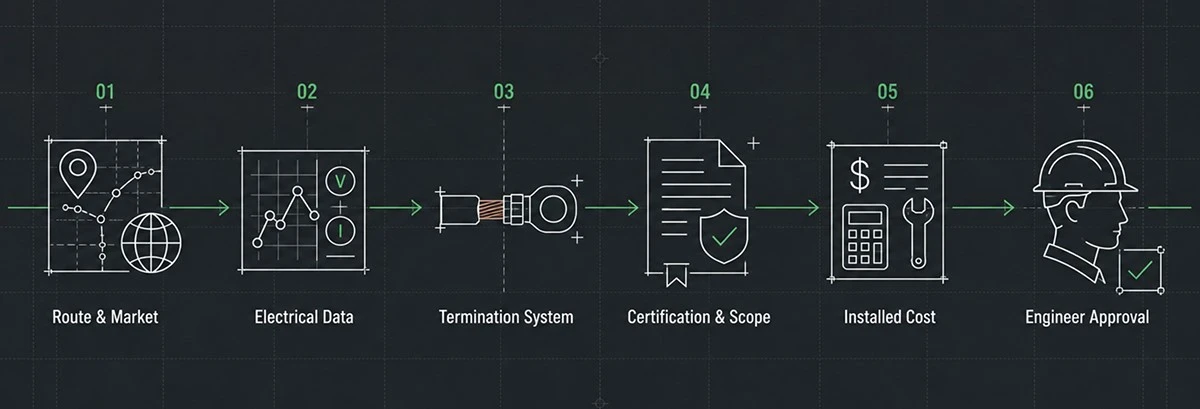
The useful comparison is not "which metal is better?" It is "which complete cable-and-termination system meets the circuit, route, compliance and lifecycle requirements with the lowest acceptable installed risk?" A low cable-unit price can disappear after upsizing, special lugs, transition hardware, different drums, additional labor or rework are included.
First, Identify the Conductor You Are Actually Comparing
"Copper cable" and "aluminum cable" are not sufficiently precise purchase descriptions. A datasheet and cable marking should identify the conductor material and construction. The conductor class, strand construction and finished-cable standard also affect flexibility, resistance limits and permitted use.
|
Conductor description |
What it means |
Procurement caution |
|
Tinned copper |
Copper strands with a tin coating; widely used in flexible PV cable constructions |
Confirm strand class, resistance, size and connector approval for the exact product |
|
Bare copper |
Copper conductor without a tin coating |
Do not assume environmental behavior or product certification from the metal name alone |
|
Aluminum or aluminum alloy |
A conductor whose electrical and mechanical design differs from copper |
Require exact alloy/construction, resistance, size range, installation scope and termination system |
|
Copper-clad aluminum (CCA) |
An aluminum core with a metallurgically bonded copper layer |
It is not the same as solid copper or an ordinary aluminum-alloy conductor; evaluate only under its exact listing and application |
IEC 60228:2023 includes requirements for conductor nominal areas, wire construction and resistance values across copper, aluminum and aluminum-alloy conductors used in applicable cable types. That does not make every material interchangeable: the finished cable standard, product certificate and intended installation still determine whether a particular construction is acceptable.
Copper vs Aluminum Solar Cable: Engineering Comparison
|
Decision factor |
Copper / tinned copper |
Aluminum / aluminum alloy |
What to verify |
|
Electrical resistance |
Lower resistance than aluminum at the same nominal area, subject to exact construction |
Generally requires a different area to meet the same circuit objective |
Maximum DC resistance from each offered datasheet |
|
Cable size |
Often smaller for a given electrical target |
May require a larger nominal section and outer diameter |
Ampacity, voltage drop, thermal limits, gland and tray space |
|
Mass and handling |
Higher conductor density |
Lower conductor mass can help on long runs |
Complete cable weight, drum size, pulling and support method |
|
Flexibility and routing |
Flexible tinned-copper products are common near modules |
Construction may be intended for fixed routes |
Conductor class, bend radius, pulling force and movement exposure |
|
Terminations |
Many small PV connector systems are built around specified copper conductors |
Requires explicitly suitable terminals, lugs or transition components |
Material, conductor class, size range, tool, torque and approval |
|
Interface control |
Still requires correct contact, seal and assembly |
Oxide and dissimilar-metal interfaces require product-specific control |
Manufacturer instructions; approved Cu-Al transition |
|
Compliance |
PV product evidence must cover the exact model and size |
May use a distinct aluminum-PV cable assessment route |
Certificate owner, model, size, standard and installation scope |
|
Economics |
Higher metal mass may increase cable purchase cost |
Material saving can be offset by larger size and added hardware/labor |
Total installed and lifecycle cost, not unit price alone |
TÜV Rheinland's photovoltaic-component service page lists DC PV cable under EN 50618 or IEC 62930 and PV aluminum cable under 2 PfG 2642. This is an important procurement signal: an aluminum PV cable should be evaluated through its own product evidence and intended application, not assumed to inherit the acceptance of a copper H1Z2Z2-K product.
Why the Same mm² Is Not the Same Electrical Result
Nominal conductor area is only one input. For each offered cable, obtain the maximum conductor resistance at the stated reference temperature from the current datasheet or applicable product evidence. Use that value in the project voltage-drop and loss calculation, then apply the required ampacity and thermal method for the actual installation.
A technically useful comparison sheet records circuit current, one-way route length, system voltage, permitted voltage drop, ambient and conductor-temperature assumptions, grouping, installation method, maximum conductor resistance, calculated loss and protective-device coordination. If any of those inputs change, the selected section can change.
For the calculation logic used when comparing conventional copper sizes, see 4mm² vs 6mm² solar cable. Do not copy its result into an aluminum offer: enter the aluminum product's own resistance, ampacity, diameter and termination data.
Use a Project Worksheet, Not a Material Shortcut
|
Input |
Copper offer |
Aluminum offer |
Acceptance evidence |
|
Cable model and conductor |
Record exact designation |
Record exact designation/alloy |
Datasheet and cable marking |
|
Nominal area and class |
Enter offered value |
Enter independently selected value |
Certificate/listing size scope |
|
Maximum DC resistance |
Enter stated value and reference temperature |
Enter stated value and reference temperature |
Current technical document |
|
Route and current |
Use same approved design basis |
Use same approved design basis |
Cable schedule and single-line diagram |
|
Ampacity and corrections |
Calculate for route |
Calculate for route |
Applicable engineering method |
|
Voltage drop and loss |
Calculate |
Calculate |
Approved project limit |
|
Outer diameter / bend |
Check |
Check |
Datasheet, glands, tray and route |
|
Termination system |
List contact/lug/tool |
List lug/transition/tool |
Manufacturer approval/instructions |
|
Installed cost |
Sum all cost items |
Sum all cost items |
Comparable commercial scope |
Terminations Decide Whether the Material Change Is Realistic
A cable is only useful when it can be terminated into the rest of the system with approved components and controlled workmanship. Check the terminal, contact or lug for conductor material, conductor class, size range, strand construction and equipment rating. Then verify stripping dimensions, preparation, tool and die, compression sequence, torque, seal range, pull-out requirement and inspection method from the relevant manufacturer instructions.
Do not insert aluminum into a contact merely because the conductor physically fits. Do not use a generic oxide inhibitor, brush procedure or torque value unless the approved termination manufacturer requires it. Where an aluminum route interfaces with copper equipment or a copper string cable, specify an approved transition solution and keep the interface accessible if the design or maintenance plan requires it.
For the full cable-contact-seal-tool-mating review, use solar cable and connector compatibility. This material article only establishes the added rule: the interface must be approved for the exact conductor material and construction.
UL's wire and cable guide explains that aluminum and copper-clad aluminum conductors require identifying markings, while NEMA training material illustrates how terminal markings communicate conductor-material suitability. Those references are useful reading aids, but the exact listed product, equipment instructions and local code govern the installation.
Ten Checks Before Approving Aluminum PV Cable
- Confirm that the destination market, owner, EPC, insurer, utility and project specification permit the proposed conductor material and cable application.
- Identify the exact conductor material or alloy, conductor class, strand construction, model and manufacturer; reject descriptions that say only "aluminum cable."
- Obtain maximum conductor resistance, nominal area, outside diameter, cable weight, minimum bend radius and permitted pulling conditions from current documents.
- Recalculate ampacity, temperature and grouping corrections, voltage drop, energy loss and protection for the actual route.
- Verify that every connector, lug, terminal and equipment entry covers the conductor material, class, size and cable diameter.
- Define only the manufacturer-approved stripping, surface preparation, inhibitor, tool, die, compression, torque and inspection steps.
- Specify an approved copper-to-aluminum transition wherever the conductor changes material; manage moisture and dissimilar-metal interfaces.
- Check drums, pulling, bend radius, supports, tray or conduit fill, route movement, burial conditions and accessible transition locations.
- Verify the cable standard or assessment basis, certificate owner, model, size range, marking, factory records and project acceptance.
- Compare total installed and lifecycle cost, then obtain written engineering and project approval before procurement or substitution.
Use how to verify a solar cable certificate to confirm that the exact offered aluminum or copper model and ordered size fall inside the current evidence scope. A certificate for a different conductor construction is not a substitute.
Where Copper and Aluminum May Fit in a PV System
Flexible tinned-copper PV cable is commonly practical between modules, junction boxes and string connectors, where relatively small conductor sizes, repeated routing and a defined connector/contact system are involved. An approved aluminum or aluminum-alloy cable may be considered for longer fixed collection or feeder routes where the cable, terminals, transitions, route and compliance package were designed as one system.
These are application tendencies, not universal rules. A project may prohibit aluminum, or an approved aluminum product may have a defined installation scope that differs from the copper product beside it. Confirm movement, direct-burial or conduit conditions, water exposure, mechanical protection and accessibility.
If the route enters soil, duct or wet conduit, first apply direct burial vs conduit for solar cable. Conductor material does not by itself prove that the finished cable is suitable for burial or permanent wet exposure.
For a current flexible tinned-copper product route, review EN 50618 H1Z2Z2-K solar cable and request the exact size, resistance, diameter, certificate and installation data for the offered model.
For an aluminum option, use the current TUV PV DC1500 AL Solar Cable listing as the commercial starting point, then request the exact live product URL and technical evidence before publication or approval.
Compare Total Installed Cost, Not Price per Metre
Metal-market prices and supplier quotations change. A durable engineering article should therefore explain the cost model rather than publish a short-lived price range. Build both offers around the same route, delivered scope, documentation, installation and performance assumptions.
- Cable quantity, selected section, route allowance, minimum order and cutting waste.
- Drums, packaging, freight, site storage, handling equipment and returnable-reel terms.
- Lugs, contacts, glands, transition blocks, junction boxes, heat-shrink and route protection.
- Conduit or tray capacity, cable supports, bend space, pulling equipment and access changes.
- Approved tools, dies, calibration, installer training, supervision and termination labor.
- Incoming inspection, sample testing, certificates, traceability and as-built documentation.
- Electrical losses under the approved load profile and any project energy-cost assumption.
- Spares, inspection access, maintenance, failure risk, rework, outage and warranty administration.
Record which party supplies each item. If one quotation includes terminations, factory testing and delivered drums while the other lists cable only, the totals are not comparable. Keep commodity assumptions and quotation dates in the internal cost workbook, not in the evergreen SEO copy.
Common Copper-to-Aluminum Substitution Mistakes
|
Mistake |
Why it fails |
Better control |
|
Replace copper with the same aluminum mm² |
Resistance, ampacity and voltage-drop results can differ |
Recalculate from exact offered data |
|
Approve from metal price alone |
Upsizing, hardware, labor and route changes are omitted |
Compare a common total-installed-cost scope |
|
Use any lug that fits |
Physical fit does not establish material, size or rating approval |
Verify marked/listed range and instructions |
|
Treat CCA as copper or aluminum alloy |
It is a different construction with its own acceptance basis |
Identify and approve the exact conductor |
|
Rely on one certificate image |
Model, size, holder or installation scope may not match |
Verify current evidence and product marking |
|
Hide transitions inside inaccessible routes |
Inspection and maintenance become difficult; interface risk may be unmanaged |
Use an approved, documented transition location |
|
Ignore cable OD after upsizing |
Glands, seals, tray fill, bends and connectors may no longer fit |
Recheck every mechanical interface |
|
Copy a generic preparation method |
Required surface preparation, compound, die and torque are product-specific |
Follow the approved manufacturer procedure |
Copper vs Aluminum Solar Cable RFQ Checklist
- Project country, owner/EPC specification, system voltage, route type and permitted conductor material.
- Circuit current, one-way length, voltage-drop limit, ambient conditions, grouping and installation method.
- Offered cable designation, exact conductor/alloy, class, sizes, resistance, ampacity basis, OD, weight and bend radius.
- Applicable PV cable standard or assessment basis, certificate/listing, model and size scope, marking and traceability.
- Connector, lug, terminal, gland and transition models with conductor-material and size approval.
- Tool, die, preparation, compound, compression, torque, pull-test or inspection requirements where applicable.
- Drum lengths, color, packing, freight, delivery schedule, samples, spare quantity and minimum order.
- Required datasheet, certificate, declaration, test report, inspection plan, factory evidence and warranty.
- Comparable total-installed-cost schedule showing cable, hardware, route changes, labor, tools, logistics and loss assumptions.
If the project includes several DC and AC cable families, coordinate this decision through the PV power station cable solution so that conductor material, terminations, routing, evidence and spares remain consistent across the cable schedule.
For an operating asset, include inspection findings and fault history from the solar cable lifespan and replacement guide before proposing a material change during repair or repowering.
Request a Copper-vs-Aluminum PV Cable Review
Send the project country, single-line diagram, current, voltage, route length and method, environmental conditions, voltage-drop target, proposed cable datasheets, terminal system and required evidence. SINELINK can organize a like-for-like technical and commercial comparison for the available product range. Final design, component approval and installation remain the responsibility of the project's qualified professionals.
Request a Copper-vs-Aluminum PV Cable Review
Frequently Asked Questions
Can aluminum cable be used in a solar PV system?
It can be considered where the exact finished cable, route, terminals, transitions, certification and project rules permit it. Approval is product- and application-specific.
Can aluminum solar cable replace copper at the same mm²?
Do not assume so. Compare maximum conductor resistance, ampacity, thermal corrections and voltage drop, then verify every termination and mechanical interface.
Is aluminum solar cable cheaper than copper?
The cable material may cost less in some markets, but the engineering decision should compare total installed cost, including larger section, hardware, route capacity, tools, labor, logistics, losses and maintenance.
Is tinned copper the same as bare copper?
No. Tinned copper has a tin coating over the copper strands. Both still require verification of the exact conductor class, resistance, cable standard and approved termination.
Is copper-clad aluminum the same as aluminum alloy cable?
No. Copper-clad aluminum is a distinct composite construction. Do not classify or purchase it as solid copper or ordinary aluminum alloy.
Can an aluminum conductor be inserted into a standard PV connector?
Only when the connector/contact manufacturer and applicable approval explicitly cover the conductor material, class, size and cable diameter. Physical fit alone is not approval.
How should copper and aluminum conductors be joined?
Use a specifically approved transition or terminal system and follow its manufacturer instructions. Do not improvise preparation, compound, tooling or torque.
Is aluminum PV cable suitable for direct burial?
Conductor material alone does not establish burial suitability. The finished cable's standard, certificate, datasheet, installation instructions and project requirements must permit the route.
What documents should an aluminum PV cable supplier provide?
Request the datasheet, exact conductor description, resistance and dimensional data, current certificate/listing and scope, cable marking, termination compatibility, traceability, test/inspection records and warranty.
Technical References
IEC 60228:2023 - Conductors of insulated cables - Official IEC record covering copper, aluminum and aluminum-alloy conductor requirements.
IEC 62930:2017 - Electric cables for photovoltaic systems - Official IEC PV cable standard record.
IEC 62548-1:2023 - Photovoltaic arrays - Design requirements - Official IEC array-design standard record.
TÜV Rheinland - Photovoltaic components - Official service page distinguishing PV DC cable and PV aluminum cable assessment references.
UL - Wire and Cable Application Guide - Official guide including conductor-material marking context.
NEMA - Electrical Conductors training module - Official educational reference for conductor and terminal-marking context.