
In this article
MARKET INSIGHT | BOTSWANA & SOUTHERN AFRICA | OCTOBER 2026
Botswana Solar Projects 2026: What EPC Buyers Should Know About PV Cables, Connectors and BESS
Jwaneng 100 MW and Maun 500 MW + 500 MWh: project news turned into a practical electrical balance-of-system procurement checklist.
Editorial disclosure: SINELINK is not identified as a supplier, contractor or project participant at Jwaneng or Maun. All project figures below are attributed to dated reporting; engineering examples are illustrative.
Quick answer: what should an EPC buyer take from Botswana's solar expansion?
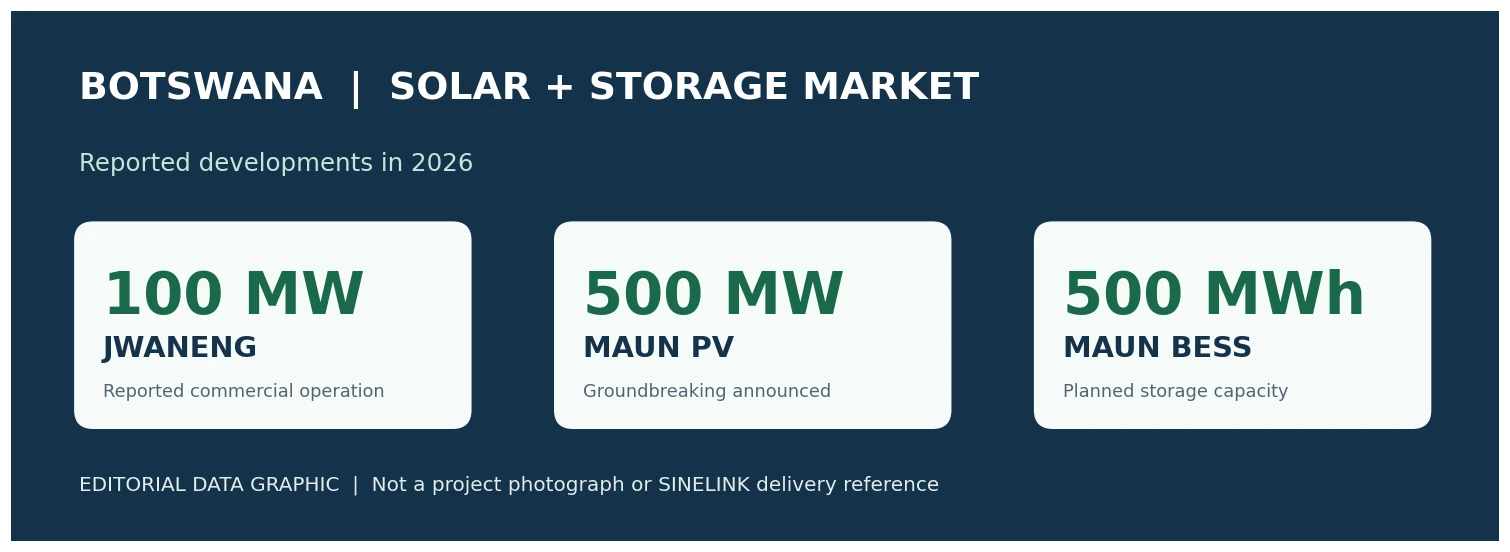
Botswana's new utility-scale solar developments make PV cable and connector planning more important for EPC teams. The reported 100 MW Jwaneng project is in commercial operation, while the announced Maun project combines 500 MW of PV generation with 500 MWh of battery storage. But these headline numbers do not tell buyers which cable size, connector, or battery feeder to order. Those choices depend on the project's electrical drawings, site conditions, approved standards and delivery schedule.
This guide explains the project news, shows five checks that reduce procurement errors, compares PV and BESS cable duties, and provides a short RFQ checklist for buyers planning solar or solar-plus-storage work in Southern Africa.
1. What has actually been reported in Botswana?
A 15 October 2026 People's Daily report said the 100 MW Jwaneng solar plant had entered commercial operation. It described a consortium involving China Harbour Engineering Company and Botswana partners, an integrated investment–construction–operation model, a 132 kV substation and transmission facilities, and an 11-month construction period. The report attributed equipment availability above 99% to the project; this is not a SINELINK performance claim.
The Government of Botswana's 16 April 2026 announcement described the groundbreaking for the Maun 500 MW PV and 500 MWh BESS project. Botswana DailyNews reporting discussed a planned 2029 commissioning date. Project dates, capacities and construction milestones can change, so procurement teams should reconfirm them with the owner or tender documents.
|
Reported item
|
Project context
|
Buyer takeaway
|
|---|---|---|
|
Jwaneng: 100 MW
|
Commercial operation reported in October 2026
|
Large plant capacity does not define string cable sizes or connector quantities.
|
|
Jwaneng: 132 kV
|
Reported substation / grid infrastructure
|
Separate PV-side DC cables from medium/high-voltage grid works.
|
|
Maun: 500 MW PV + 500 MWh BESS
|
Groundbreaking announced April 2026
|
Battery energy capacity (MWh) is not the same as power rating (MW).
|
|
Maun: planned 2029
|
Reported target, subject to change
|
Align document approvals and delivery milestones with live tender schedules.
|
2. What do these projects mean for solar EPC procurement?
The main lesson is not that every African solar project needs the same products. It is that utility-scale projects contain several different electrical interfaces. EPC buyers need a route-by-route bill of materials (BOM), not a price quote based only on megawatts.
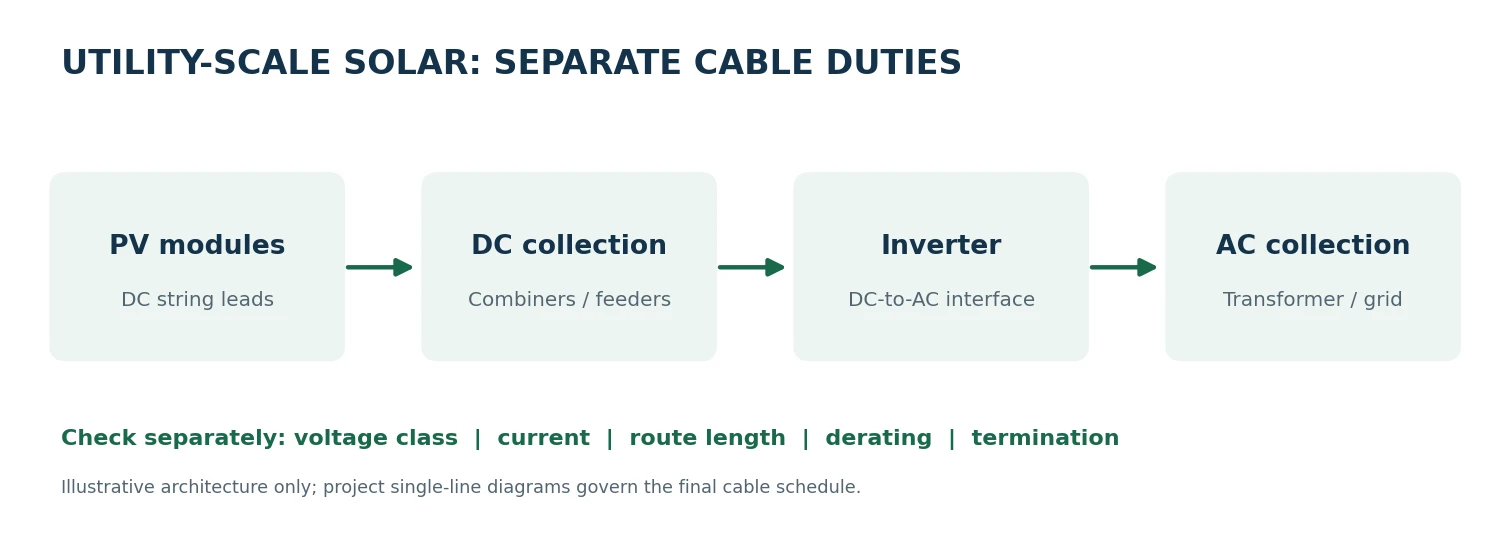
Start with the site single-line diagram, cable schedule and approved design. A PV power station cable solution can help organize the procurement discussion around string wiring, DC collection, inverter interfaces, grounding and related routes. However, the project engineer must approve each final specification.
3. Five technical checks before ordering PV cables and connectors
Check 1 - Voltage class and standards
Confirm maximum system voltage, the project jurisdiction and the exact product certification scope. For example, EN 50618 H1Z2Z2-K solar cable may be relevant where specified, but a "1,500 V DC" label alone does not approve every application, installation method or termination. Use the solar DC cable selection guide for the broader design process.
Check 2 - Current, temperature and cable grouping
Calculate design current and corrected ampacity using the applicable electrical code, cable construction, installation method, ambient temperature, grouping and manufacturer data. High outdoor temperatures and closely packed circuits can reduce allowable current. A conductor size that works on one route may not work on another.
Check 3 - Route length and voltage drop
Voltage drop is a calculation, not a fixed rule for a given plant size. For DC circuits, the simplified copper resistance approach below illustrates why one-way route length, operating current and conductor temperature matter. It is not a final sizing approval.
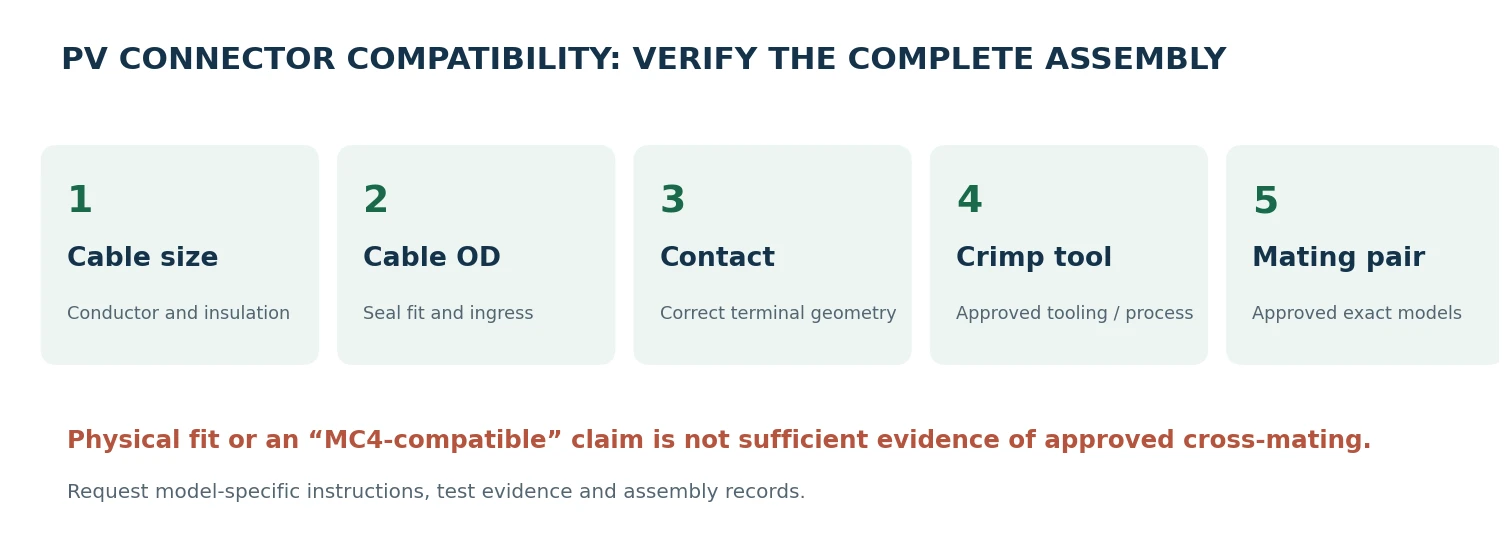
Check 4 - Connector and cable compatibility
Confirm the cable cross-section and outer diameter, connector contact and seal, crimp tool, assembly process and exact mating models. The 1,500 V PV connector product page provides a product-family starting point; the cable–connector compatibility guide explains why "MC4-compatible" is not sufficient evidence for mixing manufacturers.
Check 5 - Documentation and delivery readiness
Request applicable certificates and test reports, product datasheets, traceability labels, packing list, reel lengths, connector assembly records, inspection plan and lead time. Early document approval can prevent a late-site substitution that delays commissioning.
4. Illustrative DC voltage-drop calculation: what does cable size change?
Assume a PV string circuit with a 1,500 V DC equipment voltage class, but an illustrative operating voltage of 1,000 V. Use 20 A DC, 80 m one-way copper cable length (160 m conductor loop), and a conductor temperature of 70°C. Take copper resistivity at 20°C as 0.0175 Ω·mm²/m and a temperature coefficient of 0.00393/°C. These are simplified example inputs, not site measurements.
Formula: R(T) = [2 × one-way length × 0.0175 / conductor area] × [1 + 0.00393 × (T − 20)]. Then ΔV = I × R(T); voltage-drop % = ΔV / operating voltage × 100.
|
Copper area
|
Loop resistance at 70°C
|
Drop at 20 A
|
% of 1,000 V
|
|---|---|---|---|
|
4 mm²
|
0.838 Ω
|
16.75 V
|
1.68%
|
|
6 mm²
|
0.558 Ω
|
11.17 V
|
1.12%
|
|
10 mm²
|
0.335 Ω
|
6.70 V
|
0.67%
|
This table shows only resistive voltage drop for the stated assumptions. It does not verify ampacity, short-circuit withstand, connector compatibility, termination temperature, installation compliance or the actual system voltage. The design engineer must review all of these. A 6 mm² cable is not automatically "best"; project economics and route constraints matter.
For more on common sizes, refer to SINELINK's 4 mm² vs 6 mm² solar cable calculation guide rather than using this illustrative table as a purchase specification.
5. What changes when a project adds BESS?
A 500 MWh battery figure describes stored energy, not necessarily 500 MW of instantaneous discharge power. The battery power rating, discharge duration, PCS architecture, rack layout and protection scheme must be established separately. Botswana state reporting discussed a possible 125 MW × 4-hour configuration; buyers must use current approved project documents rather than assuming this is the final design.
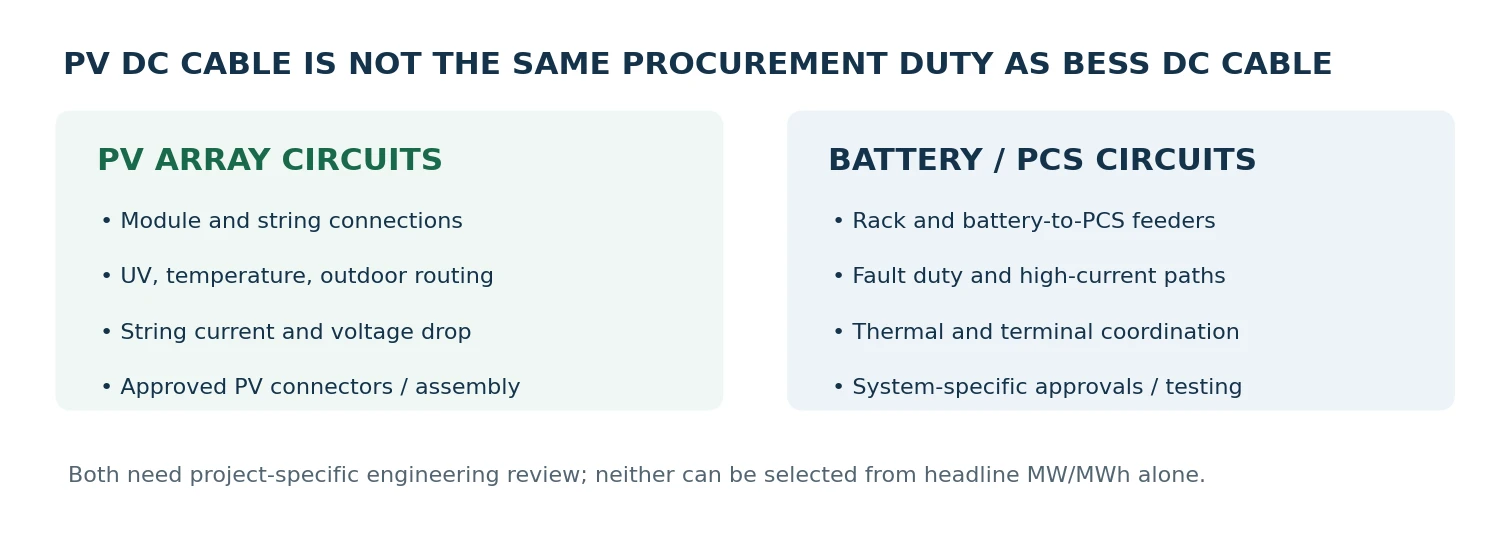
Battery rack connections and battery-to-PCS feeders have different electrical and thermal duties from PV string wiring. Review the BESS cable selection guide for voltage, current, temperature, termination and application checks. SINELINK's containerized energy storage product category offers product context, not proof of supply to the Maun project.
6. What should an African solar EPC include in the RFQ?
A useful RFQ starts with a technical scope. Sending only "100 MW solar cable price" usually creates avoidable questions and incomparable offers. Send enough information for suppliers to quote against the same design basis.
|
RFQ information
|
What to provide
|
|---|---|
|
Project basics
|
Country, site location, project stage, expected shipping and installation dates.
|
|
Electrical design
|
Single-line diagram, system maximum DC voltage, operating current and applicable standards.
|
|
Cable schedule
|
Conductor size, one-way route length, circuit count, insulation, installation method and reel preference.
|
|
Site conditions
|
Ambient temperature, UV exposure, soil/duct/tray routing, water exposure, grouping and protection needs.
|
|
Connectors / assemblies
|
Exact mating model, cable OD, contacts, tooling, harness lengths, assembly tests.
|
|
BESS, if applicable
|
Battery and PCS interfaces, power/current, fault duty, terminal requirements, cable routes.
|
|
Quality / logistics
|
Requested certificates, test evidence, inspection records, packaging, Incoterms and target delivery.
|
Procurement teams should also ask for model-specific product evidence and a clear deviation list. If a supplier proposes an alternative, require engineering approval before ordering. Do not accept a broad statement such as "suitable for Africa" as a substitute for a documented design check.
7. How SINELINK can support a technical procurement review
SINELINK supplies solar DC cable and PV connector product families, project cable assemblies and related storage connection products. For a new EPC enquiry, the first step is to share the approved route schedule and requirements through the PV power station cable solution and identify the exact interfaces that need quotation.
SINELINK has not been identified as a participant in the Jwaneng or Maun projects. This article uses public project news to explain procurement decisions that may apply to future solar and solar-plus-storage projects in Botswana and other African markets.
Planning a solar or solar-plus-storage project in Africa? Email sales@sinelinkenergy.com with your cable schedule, system voltage, installation conditions, estimated quantities, connector models and delivery target. Ask for a technical product review and quotation based on your actual project documents.
Frequently Asked Questions
Is the Jwaneng 100 MW solar plant already operating?
People's Daily reported commercial operation on 15 October 2026. Buyers should confirm any current operational or procurement status with the project owner.
What is the Maun 500 MW solar-plus-storage project?
Botswana announced a 500 MW solar PV project with 500 MWh of battery storage in April 2026. Its schedule and final technical configuration require current project confirmation.
Does a 100 MW plant automatically need 1,500 V DC solar cable?
No. Maximum system voltage and cable approval come from the electrical design, equipment ratings and project requirements, not the plant MW figure alone.
What cable information should an EPC send in an RFQ?
Send drawings, maximum voltage, design current, route lengths, installation conditions, applicable standards, conductor sizes, quantities and delivery needs.
Is 6 mm² always better than 4 mm² PV cable?
No. The correct choice depends on corrected ampacity, voltage drop, installation method, temperature, terminations and project cost.
Can two MC4-style PV connectors from different brands be connected?
Do not assume so. Obtain approval for the exact mating models and confirm the cable, contacts, seals, tools and assembly method.
Is 500 MWh of battery storage the same as 500 MW power output?
No. MWh measures energy and MW measures power. Duration depends on the approved power rating and usable energy definition.
Can the same PV cable be used between batteries and a PCS?
Only if the specific cable and terminations are approved for that duty after checking voltage, current, fault conditions, temperature and installation requirements.
Sources
People's Daily - 15 October 2026, Jwaneng 100 MW commercial operation
Government of Botswana - 16 April 2026, Maun 500 MW PV / 500 MWh BESS groundbreaking
Botswana DailyNews - Maun project timeline
Botswana DailyNews - reported storage power / duration context
SINELINK
Market insight · Botswana & Southern Africa