

BESS CABLE PROCUREMENT GUIDE
A cable that meets one voltage or conductor-size requirement can still be wrong for its installation. This guide helps EPC, engineering, and procurement teams compare the electrical, thermal, mechanical and environmental duties that change across BESS applications.
Select a BESS cable for the exact circuit and installation-not from voltage, cross-section or flexibility alone. Confirm maximum system voltage, corrected ampacity, fault withstand, voltage drop, temperature, movement, environment, fire performance, bend radius, and terminal or gland compatibility. Final selection must follow the project specification, equipment instructions and locally applicable electrical rules.
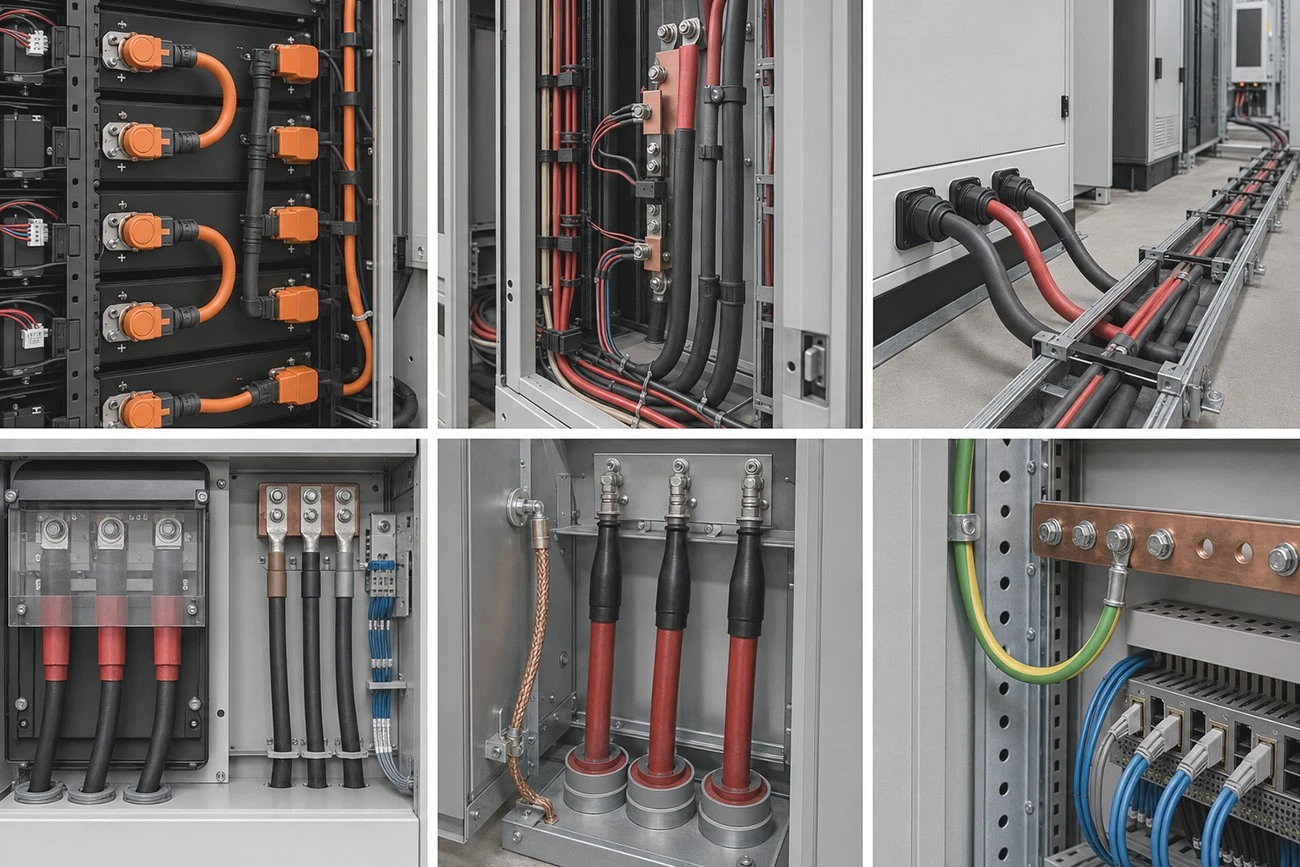
Why BESS Cable Performance Changes by Application
Battery energy storage systems contain several cable duties: module and rack interconnects, rack-to-combiner feeders, battery-to-PCS DC circuits, AC output, protective earth, auxiliaries and communications. The same cable construction does not automatically suit all of them.
The biggest procurement mistake is treating "battery cable," "high-voltage cable" or "1500 V cable" as a complete specification. These labels do not define installation method, temperature correction, movement, environmental exposure, fire performance or termination compatibility.
Stationary BESS, Solar-Plus-Storage and EV Charging Do Not Have the Same Cable Priorities
The operating environment determines which cable properties carry the most risk. The following comparison is a specification prompt, not a universal product approval.
| Application | Typical cable duty | Priority checks | Common oversight |
|---|---|---|---|
| Inside a battery cabinet | Module, rack and internal DC wiring | Flexibility, enclosure temperature, terminal system, touch protection | Using an external-routing cable assumption for protected internal wiring, or the reverse |
| Stationary outdoor BESS | Cabinet-to-cabinet or battery-to-PCS feeders | Voltage, ampacity correction, fault current, moisture, UV, chemicals, routing | Assuming an internal equipment wire is approved for exposed field installation |
| Solar-plus-storage | PV-side and battery-side DC circuits | Separate circuit ratings, outdoor exposure, polarity, voltage drop, connector scope | Treating PV cable and BESS cable as interchangeable because both carry DC |
| EV charging equipment | Charger internal wiring, feeder or user-handled charging cable | Flexing, torsion, handling temperature, abrasion, shielding or communications | Applying charging-cable flexibility requirements to a fixed BESS feeder-or vice versa |
For complete conductor sizing, voltage-drop and short-circuit checks, continue to the BESS Cable Selection Guide.
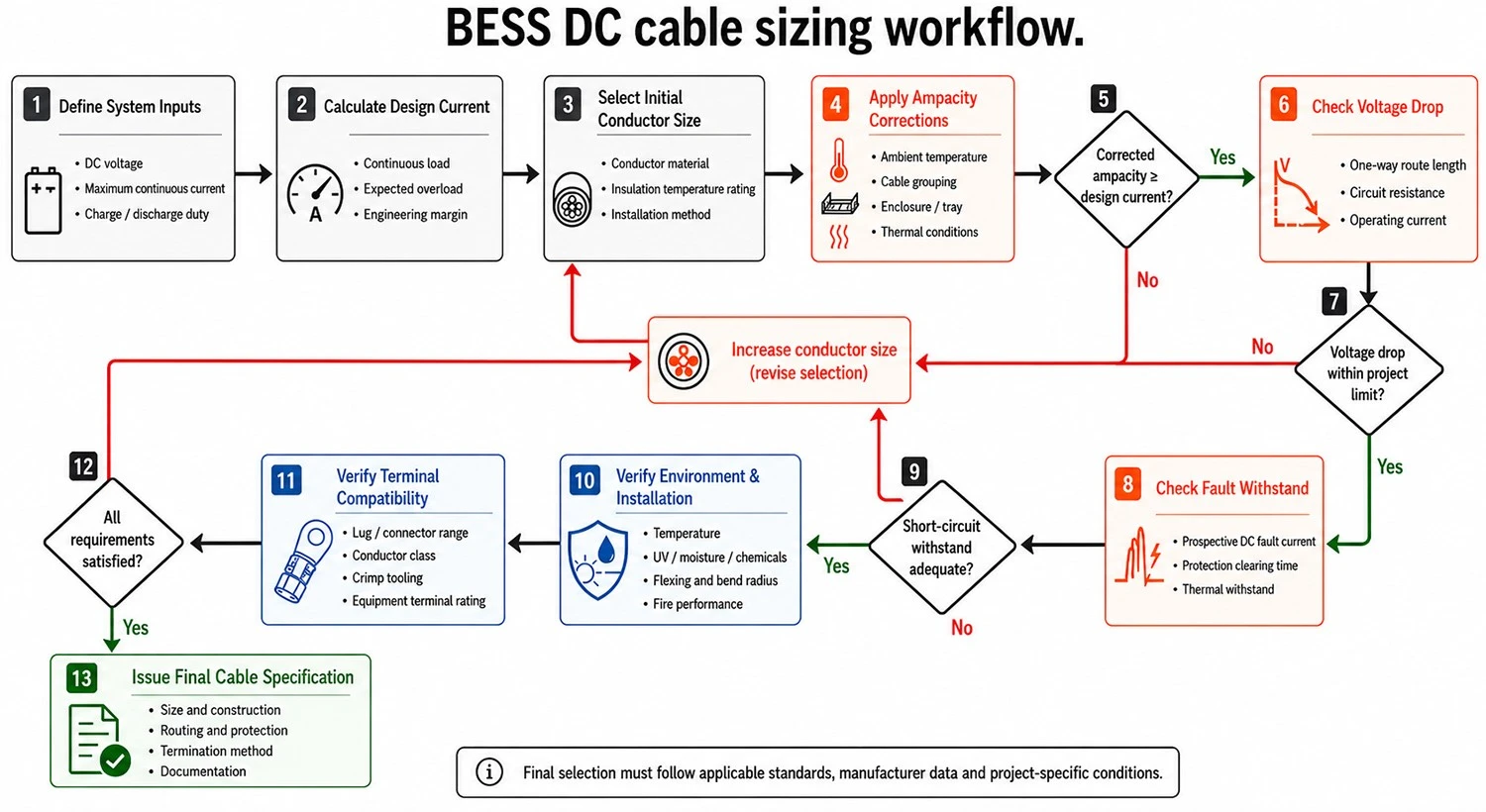
Pitfall 1: Balancing Voltage Rating, Ampacity and Flexibility Incorrectly
Higher voltage does not automatically mean a cable is suitable for a high-power BESS feeder. The voltage rating must cover the circuit's maximum calculated voltage, while conductor size and installation corrections must support continuous and temporary current. Fault withstand and voltage drop require separate checks.
Flexibility is also not a stand-alone quality grade. Fine-stranded conductors can support compact assembly or repeated movement, but conductor class must remain compatible with the approved lug, contact, crimp barrel and tooling.
Buyer action: issue the voltage range, design current, route length, installation method, ambient and enclosure temperatures, grouping, bend limits and terminal details together. Do not approve from one catalogue rating.
Pitfall 2: Treating One Cable Type as a Safe Substitute for Another
A PV cable, EV charging cable or appliance wiring material may share a voltage, temperature or flexibility feature with a BESS cable. That overlap does not establish equivalent permitted use. Outdoor exposure, wet-location ratings, flame performance, field-wiring approval, shielding and mechanical duty can differ.
Do not use a substitution rule based on product name. A proposed alternative should be reviewed against the complete approved specification, certificate scope, installation boundary and termination system. Any change that affects electrical design, certification or equipment approval must be accepted by the responsible engineer and relevant project parties.
For example, UL 11627 energy storage cable is presented for protected internal equipment wiring. Its voltage marking alone does not establish suitability for exposed cable tray, wet location, direct burial or arbitrary field interconnection.

Pitfall 3: Specifying the Main Cable Without Its Termination System
Cable performance depends on the complete connection. A nominally correct conductor can still be mismatched with the lug barrel, contact, gland or seal. Strand construction, plating, cable outside diameter, stripping length, crimp die, terminal temperature and tightening requirements all matter.
Check the conductive interface: conductor material, cross-section, terminal material, barrel range and connection resistance.
Check the insulation interface: cable diameter, seal or gland range, heat-shrink rating, creepage and touch protection.
Check the mechanical interface: bend radius, cable support, strain relief, vibration, pulling force and approved assembly tooling.
Pitfall 4: Assuming Correct Product Parameters Guarantee Correct Installation
A suitable cable can still underperform when routing, support or termination work changes its operating conditions. Installation quality should therefore be included in the inspection plan, not treated as a separate site issue.
• Separate power and communication routes as required by the system design.
• Protect cables from sharp edges, heat sources, coolant exposure and moving parts.
• Preserve the specified minimum bend radius and support spacing.
• Keep parallel paths consistent where current sharing depends on route impedance.
• Use the released crimp tool, die, strip length and torque procedure.
• Record polarity, labeling, continuity, insulation and inspection results as required.
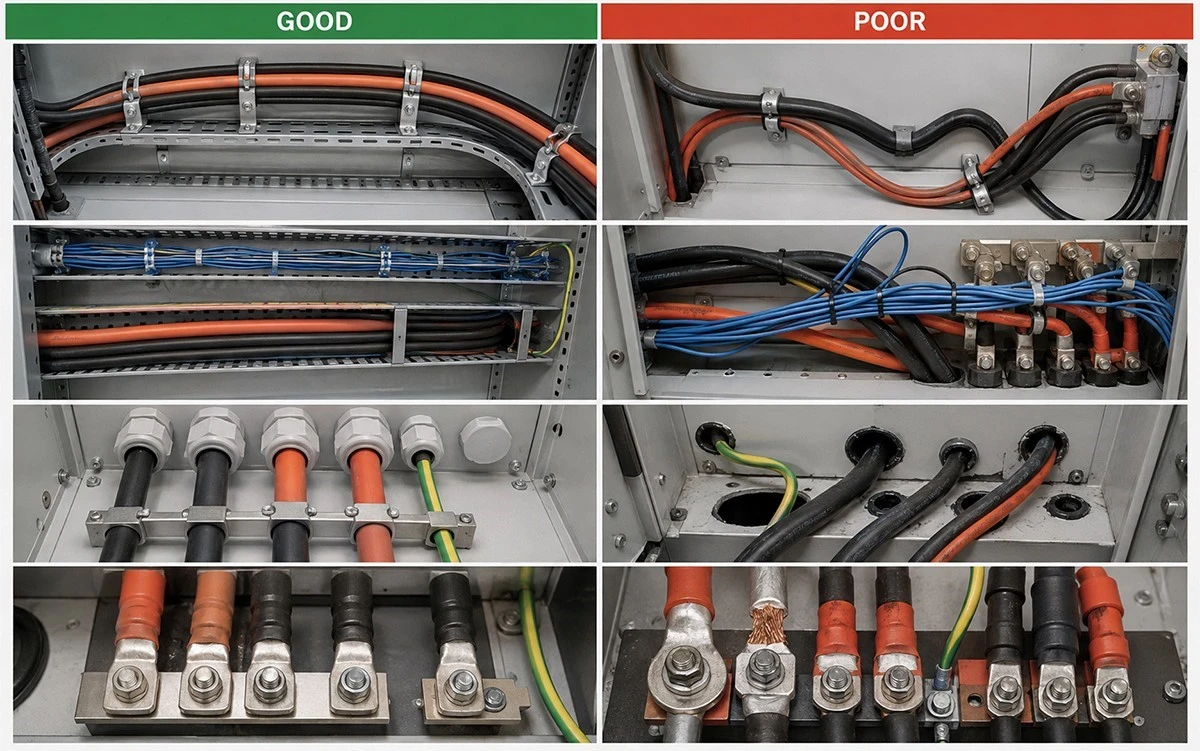
Routing examples illustrate the need for controlled support, separation, entry sealing and termination workmanship.
A Practical BESS Cable Procurement Checklist
Before comparing quotations, give each supplier the same electrical and installation boundary:
□ Circuit function and connection points
□ Nominal, minimum and maximum operating voltage
□ Continuous, temporary and prospective fault current
□ One-way route length and voltage-drop limit
□ Ambient temperature, enclosure temperature and cable grouping
□ Fixed, flexing or vibration duty and minimum bend radius
□ Indoor, outdoor, wet, UV, oil, coolant, salt or chemical exposure
□ Lug, connector, gland, seal and tooling references
□ Required standard, certification scope and destination market
□ Marking, cut length, packaging, traceability and inspection documents
Review SINELINK's energy storage cable range, then confirm the exact model, datasheet and documentation scope for the intended circuit.
BESS Cable Selection FAQ
Can PV cable be used for a battery energy storage system?
Only when the exact cable's approved scope and project requirements permit the intended circuit and installation. A PV cable designation does not automatically prove suitability for internal battery wiring or a high-current battery-to-PCS feeder.
Is a more flexible cable always better for BESS?
No. Flexibility must match movement and routing needs, while the conductor class, terminals, voltage, ampacity, environment and fire requirements must also remain compatible.
Is a 1500 V cable automatically suitable for a 1500 V BESS?
No. Confirm the system's maximum calculated voltage, rating convention, insulation coordination, temperature, installation method, current, fault duty and all connected components.
What information should be included in a BESS cable RFQ?
Provide the circuit, voltage range, current, route length, temperatures, installation method, environmental exposure, bend requirements, terminal details, destination standards, quantities and document requirements.
Need a preliminary BESS cable match?
Send the circuit, voltage, current, route, environment, terminal and destination-market requirements. SINELINK can help organize a reviewable product and documentation scope.