

SINELINK / CABLE TECHNICAL SERIES
XLPO in Solar Cables
Material properties and electron beam crosslinking explained
Solar cable insulation has to remain dependable through years of electrical loading, outdoor exposure and temperature changes. Cross-linked polyolefin, usually abbreviated to XLPO, is widely used in the insulation and outer sheath of photovoltaic cables because its formulation and cross-linked structure can be engineered for these conditions.
For buyers, however, "XLPO" is only the beginning of a specification. It identifies a family of materials, rather than one recipe or a complete set of guaranteed properties. Understanding how the compound is formulated, processed and tested makes it easier to evaluate claims about heat resistance, weathering and service life.
This guide explains XLPO in the context of solar DC cables, with particular attention to electron-beam irradiation. It also shows how material knowledge connects to cable designations, product documentation and practical procurement decisions.

ON THIS PAGE
- Why cable materials matter outdoors
- Understanding XLPO and related terms
- Where XLPO is used in a solar cable
- How crosslinking changes polymer behavior
- How electron beam irradiation creates crosslinks
- The cable processing route
- Why electron energy, dose and uniformity matter
- How electron beam processing compares with other routes
- Where XLPO performance comes from
- Understanding temperature, water exposure and service-life claims
- Aging, maintenance and end of life
- How finished cable performance is verified
- Connecting XLPO to cable models and standards
- Selecting an XLPO solar cable for a project
- SINELINK solar cables using cross-linked polyolefin
- Frequently asked questions
- Request a solar cable specification and quotation
Why cable materials matter outdoors
A PV cable beneath a module may experience very different conditions from an indoor wiring cable. Sunlight heats exposed surfaces, electrical current heats the conductor, and cooling changes with cable grouping, airflow and the installation route. Water can collect in ducts. Movement against a sharp support can gradually damage a sheath.
These stresses interact. A small cut can expose an underlying layer to conditions it was not intended to face directly. Sustained mechanical pressure becomes more significant when the polymer is hot. The material therefore needs to retain useful properties after exposure, rather than merely look sound when it leaves the factory.
Conductor size remains important, but it addresses only part of the problem. A technically complete cable selection also considers the insulation system, sheath construction, environmental evidence and installation details. Good materials support reliable service; careful manufacturing and installation preserve that capability.
Understanding XLPO and related terms
XLPO describes a material family
Polyolefins are a family of polymers that includes polyethylene. Commercial cable compounds may use selected polymers, copolymers or blends, together with additives chosen for the intended application. Crosslinking creates connections between polymer chains, producing a network within the material.
A compound described as XLPO can therefore differ substantially from another XLPO compound. The polymer blend, filler loading, stabilization system and crosslinking route all matter. Even two materials supplied for the insulation and sheath of the same cable may be formulated differently.
|
Term |
Meaning |
What it tells a buyer |
|
PO |
Polyolefin |
A broad polymer family rather than a finished cable specification |
|
XLPO |
Cross-linked polyolefin |
A cross-linked polyolefin material system without a unique recipe |
|
XLPE |
Cross-linked polyethylene |
A more specific polyethylene-based member of the broader XLPO family |
|
LSZH |
Low smoke zero halogen |
A performance description that requires defined test evidence |
|
HFFR |
Halogen-free flame retardant |
A description of composition and fire behavior rather than one polymer |
|
Electron-beam cross-linked |
Crosslinking induced by accelerated electrons |
A processing route rather than a certificate or complete performance rating |
Why XLPO and XLPE are sometimes confused
Because polyethylene belongs to the polyolefin family, XLPE falls within the broader XLPO classification. The terms are nevertheless not interchangeable in a product specification. A supplier declaring XLPO may be referring to a blend or copolymer system that should not be renamed XLPE without confirmation.
The same distinction applies to LSZH. A product can be both XLPO and LSZH, but the two descriptions answer different questions. One concerns the material system; the other concerns specified smoke and halogen-related behavior.
A useful comparison with PVC
PVC is a different polymer family and contains chlorine in its chemical structure. Many conventional PVC cable compounds are thermoplastic, while XLPO identifies a cross-linked system. This difference affects processing and behavior under heat. However, flexibility, weather resistance and flame performance depend on the actual formulations. A comparison should use cables intended for the same service, rather than assign every PVC or XLPO product a universal temperature or lifespan.
Where XLPO is used in a solar cable
A common single-core PV cable has a conductor, an insulation layer and an outer sheath. In SINELINK's H1Z2Z2-K product, the conductor is flexible tinned copper and both polymer layers are described as XLPO.
The insulation provides the primary electrical barrier around the conductor. Its thickness, continuity and freedom from defects matter because electric stress acts across the material. The outer sheath protects the underlying structure against external exposure and mechanical damage, while also meeting the applicable cable requirements.
The two layers work together. A weather-resistant sheath cannot compensate for a locally thin insulation wall, and good insulation does not justify leaving the sheath damaged. Compatibility between the layers also matters during processing and aging.

Conductor, insulation and outer sheath
The insulation and outer sheath have different roles and may use different XLPO formulations.
How crosslinking changes polymer behavior
Uncross-linked thermoplastic chains can move more freely as the material heats. Crosslinks restrict that movement by connecting chains into a network. One important result is improved resistance to flow and creep under elevated temperature and load. Creep is gradual deformation while a force remains applied.
This does not make a cable immune to heat. The material can still lose strength, age or decompose. cross-linked polymers also cannot normally be remelted and reshaped in the same way as their thermoplastic precursors.
The amount and distribution of crosslinking must suit the compound. The objective is a useful balance of properties, including mechanical performance and processability. A higher crosslinking indicator alone is not sufficient evidence that a finished cable will perform better.
How electron beam irradiation creates crosslinks
Energy is delivered to the polymer
In electron-beam processing, an accelerator produces energetic electrons. Energy deposited in the polymer generates reactive species, including free radicals. In a suitable formulation, reactions between these sites create links between molecular chains. The treatment modifies the existing insulation or sheath; it does not apply a new coating or crosslink the metal conductor.
Radiation chemistry can also produce chain scission, which breaks molecular chains, and oxidation. Which changes dominate depends on the polymer, formulation and irradiation conditions. That is why a compound must be developed and qualified for the intended process.
From polymer chains to a network
Electron-beam treatment can create molecular links within a formulation designed for radiation crosslinking.

Electron beams differ from ultraviolet and gamma radiation
Electron-beam irradiation uses accelerated particles. Ultraviolet curing uses photons and different material chemistry and equipment. Gamma irradiation is another radiation-processing route, typically using a radioactive source. These processes use different sources and treatment conditions.
For a solar cable described as electron-beam cross-linked, the relevant question is how its particular polymer layers were processed and validated. Buyers should confirm the processing route through production records and relevant test results.
The finished cable is not a radiation source
Properly specified industrial electron-beam processing uses controlled energies and materials to avoid activation. It does not make the cable a continuing source of radiation. The irradiation installation requires shielding and controlled access during operation, but that is a facility issue, not a reason to regard the finished cable as radioactive. BGS explicitly describes limiting accelerator energy to prevent product activation.
The cable processing route
Compound preparation and extrusion
Production begins with the specified crosslinkable compound. Its handling requirements must be followed, and contamination or uncontrolled mixing with other materials should be prevented. The compound is extruded to form the required insulation or sheath geometry and then cooled.
At this stage, wall thickness and concentricity deserve close attention. Irradiation cannot add missing material to a thin area or remove a particle embedded during extrusion. A sound starting construction is essential before the next process begins.
Controlled passage through the irradiation zone
For a typical reel-to-reel process, cable is paid off, guided under controlled tension and passed through a shielded treatment area. An engineered arrangement of rollers and passes exposes the required material around the cable. The exact layout depends on the accelerator, cable construction and qualified procedure.
Separating extrusion from subsequent irradiation allows the manufacturer to manage geometry and crosslinking as distinct operations. Industrial electron-beam applications include cable manufacture, and IAEA-supported facilities have incorporated dosimetry and quality assurance into their operating capability.
Inspection and traceability
After treatment, the cable is collected and inspected according to the manufacturing plan. Records should connect the material batch, cable construction, irradiation run and relevant test results. Where processing is outsourced, this connection remains important: the processing service and cable manufacturer contribute different parts of the quality record.
A reel label should connect the delivered product to its production and irradiation records.

Electron-beam irradiation equipment
Electron-beam irradiation equipment cross-links cable insulation and sheath materials after extrusion and cooling. Controlled beam exposure and cable transport help achieve consistent processing, improving heat resistance and dimensional stability in suitably formulated XLPO compounds..
Why electron energy, dose and uniformity matter
Electron energy and absorbed dose describe different things
Electron energy, commonly expressed in megaelectronvolts or MeV, is associated with penetration into the product. Absorbed dose, expressed in gray or kilogray, measures deposited energy per unit mass. One gray is one joule per kilogram. Dose rate describes how quickly that dose is delivered.
A cable can receive different doses at different positions. The outside surface, inner insulation and regions around a metal conductor do not necessarily experience identical conditions. Cable diameter, polymer thickness, density and irradiation direction all influence treatment. Research on wire and cable crosslinking has examined these effects through dose-distribution modeling and experimental verification.
The process needs a validated operating window
A useful production procedure establishes acceptable conditions for the specific compound and construction. The manufacturer then controls the parameters that deliver those conditions and checks the resulting properties. A universal "best dose" is not meaningful across all solar cable sizes and formulations.
|
Process factor |
Why it matters |
|
Polymer and additive system |
Determines the material response to irradiation |
|
Electron energy |
Influences penetration into the layered construction |
|
Beam current and line speed |
Affect energy delivery during passage through the beam |
|
Number and direction of passes |
Help manage exposure around and through the cable |
|
Wall thickness and material density |
Change energy deposition in the polymer layers |
|
Temperature and processing atmosphere |
Can affect oxidation and the balance of material changes |
|
Dosimetry and run records |
Support confirmation and traceability of the qualified treatment |
Increasing exposure is not an automatic improvement. Insufficient treatment may leave inadequate network formation, while unsuitable or excessive exposure may damage properties. Changes in line speed, construction or formulation therefore require evaluation rather than an assumption that the previous settings remain suitable.
Processing speed also has practical limits. Dose requirements, cable dimensions and handling characteristics influence throughput. A faster line is useful only when the required treatment and cable integrity are maintained.
How electron beam processing compares with other routes
Electron-beam treatment is one route to a cross-linked cable compound. Chemical routes can also produce suitable cross-linked systems when the formulation, equipment and curing conditions are matched to the product.
|
Route |
Basic principle |
Main process considerations |
|
Electron beam |
Accelerated electrons initiate reactions in a radiation-compatible compound |
Energy deposition, exposure pattern, dose and material response |
|
Peroxide |
Thermal decomposition of a peroxide initiates crosslinking reactions |
Temperature, residence time, premature curing and formulation |
|
Silane |
A silane-functional system develops crosslinks through moisture-dependent reactions |
Moisture, temperature, catalyst system and completion of cure |
The right comparison is the performance and consistency of the resulting cable. Electron-beam processing offers a controllable post-extrusion treatment, but it does not remove the need for a suitable formulation or final testing. Equally, chemical crosslinking should not be dismissed simply because it uses a different production route. Borealis, for example, supplies silane-crosslinkable polyethylene systems for cable applications.
Where XLPO performance comes from
Electrical insulation and physical integrity
The polymer system provides electrical separation, while construction quality determines how consistently that barrier is formed. Insulation resistance and dielectric strength describe different aspects of electrical behavior. Both depend on test conditions, and neither should be inferred from the material abbreviation alone.
A material data sheet typically describes a compound tested under controlled conditions. The finished cable adds geometry, interfaces and manufacturing variation. That is why buyers should request evidence for the finished construction as well as a clear material description.
Heat resistance and mechanical stability
Crosslinking can improve thermal stability, dimensional integrity and resistance to deformation. E-BEAM Services identifies these among the reasons for treating wire and cable polymers. Mechanical and chemical benefits depend on the material and application.
For installation, flexibility also depends on conductor stranding, cable diameter and layer thickness. Sheath softness alone does not indicate cable quality. A firmer cable may still meet its declared bending and mechanical requirements.
Weathering protection depends on the formulation
Outdoor durability requires appropriate stabilization. Antioxidant systems help manage oxidation, while weathering performance depends on the polymer and its UV-protection system, including suitable stabilizers and pigments. A black color alone proves neither UV durability nor correct additive dispersion.
Fillers and other additives can change processing, elongation and electrical behavior. The compound developer must balance these effects rather than maximize one property in isolation. For example, adding a flame-retardant package should not be assumed to leave every mechanical property unchanged.
Fire performance involves separate requirements
Halogen-free, low-smoke and flame-retardant claims are related but distinct. A halogen-free polymer base does not establish the composition of every additive in the final compound. Low smoke concerns smoke production under a specified test. Flame retardancy concerns behavior under defined fire exposure.
A flame-retardant cable is also different from a fire-resistant circuit designed to maintain electrical function during a fire. These terms should be used with their supporting tests, rather than grouped under the vague word "fireproof."
Understanding temperature, water exposure and service-life claims
Keep temperature conditions attached to the number
A temperature value is incomplete without the part of the cable it refers to and the permitted duration. An ambient limit describes the surroundings. A conductor limit concerns the temperature reached by the current-carrying metal. An aging-test temperature describes a laboratory exposure.
|
Temperature statement |
How to interpret it |
|
Ambient temperature range |
Environmental conditions for the declared use |
|
Continuous conductor temperature |
The normal thermal limit used with applicable installation calculations |
|
Time-limited high temperature |
An allowance tied to a stated cumulative or event duration |
|
Short-circuit temperature |
A fault condition with a limited duration and separate electrical checks |
|
Minimum installation temperature |
Conditions under which handling and bending are permitted |
|
Accelerated aging temperature |
A test condition rather than a continuous operating permission |
For example, IEC 62930:2017 specifies a normal continuous maximum conductor temperature of 90°C and limits use at 120°C to 20,000 hours. These values belong to that cable standard, rather than to every material called XLPO.
A 120°C entry on a product page should not be used as an unrestricted continuous design temperature without its conditions. Obtain the complete technical specification. Cable grouping, ambient temperature, connectors and equipment terminals can impose additional restrictions even when the insulation system has a higher thermal capability.
Outdoor use does not define every wet installation
Rain exposure, damp heat, water-filled conduit and long-term immersion are different conditions. Likewise, direct contact with soil introduces mechanical and environmental demands that are not established by a UV test.
For a wet or buried route, identify the exact installation and ask for the corresponding product evidence. The cable, joints, glands and connectors should be considered together. Further guidance is available in Can H1Z2Z2-K Solar Cable Be Buried.
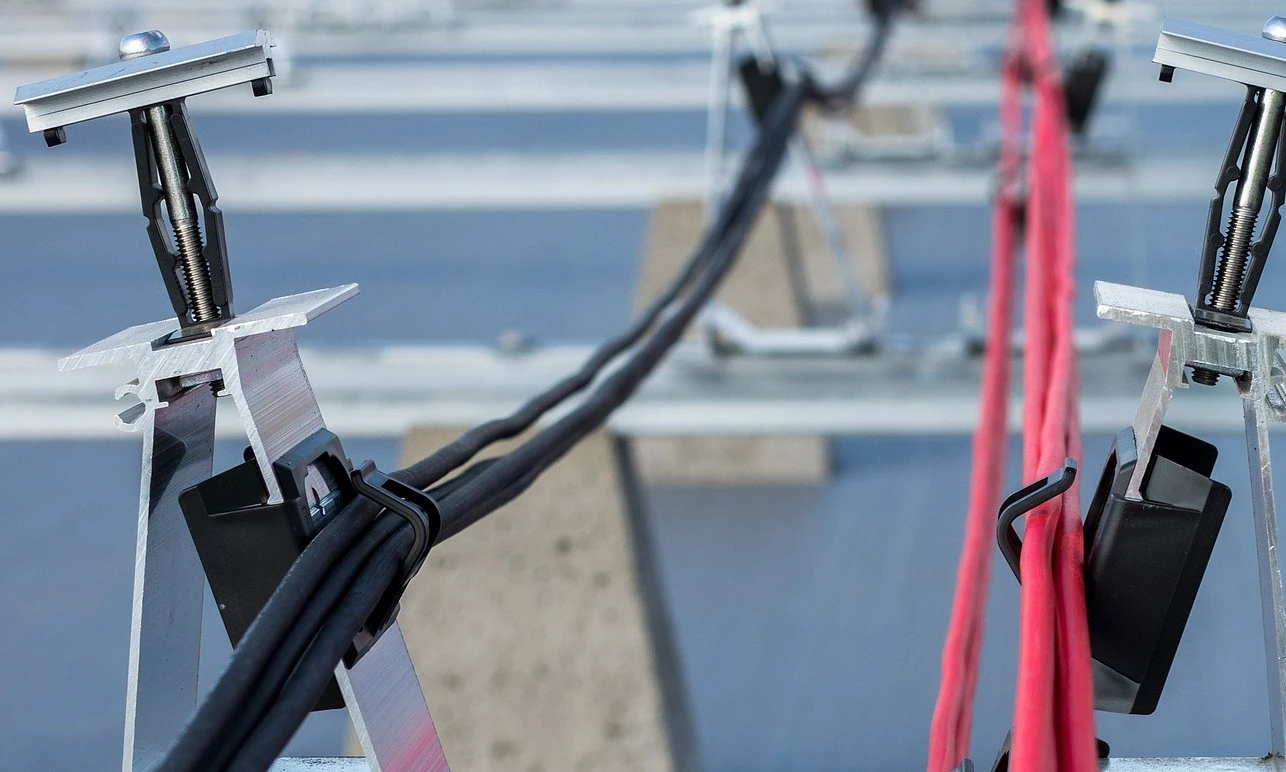
Solar cables face years of UV exposure, rain, temperature changes and mechanical stress on rooftops and in open-field installations. Properly formulated XLPO insulation and sheathing provide heat resistance, electrical insulation and protection against weathering. The cross-linked structure helps the material resist deformation at elevated temperatures, supporting reliable long-term outdoor performance.
Aging, maintenance and end of life
Cross-linked materials still age. Heat and oxygen can change the polymer and consume protective additives. UV exposure mainly challenges exposed surfaces, while repeated movement can concentrate stress at supports and bends. The time history of these conditions matters more than a single photograph of the installation.
Inspection should therefore look for changes such as cracks, cuts, flattening, abrasion or discoloration, then investigate their cause. Appearance alone cannot establish remaining life. A cable that looks clean may have experienced excessive heat, and a surface mark does not by itself quantify electrical deterioration.
A design-life statement, an accelerated-aging result and a commercial warranty describe different things. When a supplier claims 25 years or longer, ask for the temperature basis, application conditions and supporting evidence. Installation quality and maintenance remain relevant throughout service.
Crosslinking also affects disposal. The network generally prevents ordinary melt reprocessing of the polymer, although specialized recovery or reuse routes may exist. Recovering copper or aluminum is a different operation from recovering insulation and sheath material. Halogen-free does not mean biodegradable or automatically recyclable through a local plastics stream. End-of-life planning should address the actual cable construction and available treatment route.
How finished cable performance is verified
Testing turns a general material claim into evidence for a defined construction. Electrical, mechanical, environmental and fire-related tests answer different questions. The TÜV Rheinland overview of EN 50618:2014 includes these categories; the applicable standard edition and test plan determine the required methods, samples and acceptance criteria.
|
Check |
What it evaluates |
|
Insulation and sheath dimensions |
Required thickness and construction consistency |
|
Hot-set test |
Extension under a specified heated load and residual set after recovery |
|
Tensile strength and elongation |
Mechanical behavior before and after specified aging |
|
Shrinkage |
Dimensional change after prescribed heating |
|
Low-temperature tests |
Resistance to cracking or damage during specified cold exposure and loading |
|
UV weathering, ozone and damp heat |
Property retention after particular environmental stresses |
|
Insulation resistance and voltage tests |
Electrical behavior under defined test conditions |
|
Flame, smoke and halogen-related tests |
Separate aspects of combustion and emitted products |
Hot set and gel content are different measurements
The hot-set test evaluates behavior under heat and load. It is useful for assessing whether the processed material has the required dimensional stability, but does not directly report a universal percentage of crosslinks.
Gel-content testing determines an insoluble fraction using a defined extraction procedure. For filled compounds, the method and treatment of non-polymer content affect interpretation. Gel content can support process development or control, but cannot replace the required hot-set, aging or electrical tests simply because it yields a percentage.
Qualification and production checks have different roles
Type testing evaluates a defined design against the relevant requirements. Routine and sample checks support production control according to the standard and quality plan. It is neither necessary nor accurate to claim that every reel undergoes every long-duration qualification test.
For procurement, review how the proposed product relates to its qualification and how the delivered batch is identified. A generic compound report cannot establish that an unrelated cable model meets the same requirements.
Connecting XLPO to cable models and standards
XLPO identifies a material family. H1Z2Z2-K identifies a cable designation, and EN 50618 is a product standard. Keeping these categories separate makes specifications clearer.
In H1Z2Z2-K, the two Z2 elements relate to the halogen-free cross-linked insulation and sheath. They do not disclose a supplier's exact formulation. The -K suffix identifies flexible conductor construction; the full requirements for the PV cable determine the applicable conductor details. For a fuller explanation, read What Does H1Z2Z2-K Mean.
PV1-F and H1Z2Z2-K should also be compared by their documented standards, ratings and construction. Similar polymer descriptions do not establish interchangeability. Our PV1-F and H1Z2Z2-K comparison introduces the naming and specification context.
IEC 62930 addresses photovoltaic DC cables and includes both halogen-free low-smoke constructions and constructions that may contain halogens. It should not be used as a blanket synonym for LSZH. UL 4703 provides a separate PV wire framework. A contract can specify one or several requirements. The buyer should verify the exact model, size range, factory and standard covered by the supporting documents. A certification body's name is not itself the cable standard, and a conformity logo does not disclose the certificate scope.
For European building applications, any required reaction-to-fire classification needs its own applicable documentation. RoHS or REACH information addresses substance-related obligations; it does not substitute for voltage, weathering or fire testing.
Selecting an XLPO solar cable for a project
Begin with the circuit and environment, then match the product. The following sequence helps keep material selection connected to the installed system.
- Define the destination market and the project's required standards and documents.
- Establish maximum circuit voltage, design current, route length and the permitted voltage drop.
- Select conductor material and cross-section using the installation conditions and applicable correction factors.
- Describe the route accurately, including sunlight, grouping, ducts, water exposure or direct soil contact.
- Verify conductor construction, finished diameter and compatibility with the selected connector and terminal system.
- Match the product data, certificate scope, sample marking and delivered-batch identification.
For example, if a cable is moved from a freely ventilated route into a crowded conduit, the XLPO description may remain unchanged while the thermal calculation changes. If copper is replaced with aluminum alloy, conductor sizing and termination requirements also change. These are system decisions that cannot be settled by the insulation acronym.
Our Solar DC Cable Selection Guide covers the broader selection process. The companion guide on verifying solar cable certificates explains how to connect a certificate to the product being purchased.
SINELINK solar cables using cross-linked polyolefin
Flexible tinned copper solar cable
SINELINK's EN 50618 H1Z2Z2-K Solar Cable uses flexible tinned copper with XLPO insulation and sheath. It provides a practical product reference for the layered construction discussed in this article.
Review the product page for available sizes and construction. Confirm temperature conditions, dimensions and connector compatibility for the offered specification. The published material description should not be taken as evidence of a specific irradiation route unless that route is confirmed for the product supplied.
Aluminum alloy solar cable
SINELINK's TUV PV DC1500 AL Solar Cable lists an aluminum alloy conductor with electron-beam cross-linked polyolefin copolymer insulation and outer sheath. It illustrates how a related polymer system can be used with a different conductor material.
Aluminum alloy may be evaluated where conductor weight and material cost matter. Any comparison should include electrical resistance, required cross-section, cable dimensions and suitable terminals. Equal cross-sectional area does not make copper and aluminum cables equivalent, and ordinary copper-only contacts should not be assumed suitable for aluminum.
FAQ
Q: Is XLPO the same as XLPE?
XLPE is polyethylene-based and belongs to the broader cross-linked polyolefin family. An XLPO label may cover other formulations, so it should not be changed to XLPE without confirmation of the actual material.
Q: Does XLPO automatically mean low smoke and flame retardant?
No. The final compound and cable must support each declared property through the relevant evidence. Material family, smoke behavior, halogen content and flame propagation are separate parts of the specification.
Q: Is electron beam processing always better than chemical crosslinking?
No single route establishes superior finished-cable quality. Evaluate the qualified construction, manufacturing consistency and test results. The suitability of a processing route depends on its material and product requirements.
Q: Can irradiation correct a poorly extruded insulation layer?
It cannot restore missing wall thickness or remove embedded contamination. Irradiation changes the polymer network; sound extrusion and dimensional control are still required.
Q: Does electron beam treatment leave the cable radioactive?
Properly controlled industrial cable processing is designed to avoid activation. The resulting cable is not a continuing radiation source. The accelerator's operating enclosure and the finished cable have different safety considerations.
Q: Can an XLPO solar cable be directly buried or continuously immersed?
The material description alone does not establish either use. Check the exact cable's documented suitability, the installation method and the requirements for its joints and terminations.
Q: Can a higher temperature rating justify using a smaller conductor?
Only a complete electrical and thermal assessment can establish the size. Voltage drop, fault conditions, equipment limits and installation factors remain relevant even when an insulation system permits a higher temperature.
Q: What should a buyer send when requesting a quotation?
Start with the destination country, cable model or required standard, conductor size, quantity and installation environment. If the specification is incomplete, send the BOQ or existing data sheet and identify which parameters still need review.
Request a solar cable specification and quotation
Request a project-specific solar cable quotation from SINELINK. Send the required model or standard, conductor size, quantity, delivery destination and installation conditions, including any requirements for water exposure, fire performance, marking or packaging. If the specification is incomplete, share your BOQ, system voltage, design current, route length and connector details.
Technical references
- IAEA Advances in Radiation Chemistry of Polymers - Radiation-induced material changes and their dependence on processing conditions.
- BGS Radiation Crosslinking - Network formation, processing concepts and technical questions about irradiation.
- E-BEAM Services Cable and Wire Crosslinking - Industrial wire and cable applications.
- Optimization of Electron Beam Crosslinking of Wire and Cable Insulation - Research concerning dose distribution and process optimization.
- IAEA Industrial Irradiation Support Project - Industrial processing, dosimetry and quality-management capability.
- TÜV Rheinland PV Cable Test Overview - Overview associated with EN 50618:2014, not a replacement for the applicable standard.
- Borealis Energy and Cable Materials - Cable compound families and crosslinkable material systems.
- IEC 62930 Official Standard Scope - PV cable scope and stated conductor temperature limits.