

SINELINK / CABLE TECHNICAL SERIES
What Does H1Z2Z2-K Mean?
Solar Cable Code Explained
THE SHORT ANSWER
H1Z2Z2-K is the harmonized designation used for a single-core photovoltaic cable associated with EN 50618. In practical terms, H1 indicates a harmonized 1.5/1.5 kV DC voltage designation; the first Z2 identifies halogen-free cross-linked insulation; the second Z2 identifies a halogen-free cross-linked outer sheath; and -K identifies a flexible, Class 5 tinned-copper conductor. The code describes a cable family-not its cross-section, current-carrying capacity, connector fit, CPR class or approval for direct burial. Those details must be verified in the exact product datasheet and certificate scope. [1][3]
H1
VOLTAGE DESIGNATION
1.5/1.5 kV DC
Z2
INSULATION
Halogen-free / cross-linked
Z2
OUTER SHEATH
Halogen-free / cross-linked
-K
CONDUCTOR
Flexible / Class 5 tinned copper
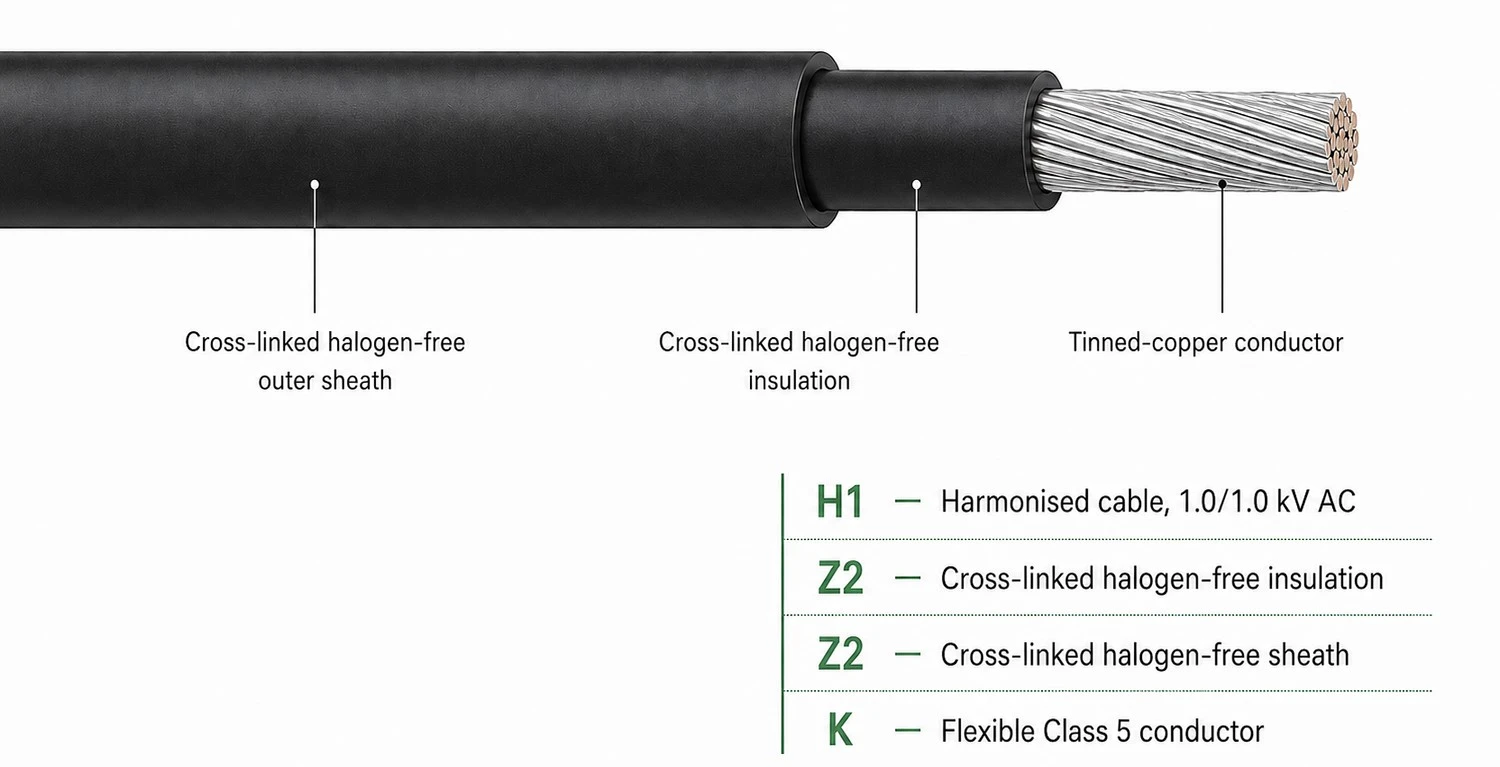
H1Z2Z2-K Solar Cable Code at a Glance
If H1Z2Z2-K looks like an engineering password, you are not alone. For EPC and procurement teams, however, the code is useful: it gives a compact first description of a modern European photovoltaic cable. The problem starts when the designation is treated as a complete specification. It is not.
This guide explains the code, then shows what still needs to be checked before an order is approved. For the broader selection workflow-standard, voltage, current, route length, installation environment and connector fit-use the Solar DC Cable Selection Guide as the cluster's main reference.
.
CONTENTS
- H1Z2Z2-K Meaning in One Sentence
- How to Read the H1Z2Z2-K Designation
- What EN 50618 Adds Beyond the Code
- What H1Z2Z2-K Does Not Tell You
- How EPC and Procurement Teams Should Verify a Cable
- How to Read the Marking on a Cable Jacket
- H1Z2Z2-K vs PV1-F: Do Not Treat Them as Synonyms
- Common Specification Mistakes
- Frequently Asked Questions
H1Z2Z2-K Meaning in One Sentence
IN BRIEF
H1Z2Z2-K identifies a harmonized 1.5 kV DC photovoltaic cable construction with halogen-free cross-linked insulation and sheath over a flexible Class 5 tinned-copper conductor. It is commonly specified for the DC side of PV systems, subject to the exact product approval and project rules. [1][3]
The code is read from the cable family and rated-voltage context toward its material layers and conductor construction. A practical decoding is shown below.
|
Code |
Practical meaning |
What it helps confirm |
What it does not confirm |
|
H1 |
Harmonized cable; 1.5/1.5 kV DC designation |
Voltage family and harmonized designation context |
Maximum system voltage calculation for the project |
|
Z2 |
Halogen-free cross-linked insulation |
Insulation material family |
Exact compound chemistry or insulation thickness |
|
Z2 |
Halogen-free cross-linked outer sheath |
Sheath material family |
CPR class, water class or direct-burial approval |
|
-K |
Flexible tinned-copper conductor, Class 5 |
Conductor flexibility/construction family |
Cross-section, resistance, ampacity or connector compatibility |
Source note: Designation interpretation is supported by a cable manufacturer's technical explanation and cross-checked against EN 50618 product data from established manufacturers. [3][4]
How to Read the H1Z2Z2-K Designation
H1: the harmonized 1.5 kV DC designation
H1 is commonly presented in manufacturer technical literature as the harmonized 1.5/1.5 kV DC designation. The paired voltage format matters. U₀/U expresses the rated voltage between conductor and earth and between conductors. In PV cable data, the corresponding AC rating is commonly stated as 1.0/1.0 kV, while the DC rating is 1.5/1.5 kV. [3][4]
That does not mean a designer can skip the maximum-voltage calculation. The PV array's cold-temperature open-circuit voltage, inverter limits, connector rating and every other component in the circuit still have to be coordinated. The lowest applicable rating can constrain the design.
First Z2: halogen-free cross-linked insulation
The first Z2 refers to the insulation around the conductor. 'Cross-linked' describes a polymer structure designed for greater thermal and mechanical stability than a comparable non-cross-linked material. 'Halogen-free' relates to the material system and its fire effluent characteristics; it is not a claim that a cable is non-combustible.
The exact material can differ by product design. One manufacturer may use a cross-linked polyolefin system; another may identify cross-linked HEPR. For a purchase specification, use the approved datasheet wording rather than substituting a generic material name.
Second Z2: halogen-free cross-linked outer sheath
The second Z2 refers to the outer protective layer. The sheath is exposed to handling, sunlight, temperature cycling, moisture and other site conditions. EN 50618 addresses a defined set of electrical, thermal, mechanical, weathering and fire-related tests, but individual products can carry additional claims or classifications. [1][4]
This distinction is important in tender documents. A Z2 sheath does not by itself establish a specific CPR reaction-to-fire class, an AD8 water claim, rodent protection or direct-burial suitability. These are product-specific statements that need their own evidence.
-K: flexible Class 5 tinned-copper conductor
The -K suffix identifies a flexible conductor construction. H1Z2Z2-K solar cables commonly use fine-stranded, tinned copper in Class 5 according to IEC 60228. The fine strands improve flexibility during routing and termination, while tinning supports the conductor construction required for this cable type and can improve resistance to surface oxidation in demanding environments. [3][4]
Class 5 does not mean 'higher electrical class' than a solid conductor; it is a construction category. Nor does -K tell you whether the cable is 4 mm² or 6 mm². Cross-section and maximum conductor resistance must appear elsewhere in the marking, datasheet and certificate scope.
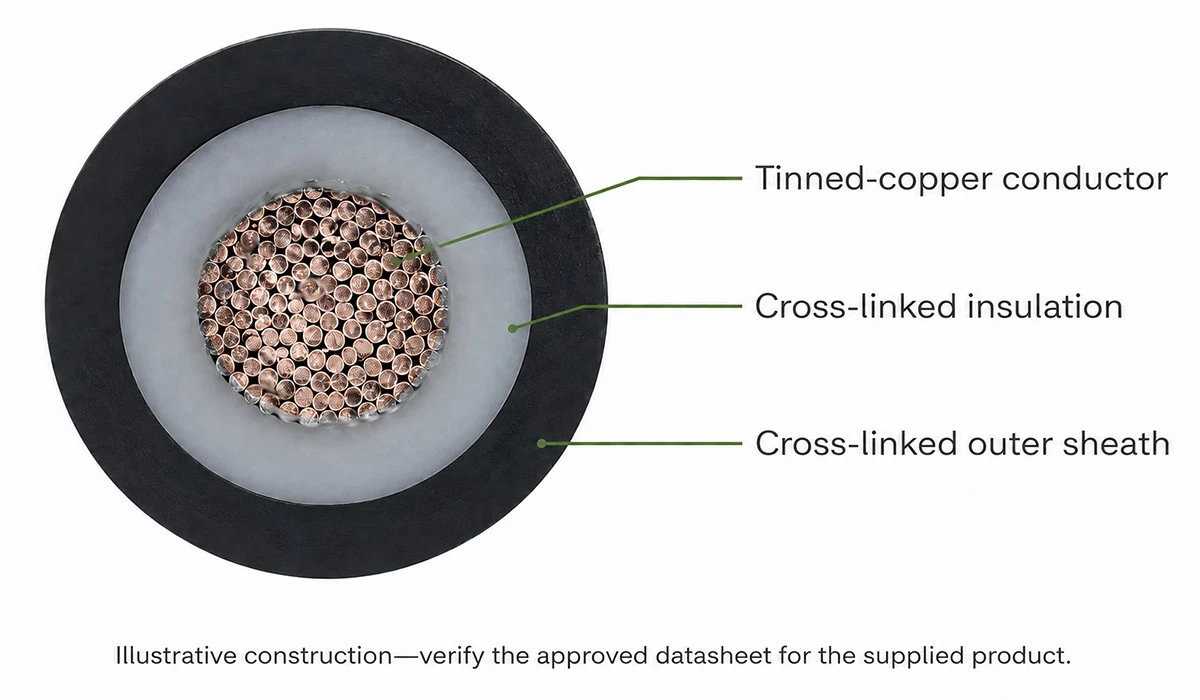
CONSTRUCTION CHECK
Conductor.
Insulation.
Outer sheath.
Illustrative construction-verify the approved datasheet for the supplied product.
What EN 50618 Adds Beyond the Code
EN 50618 is the European standard specifically addressing electric cables for photovoltaic systems. Its scope covers flexible, single-core power cables with cross-linked insulation and sheath for the DC side of PV systems at a nominal DC voltage of 1.5 kV between conductors and between conductor and earth. BSI's adoption is identical to EN 50618:2014. [1]
The standard framework goes beyond a name on the jacket. Depending on the applicable clauses and product design, evaluation includes electrical resistance and voltage tests, insulation resistance, long-term DC behavior, dimensional controls, mechanical performance, weathering and fire-related characteristics. Manufacturer data for certified products illustrates the breadth of these tests, including conductor resistance, voltage withstand, UV and ozone exposure, cold behavior and print durability. [4]
IEC 62930 is the related international standard for single-core cross-linked PV cables up to 1.5 kV DC. IEC states a normal continuous maximum conductor temperature of 90°C and limits operation at 120°C to a cumulative 20,000 hours. That is an exceptional thermal allowance, not a design target for routine operation. [2]
WHAT TO RETAIN
- H1Z2Z2-K is a designation, not a complete bill of materials.
- EN 50618 defines the European PV-cable performance framework; IEC 62930 provides an international framework with closely related scope.
- 90°C is the normal continuous maximum conductor temperature cited by IEC 62930; 120°C is limited to 20,000 cumulative hours.
- Project acceptance still depends on the exact certificate, cable size, marking, installation method and local requirements.
SINELINK's current EN 50618 H1Z2Z2-K solar cable product page lists available cross-sections and conductor-resistance values. Treat that page as the product entry point, then request the controlled datasheet and certificate that match the proposed order.
What H1Z2Z2-K Does Not Tell You
This is the most useful procurement lesson in the entire article: the designation narrows the cable family, but it does not close the technical review.
- Cable cross-section. The code does not distinguish 1.5, 2.5, 4, 6, 10 or larger mm² sizes.
- Current-carrying capacity. Ampacity depends on cross-section, conductor temperature, ambient temperature, grouping and installation method.
- Voltage drop. Route length, operating current and conductor resistance must be calculated for the actual circuit.
- Connector compatibility. Both conductor cross-section and finished cable outer diameter must fit the connector's approved range.
- CPR classification. A cable's reaction-to-fire class must be supported by its Declaration of Performance and applicable documentation.
- Direct-burial approval. Some products have additional direct-burial evidence; the designation alone does not grant it.
- Permanent water immersion. Outdoor or moisture resistance is not automatically the same as an AD8 or permanent-submersion claim.
- Certificate status. The marking does not prove that a certificate is current, that the named factory is covered or that the ordered size is in scope.
If the project is comparing an older designation, review PV1-F vs. H1Z2Z2-K before writing the procurement specification. The comparison should be made by documented standard, voltage, construction and certificate-not by product name alone.
How EPC and Procurement Teams Should Verify a Cable
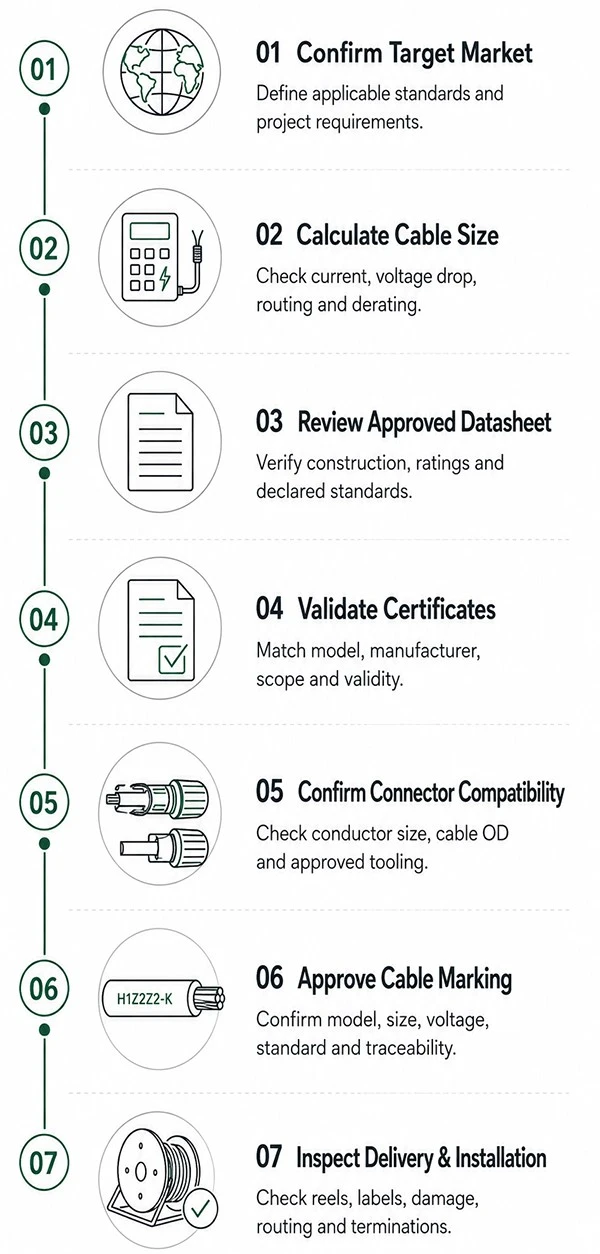
A practical verification sequence should move from the project requirement to the physical cable. It is tempting to begin with a supplier's certificate PDF, but that can cause the team to verify the wrong thing very efficiently.
- Define the destination market and applicable project rules. Confirm whether EN 50618, IEC 62930, a national standard, CPR documentation or another approval is required.
- Calculate the electrical requirement. Confirm maximum DC voltage, design current, one-way route length, voltage-drop limit and correction factors.
- Check the controlled datasheet. Match designation, cross-section, conductor, insulation, sheath, rated voltage, resistance, outer diameter and temperature limits.
- Check certificate scope and status. Match certificate holder, manufacturing site where listed, product model, standard, size range and current database status.
- Check connector compatibility. Verify approved conductor size, cable outer diameter, contact, seal, tool, die and assembly instructions.
- Check production marking and traceability. The delivered cable, packing list, drum/coil label and inspection records should agree with the approved documents.
- Record product-specific installation limits. Confirm bending radius, pulling force, water exposure, burial method, chemical exposure and any required mechanical protection.
For larger EPC packages, the photovoltaic power station cable solution page can serve as the commercial bridge from this technical article to coordinated DC cable, connector and project documentation requirements.
How to Read the Marking on a Cable Jacket
A production marking may contain more information than the designation itself. The exact sequence varies by product and certification program, but a reviewer should expect enough data to connect the physical cable to the approved documents.
ILLUSTRATIVE MARKING ONLY
MANUFACTURER / H1Z2Z2-K / 1 × 6 mm² / 1.5 kV DC / EN 50618 / CERTIFICATE OR MARK / YEAR / METRE MARKING
- Manufacturer or traceable brand: should align with the certificate holder or documented supply relationship.
- Designation: confirms the cable family stated on the jacket.
- Core count and cross-section: for example, 1 × 6 mm².
- Rated voltage and standard: should match the project specification and approved datasheet.
- Certification information: verify it in the issuer's current database where available.
- Production traceability: year, batch, lot, metre marking or other identifiers should support inspection and claims handling.
Do not copy the illustrative string into a purchase order as if it were SINELINK's final marking. The product owner should insert the exact approved print legend for the ordered cable and packaging.
H1Z2Z2-K vs PV1-F: Do Not Treat Them as Synonyms
Both designations are associated with DC-side photovoltaic wiring, but they come from different specification histories. H1Z2Z2-K is associated with EN 50618, while PV1-F is generally associated with the earlier TÜV 2 PfG 1169 approach. That history is useful, but a modern purchase decision should still compare actual certificate scope and product data.
Avoid a blanket claim that every H1Z2Z2-K cable is superior to every PV1-F product. A defensible statement is narrower: when EN 50618 and the H1Z2Z2-K designation are required by the current project specification, the supplied cable should be demonstrably compliant with that requirement. If an alternative is proposed, the designer or approving authority must evaluate it.
Common Specification Mistakes
MISTAKE 1
Writing only 'H1Z2Z2-K cable' in the BOQ. Add cross-section, color, voltage, standard, certificate/document requirements, packaging and project-specific installation conditions.
MISTAKE 2
Assuming 6 mm² is always better than 4 mm². The correct size follows current, route length, voltage drop, thermal corrections, installation method and connector limits.
MISTAKE 3
Approving a certificate screenshot. Review the searchable record or current evidence and match holder, model, standard and size range.
MISTAKE 4
Using cable size alone to choose a connector. The finished outer diameter and the connector's sealing range are equally important.
MISTAKE 5
Treating outdoor suitability as direct-burial approval. Record the actual routing method and require evidence for the exact product.
MISTAKE 6
Turning a 120°C limited allowance into a continuous design temperature. Use the normal continuous limit and applicable derating rules.
For a 1500 V DC connection, confirm the cable and the exact connector model together. SINELINK's MC4-EVO 2 DC 1500V PV connector page is a relevant next step, but the connector manufacturer's approved cable range and assembly instructions remain controlling.
FAQ
Q: What does H1Z2Z2-K stand for?
H1 identifies the harmonized 1.5/1.5 kV DC designation; the two Z2 elements identify halogen-free cross-linked insulation and outer sheath; and -K identifies a flexible Class 5 tinned-copper conductor.
Q: Is H1Z2Z2-K the same as EN 50618?
No. H1Z2Z2-K is the cable designation associated with EN 50618. EN 50618 is the standard containing scope, construction and performance requirements. A printed designation should be supported by valid product documentation.
Q: Is H1Z2Z2-K always rated 1500 V DC?
The designation is commonly stated as 1.5/1.5 kV DC. The project still needs a maximum-voltage calculation, and the exact cable datasheet, certificate and all circuit components must support the intended system voltage.
Q: Does H1Z2Z2-K mean the cable is LSZH?
The Z2 insulation and sheath designations refer to halogen-free cross-linked compounds. Fire performance and any CPR classification must still be checked in the product documentation.
Q: Can all H1Z2Z2-K cable be directly buried?
No. Direct-burial suitability is product- and installation-specific. Require an explicit datasheet statement, supporting evidence and compliance with local installation rules.
Q: What is the difference between 4 mm² and 6 mm² H1Z2Z2-K cable?
The designation is the same, but conductor cross-section, resistance, outer diameter, weight, bend requirements, connector fit, voltage drop and current capacity differ. Select size by calculation and installation conditions.
Q: Is H1Z2Z2-K compatible with every MC4-type connector?
No. Compatibility depends on the exact connector model, permitted conductor construction and cross-section, cable outer diameter, contacts, seals, tools and approved mating combination.
Q: What documents should a buyer request?
At minimum, request the controlled datasheet, current certificate evidence, declaration or compliance documentation applicable to the destination market, cable marking, size range, batch/inspection information and packaging specification.
Turn the designation into a purchase-ready specification
Send the destination country, system voltage, design current, cable length, installation method, required cross-section, connector model, packaging and documentation requirements. SINELINK can then align the quotation with the requested cable and evidence package.
ENGINEERING APPLICATION NOTE
This article supports preliminary specification and procurement. It does not replace calculations by the project designer, the locally adopted electrical code, the authority having jurisdiction, the connector manufacturer's instructions or the exact certificate and datasheet for the supplied cable.
References
[1] BSI. BS EN 50618:2014 - Electric cables for photovoltaic systems - Official standards catalogue record; BSI identifies the adoption as identical to EN 50618:2014.
[2] IEC. IEC 62930:2017 - Electric cables for photovoltaic systems - Official IEC scope and thermal operating limits: 90°C normal continuous maximum conductor temperature; 120°C limited to 20,000 h.
[3] Top Cable. TOPSOLAR PV H1Z2Z2-K technical explanation - Primary manufacturer explanation of the H1/Z2/Z2/-K designation and product construction.
[4] Prysmian Group. TECSUN(PV) H1Z2Z2-K datasheet - Primary manufacturer datasheet with EN 50618 approval, construction, ratings and test references.