


Single-Phase vs Three-Phase EV Charging: What Commercial Buyers Should KnowSINELINK / COMMERCIAL LEVEL 2 EV CHARGING CLUSTER / L2-06
Single-Phase vs Three-Phase EV Charging:
What Commercial Buyers Should Know
A practical guide to supply configuration, charger compatibility, and commercial site planning.

Quick answer
Single-phase AC charging is often suitable when vehicles stay parked for several hours and the required charging power is moderate. Three-phase AC supply can support higher common Type 2 charging configurations, such as 11 kW or 22 kW, when the charger, vehicle and site are all compatible. Three-phase is not automatically the better choice: the right option depends on local supply, vehicle onboard-charger capability, available capacity, charger quantity and future plans.
1. First, Separate the Electrical Supply from the Charging Level
Single-phase and three-phase describe how AC power is supplied to the charging equipment. They do not describe the same thing as Level 1, Level 2 or DC fast charging. In North America, "Level 2" commonly refers to AC charging equipment supplied from a 208 V or 240 V circuit. In many Type 2 markets, buyers more often compare 7.4 kW, 11 kW and 22 kW AC charger configurations.
This distinction matters when a project crosses markets. A buyer may use the phrase "Level 2 charger" while the product team is discussing a 230 V single-phase or 400 V three-phase Type 2 model. Before comparing ratings, confirm the destination country's supply arrangement and connector standard. The basic AC/DC distinction is explained in the guide to whether Level 2 charging is AC or DC.
Phase selection is only one part of a commercial Level 2 project; the wider design also has to align charger power, vehicle dwell time, site capacity, installation, and future operation. Read the broader commercial Level 2 charging plan.
2. What Single-Phase and Three-Phase Mean in Practice
Single-phase: a simpler supply for moderate AC charging
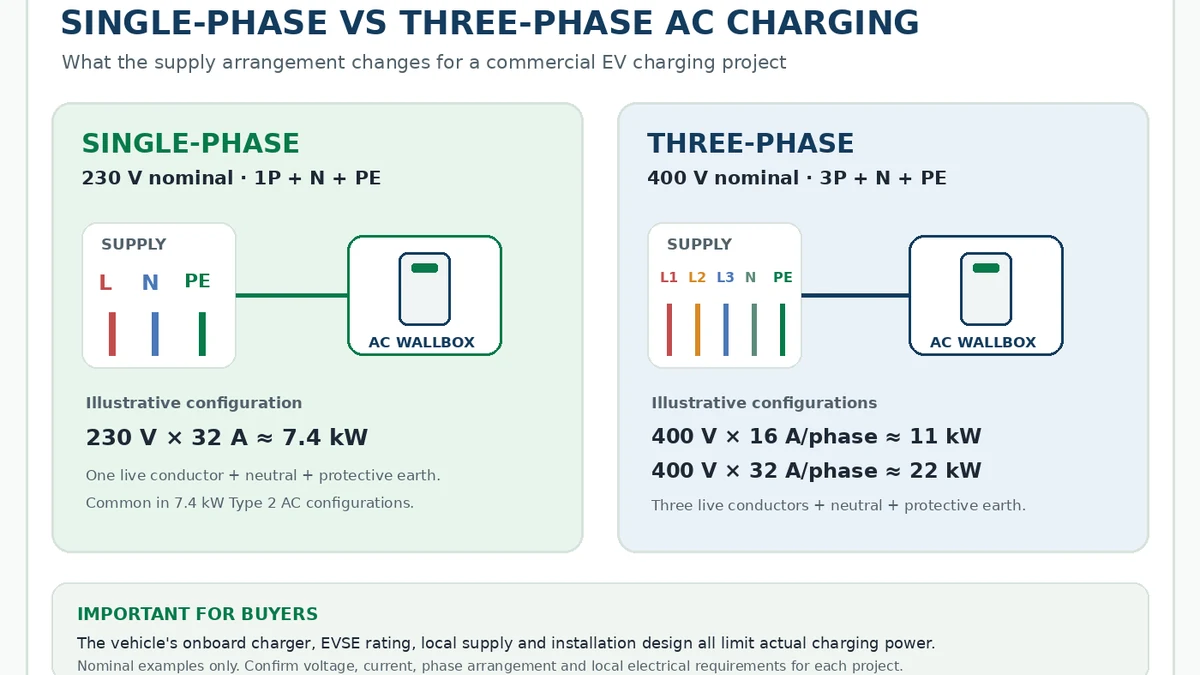
A typical European-style single-phase AC configuration uses one live conductor, neutral and protective earth. At a nominal 230 V and 32 A, the simple power calculation is about 7.4 kW. This can be a sensible fit for workplace, hotel, residential-community or destination parking where vehicles remain connected for several hours.
- The electrical arrangement is usually simpler than a three-phase charger connection.
- It can be sufficient when vehicle AC acceptance and parking time match the available power.
- It may be a practical choice for a smaller site or an initial deployment with limited charging demand.
The limitation is not that single-phase charging is unsuitable for business. The limitation is that each charging point may draw a relatively high current from one phase, so the design must consider the building's phase loading and the number of chargers that may operate together.
Three-phase: more AC power and a different way to distribute load
A typical 400 V three-phase Type 2 configuration uses three live conductors, neutral and protective earth. Common illustrative ratings include about 11 kW at 16 A per phase and about 22 kW at 32 A per phase. These values describe familiar configurations, not a guarantee that every vehicle or site can use the full rating.
- Three-phase supply can support higher AC charging power where the vehicle's onboard charger accepts it.
- It can distribute charging load across the three phases when equipment and circuits are designed correctly.
- It may provide a more flexible starting point for a site expecting several chargers or future expansion.
Three-phase equipment can also involve more demanding installation and coordination. The site must have a suitable supply, compatible protection and a charger model designed for that input arrangement.
Once the supply arrangement is clear, buyers still need to match it to the right charger rating. Comparing 7.4 kW, 11 kW and 22 kW AC charger options helps prevent a phase decision from being mistaken for a power-selection decision.
3. Typical AC Configurations at a Glance
For a single-phase circuit, power is approximately voltage × current. For a balanced three-phase system, the familiar calculation is approximately √3 × line-to-line voltage × line current. The figures above are rounded nominal examples; actual usable power depends on the equipment rating, power factor, supply tolerance and installation conditions.
| Illustrative configuration | Nominal supply | Current arrangement | Approx. AC power | What buyers should verify |
| Single-phase | 230 V | 32 A on one phase | 7.4 kW | Vehicle AC limit, circuit rating and phase headroom |
| Three-phase | 400 V | 16 A per phase | 11 kW | Three-phase input support and phase protection |
| Three-phase | 400 V | 32 A per phase | 22 kW | Vehicle onboard charger, site capacity and installation design |
4. A Three-Phase Building Does Not Mean Every Charger Must Be Three-Phase
This is an important point for commercial properties. A building may receive a three-phase electrical service while individual AC chargers are connected as single-phase loads. The electrical designer may distribute those single-phase chargers across different phases to avoid placing too much demand on one phase.
That is different from connecting a charger that is specifically designed for a three-phase 400 V input. The charger nameplate and wiring diagram determine which arrangement is allowed. Buyers should not assume that a single-phase wallbox can be connected to any two or three conductors simply because the building has a three-phase supply.
For projects with several single-phase charging points, ask the electrical contractor how the chargers will be allocated across phases and how the phase currents will be monitored. A balanced design is about the combined load, not only the rating printed on one charger.
5. North American Level 2 Projects Need a Different Voltage Check
In the United States, AC Level 2 charging commonly uses 208 V in commercial buildings and 240 V in typical residential applications. A commercial building may have a three-phase distribution service, while an individual Level 2 EVSE is connected as a single-phase 208 V or 240 V load. The building's service type and the charger's input configuration therefore need to be checked separately.
Do not assume that a charger listed as 240 V will automatically accept 208 V. For example, the SINELINK GS-B02 product information lists a 240 V AC Level 2 input with L1 + L2 + ground. The exact input range and suitability for a 208 V commercial circuit must be confirmed for the ordered model before quotation.
For North American projects, the GS-B02 Level 2 AC wallbox range provides 16 A, 32 A, 40 A and 48 A model options with nominal outputs listed from 3.5 kW to 11.5 kW. Confirm the model's voltage range, current setting, connector, branch circuit and local code requirements.
6. The Vehicle Can Still Limit the Charging Power
A three-phase charger does not force a vehicle to accept three-phase AC. The vehicle's onboard charger (OBC) determines how much AC power it can convert for the battery. A vehicle that accepts only single-phase AC may not use the full output of a three-phase wallbox.
This is one reason a 22 kW unit can deliver much less than its nameplate rating. If the vehicle, site supply or charger configuration is the limiting factor, moving to a higher-rated wallbox will not solve the issue. The practical checks are explained in the guide to why a 22 kW EV charger may only deliver 7 kW or 11 kW.
Before choosing the phase arrangement, ask for the target vehicle list or at least the maximum AC charging capability of the vehicles expected to use the site.
7. Choose the Supply Around the Site, Not Just the Charger
For a small destination site with long parking periods, single-phase charging may meet the operating need without requiring a higher-power configuration. For a larger workplace, fleet or shared parking project, three-phase supply may offer more flexibility, particularly when the site expects higher charging demand or future growth.
The decision should be based on four practical questions:
- How much energy does each vehicle need before it leaves?
- How long is each vehicle expected to remain parked?
- What supply voltage, phase arrangement and spare capacity are actually available?
- How many charging points may operate at the same time, now and after expansion?
Once the phase arrangement is known, the project still needs to establish how many Level 2 charging points the site can support. That depends on the usable site capacity, building demand, charging windows and operating assumptions-not on phase count alone.
The overall power and energy requirement is a separate calculation from the supply phase. A site can have three-phase power and still lack enough capacity for the required daily charging energy; this broader question belongs in commercial Level 2 site power planning [L2-13] and the existing EV charging site sizing guide. Assess whether dynamic load balancing is needed when several Level 2 chargers share limited site capacity The detailed control principles are covered in SINELINK's technical guide to dynamic load balancing for commercial EV charging.

8. When Multiple Chargers Share the Same Supply
The phase decision becomes more important when a project adds several charging points. A group of single-phase chargers may need to be distributed across phases. A group of three-phase chargers draws power across all three phases, but the total site demand still has to remain within the supply limit.
If building demand changes throughout the day, a fixed charging limit may leave capacity unused at quiet times or create pressure during peak periods. Buyers should decide how the available capacity will be allocated before quotation.
Dynamic load balancing can help manage the available capacity, but it does not increase the utility connection rating or create additional energy. Phase allocation, current measurement, and charger compatibility still need to be engineered correctly.
9. What This Means for SINELINK AC Charger Selection
SINELINK's H-Series Smart AC Charging Wallbox is listed with 7.4 kW, 11 kW and 22 kW options. The published product information identifies 230 V AC and 400 V AC supply arrangements, with single-phase or three-phase connection depending on the selected model. The selected configuration must match the project market, vehicle fleet, and electrical design.
For projects specifying a three-phase 22 kW Type 2 AC charger, the H-Series is a relevant product route to review. Buyers should still confirm the exact model, phase input, current range, connector option and protection requirements before finalizing the RFQ.
For larger projects that need integration with an existing charging backend, building management system or energy-management platform, SINELINK can discuss SCCI integration across different communication methods and protocols. The exact protocol combination, interface scope, and compatibility must be confirmed against the project's equipment and software environment.
10. What Commercial Buyers Should Confirm Before Ordering
- Destination country and local nominal supply voltage.
- Whether the site service is single-phase or three-phase, and the actual voltage available at the charger connection.
- Whether an individual charger is specified for single-phase or three-phase input.
- Vehicle models and maximum AC onboard-charger capability.
- Required charging power and expected parking/dwell time.
- Number of chargers planned for the first phase and future expansion.
- How single-phase chargers will be allocated across phases, where applicable.
- Main service rating, available spare capacity and measured building peak demand.
- Required circuit protection, cable size, earthing arrangement and installation method.
- Connector type, access control, networking and backend requirements.
- Whether dynamic load balancing or site-level energy management is required.
- Whether SCCI integration is needed and which communication interfaces/protocols must be supported.
- Model-specific datasheet, test documents, warranty and commissioning responsibilities.
11. A Practical RFQ Example
Project country: [Country]
Application: [Workplace / hotel / apartment / fleet / commercial parking]
Available supply: [Voltage and phase arrangement]
Target charger quantity: [Number]
Vehicle types: [Models or vehicle classes]
Typical parking time: [Hours]
Required charging power: [If known]
Connector: [Type 2 / Type 1 / other]
Communication / backend: [OCPP / local control / SCCI integration / other] F
uture expansion: [Expected additional charging points]
With these details, the supplier and electrical designer can check whether single-phase or three-phase equipment is appropriate before the model and installation scope are finalized.

User-provided real installation scene. Confirm supply arrangement, protection, cable routing, and commissioning scope with qualified professionals before equipment is ordered or installed.
FAQ
Is single-phase EV charging enough for a commercial site?
It can be. Single-phase AC may suit workplaces, hotels or destination parking where vehicles stay for several hours and the required energy can be delivered within that time. The site supply and vehicle AC limit still need to be checked.
Is three-phase EV charging always faster?
No. Three-phase equipment can offer higher AC power, but the vehicle must support that input and the site must supply it. The actual charging rate is limited by the lowest applicable limit among the vehicle, charger and electrical supply.
Can a single-phase EV charger be installed in a building with three-phase power?
Potentially, yes. A compatible single-phase charger can be supplied from an appropriate phase-to-neutral or line-to-line circuit, depending on the market and equipment. The electrical designer must allocate loads correctly and verify the charger's input rating.
Does a 22 kW Type 2 AC charger need three-phase power?
Common 400 V Type 2 22 kW configurations use three-phase supply. Always check the exact charger datasheet and local supply rather than relying on the rating alone.
What is the difference between 230 V single-phase and 400 V three-phase charging?
A common 230 V single-phase configuration uses one live conductor and neutral. A common 400 V three-phase configuration uses three live conductors and can support higher AC power, subject to charger and vehicle compatibility.
Do North American commercial Level 2 chargers use three-phase power?
Many Level 2 EVSE units are connected as single-phase 208 V or 240 V loads, even when the building itself has a three-phase distribution service. Confirm the actual circuit voltage and the charger's rated input.
Can three-phase power support more EV chargers?
It can provide more flexibility for distributing load, but charger quantity depends on total available capacity, vehicle energy demand, charging windows, protection and load management. Phase count alone does not determine the number of ports.
What information should I send SINELINK for a single-phase or three-phase charger quotation?
Send the destination country, supply voltage and phase arrangement, vehicle list, charger quantity, expected parking time, target power, connector type, communication requirements, and future expansion plan.
Need Help Selecting the Right AC Charger?
Share your destination market, available supply, vehicle mix, parking time and planned charger quantity. SINELINK can help review the appropriate AC charger configuration and identify the technical information that should be confirmed before ordering.
Discuss your project on WhatsApp→