


Choosing the wrong EV charging connector can delay a project, leave drivers unable to charge, and create costly changes after delivery. This guide helps commercial buyers avoid that problem. You will see which connector types are common in Europe, North America, China, Japan and other markets. You will also learn what to check on each vehicle, how to handle adapters, and what to send a supplier before you order. Use the regional table and buyer checklist to turn a long list of standards into a clear charging-equipment specification.
QUICK ANSWER
Europe commonly uses Type 2 for AC and CCS2 for DC. North America uses J1772/Type 1, CCS1, and the growing SAE J3400 (NACS) system. China uses GB/T interfaces. Japan has a significant CHAdeMO DC installed base. However, a country label is only a starting point. Always check the exact vehicles and local requirements before you buy.
Connector selection starts with the vehicle inlet, charging method, and destination market. The photographs illustrate real connector use and do not represent a SINELINK project installation.
Contents
- What Are the Main EV Charging Connector Types?
- EV Charging Connector Types by Region: Global Comparison Table
- Type 1 vs Type 2: AC Charging Connector Differences
- CCS1 vs CCS2: Choosing a DC Fast Charging Connector
- NACS (SAE J3400): What Buyers Need to Know in North America
- CHAdeMO and GB/T: Regional Compatibility and Procurement Considerations
- How to Verify EV Charger Compatibility Before Purchase
- Which Connector Configuration Is Best for Your Commercial Charging Site?
- EV Charging Connector Procurement Checklist for EPCs and Distributors
- Explore SINELINK AC and DC EV Charging Solutions
- Frequently Asked Questions About EV Charging Connector Types
1. What Are the Main EV Charging Connector Types?
An EV charging connector is the plug at the end of a charging cable. The vehicle inlet is the matching socket on the car. These parts must fit and support the same charging method. The charger and car must also exchange the right control signals. A plug that fits does not, by itself, prove that charging will work.
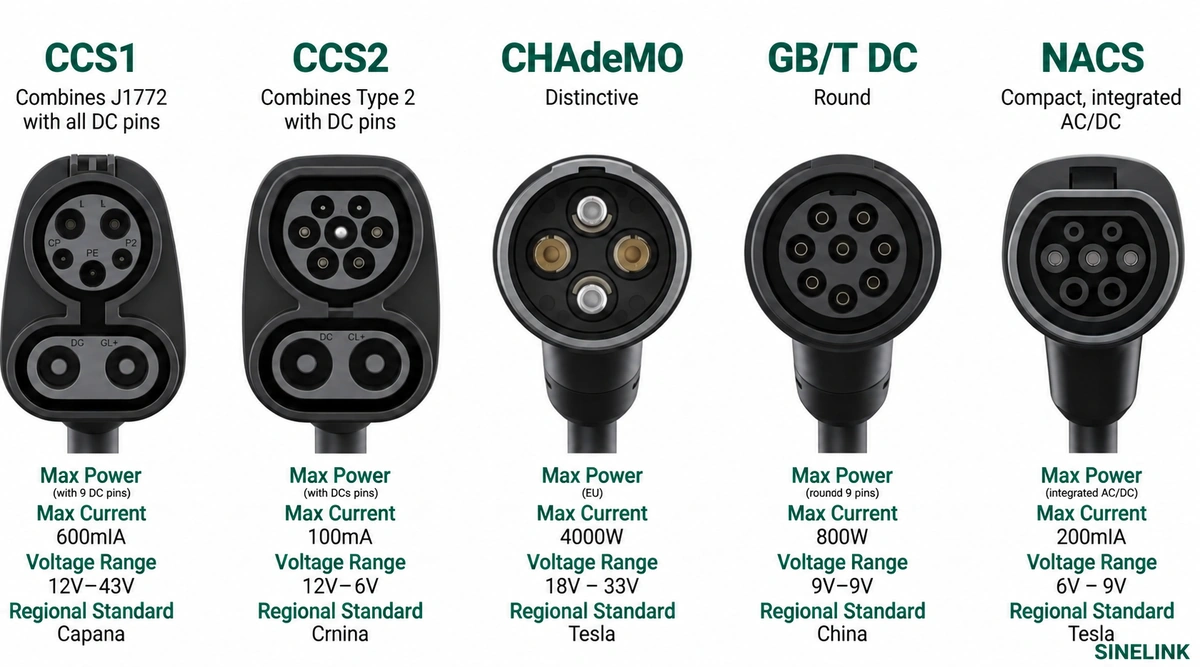
The main names you will see in international projects are Type 1 (SAE J1772), Type 2, CCS1, CCS2, CHAdeMO, GB/T and SAE J3400 (NACS). Some names describe an AC connection. Others describe DC fast charging. J3400 can support both AC and DC with the same physical connector design.
AC and DC connectors are not the same decision
In AC charging, the vehicle uses its onboard charger to convert AC power into DC for the battery. In DC charging, the charging station performs the power conversion. This is why a vehicle may accept one AC connector and a different DC connector. The connector choice must match the charging method as well as the vehicle.
If you need a simple explanation of charging speed before choosing connectors, see EV Charging Levels Explained. For the wider site design, start with the Commercial EV Charging Infrastructure Buyer's Guide.
Do not confuse a connector with a communication protocol
A connector is a physical interface. Vehicle-to-charger communication is another layer. Backend software uses yet another connection, such as OCPP, between the charger and the charging management system. You can have the right plug but the wrong vehicle communication setup. You can also have a working vehicle connection but no backend access or payment integration. Read the existing EV charging protocols overview for more context. A deeper version comparison is planned in OCPP 1.6J vs OCPP 2.0.1
2. EV Charging Connector Types by Region: Global Comparison Table
Use this table for early planning, not as a final legal or technical approval. Connector mixes can change with imported cars, fleet contracts, new vehicle models and local rules. Public chargers may need a specific interface even when private fleets have more flexibility.
| Region / market | Common AC interface | Common DC interface | Buyer action |
| EU / much of Europe | Type 2 | CCS2; some CHAdeMO legacy use | Check AFIR, national rules and the target fleet. |
| US / Canada | SAE J1772 (Type 1); J3400 | CCS1; J3400; some CHAdeMO legacy | Check vehicle model year, network access and adapter support. |
| Mainland China | GB/T AC | GB/T DC | Check the exact GB/T edition, vehicle and charger communication. |
| Japan | Type 1 common in many vehicles; model-specific exceptions | CHAdeMO installed base; other imports vary | Check domestic vs imported vehicles and local deployment rules. |
| Southeast Asia | Varies by country and fleet | Often CCS2, but not universal | Review country requirements and the actual local vehicle mix. |
| Australia / New Zealand | Type 2 common | CCS2 common; CHAdeMO legacy demand in some areas | Check used imports, local operators and installed base. |
| South Korea | Vehicle-dependent AC interfaces | CCS1 is important | Confirm national requirements and fleet models. |

The inlet shape is only one compatibility check; electrical limits and charging communication must also match.
The European Commission sets specific connector interoperability requirements for covered public infrastructure under AFIR. Other countries follow their own frameworks. For example, CharIN's regional review identifies different market choices across Asia. That is why "one charger for all of Asia" is not a safe purchase specification.
3. Type 1 vs Type 2: AC Charging Connector Differences
Type 1 / SAE J1772
Type 1, also called SAE J1772, is a familiar AC charging interface in North America. It is used by many vehicles with a J1772 inlet. In a commercial parking site, it can serve cars that stay for several hours. The actual charging rate still depends on the site supply and the car's onboard charger. The connector name alone does not tell you how many kilowatts the vehicle will take.
Type 2 / IEC 62196-2
Type 2 is the common AC interface in Europe. It can be used in single-phase and three-phase AC charging arrangements, subject to the vehicle and installation. A Type 2 socket or cable does not guarantee that every car will use three-phase power. Some cars only accept single-phase AC. Others have lower onboard charger limits than the wallbox rating.
What should a commercial buyer compare?
Start with the vehicle inlet. Then check the supply voltage, phase arrangement, rated current, cable design, socket or tethered-cable format, and local electrical rules. Ask who will supply the cable when the unit has a socket rather than a fixed lead. This small detail affects user experience, theft risk, and day-to-day operation.
If your project is mainly offices, hotels or long-stay parking, review SINELINK's AC charging product category. For a separate AC-versus-DC site decision, see AC vs DC Charging: Which Does Your Site Actually Need? [URL PENDING - A4].
4. CCS1 vs CCS2: Choosing a DC Fast Charging Connector
CCS1 and CCS2 are both part of the Combined Charging System
CCS adds dedicated DC contacts to an AC inlet layout. CCS1 is built around the Type 1 family. CCS2 is built around the Type 2 family. Both are used for DC fast charging, but the plugs are not physically interchangeable. A CCS1 cable will not simply plug into a CCS2 vehicle inlet.
For a charger order, the words "CCS supported" are not enough. Your purchase order should state CCS1 or CCS2, the required output voltage range, current rating, cable length, cooling design if relevant, and the intended vehicle models. It should also define the communication functions the target vehicles need.
Can a site offer both connector types?
A project may use separate chargers, separate outputs, or a supplier-approved mixed configuration. The answer depends on the hardware platform. Do not assume that two cables mean two vehicles can always charge at full power at the same time. Ask for the number of simultaneous charging sessions and the power-sharing rule. These points matter for busy public sites and fleet depots.
For example, SINELINK lists a North American SEC 160 kW DC charger with CCS1/NACS configurations, and a separate European SEC DC charging range with CCS2-oriented configurations. The listed options are model- and order-dependent. Confirm the approved datasheet and connector configuration before making a claim to your customer.

SINELINK product references for North American CCS1/J3400 and European CCS2-oriented configurations. Confirm the ordered connector variant in the approved datasheet.
5. NACS (SAE J3400): What Buyers Need to Know in North America
NACS began as a Tesla connector design. SAE now maintains the J3400 standard family for the North American Charging System. J3400 is relevant to both AC and DC charging. SAE J3400/2 covers the connector and inlet dimensions. This gives buyers a clearer technical reference than the older, informal phrase "Tesla plug."
Does J3400 replace CCS1 everywhere?
No. The North American vehicle fleet is mixed, and change takes time. Many cars still have CCS1 DC inlets or J1772 AC inlets. Some newer vehicles use J3400. A commercial site may need to serve both groups. Review the vehicle models expected at the site, not only future manufacturer announcements.
Adapters do not remove all compatibility checks
An adapter can help in some cases, but only when the vehicle, adapter, charger and charging network support that use. A connector adapter does not change the car's battery limits. It does not guarantee access to a private network. It does not turn every AC adapter into a DC adapter. Check the vehicle maker's instructions and any approved adapter list. Do not promise universal NACS-to-CCS compatibility.
For North American projects, include a simple question in the RFQ: "Which exact J3400 and CCS1 vehicle models must charge at launch?" This is more useful than asking only whether a unit is "NACS ready."
6. CHAdeMO and GB/T: Regional Compatibility and Procurement Considerations
CHAdeMO: still relevant to installed vehicles
CHAdeMO is a DC fast-charging interface with a long history in Japan and in some exported Japanese vehicles. Its role differs by market. In some places, new chargers focus on CCS or J3400. Yet a fleet with CHAdeMO vehicles may still need CHAdeMO service for years. Check the number of those vehicles and their daily routes before removing that option from a site plan.
GB/T: important for China and cross-border fleet projects
China uses GB/T charging interfaces. Buyers should distinguish GB/T AC and GB/T DC. They should also verify the applicable standards edition and vehicle communication requirements. Do not assume that a charger made for CCS2 will work with a GB/T vehicle because both can deliver DC power. Mechanical fit, communication and safety control all matter.
A practical import example
Imagine a logistics company buying electric vehicles from one country and charging equipment from another. The vehicle seller says the trucks support DC fast charging. The charger supplier says its cabinet is rated 120 kW. Those statements still leave a major gap. The buyer must match the vehicle inlet, voltage window, current limit, communication behavior and charger connector. A failed match may require new cables, new hardware, or a change in fleet plan.
SINELINK's 60–120 kW integrated DC charging station series lists configurable CCS2, GB/T or CCS1 interfaces. That does not mean all versions are interchangeable in the field. Ask for the exact ordered connector version and its test documentation.
7. How to Verify EV Charger Compatibility Before Purchase
This is the most important part of the buying process. Do not rely on a single line that says "compatible with all EVs." Ask for evidence against your vehicle list.
Step 1 - Identify the vehicles
List the make, model, model year and market version of each vehicle. Add the AC inlet type and DC inlet type. If you are planning a public site, use local registration data or operator demand data where available. Do not use a global average as a substitute for local demand.
Step 2 - Match the electrical limits
For AC charging, compare the wallbox supply and the vehicle onboard charger. For DC charging, compare the charger's voltage range, connector current limit and rated power with the battery voltage and charging curve. A 200 kW cabinet does not mean every connected car will charge at 200 kW. Power can be lower due to battery state, temperature, vehicle limits or shared site capacity.
Step 3 - Confirm communication and software
Ask the supplier which vehicle communication standards and versions are supported for the ordered configuration. Check start/stop control, authorization, fault reporting and the intended backend. OCPP is a backend interface. It is not a substitute for vehicle-to-charger compatibility. If your project uses multiple charging brands, test the complete system before rollout.
Step 4 - Check cables, adapters and real use
Verify cable length, reach from the parking bay, strain relief, connector handling, enclosure protection, climate and maintenance. If adapters are needed, obtain written approval for the vehicle and charging method. Run a pilot charge on representative vehicles where possible. Keep the test record with the order documents.
| Check | Ask for | Why it matters |
| Vehicle fit | Model list + inlet photos | Avoids ordering the wrong plug. |
| AC input | Voltage, phase, frequency, supply limit | Matches local electrical service. |
| DC output | Voltage range, current, power curve | Avoids overstated charging speed. |
| Communication | Vehicle and backend protocol details | Prevents failed sessions or integration gaps. |
| Cable / layout | Length, reach, protection, placement | Avoids unusable bays and damage. |
| Evidence | Datasheet, configuration drawing, pilot result | Makes the decision traceable. |

8. Which Connector Configuration Is Best for Your Commercial Charging Site?
Office and retail parking
Drivers often stay long enough for AC charging. Start with the local vehicle mix. A European office may need Type 2 AC bays. A North American site may need J1772 and J3400 access. If visitors drive many different cars, ask whether the charger format makes cable use simple. Then review the building's available power and any load-management plan.
Public DC fast-charging site
Short visits make connector availability more important. A fast charger with the wrong plug serves nobody. Use local traffic and vehicle data to choose CCS1, CCS2, J3400, CHAdeMO or GB/T as appropriate. Ask how many vehicles can charge at once and what power each output can deliver. The station layout must allow cars with different inlet locations to reach the cable safely.
Fleet depot
Fleet buyers have an advantage: they can often name every vehicle model. Use that list. If all vehicles have one connector family, a focused configuration may reduce cost and service complexity. If the fleet will change, plan for the next vehicle orders too. For depot sizing, see How to Size Your Charging Site [URL PENDING - B5]. For power sharing, see Dynamic Load Balancing [URL PENDING - B6].
Multi-brand or cross-border projects
For mixed fleets and export distributors, build a connector matrix before choosing hardware. Include the country, vehicle make, inlet type, charging method, expected dwell time and local standard. If the site needs several charging technologies, compare integrated and distributed architectures as part of the system design. The planned article Split-Type vs Integrated DC Charging [URL PENDING - B7] will cover that separate decision.

A multi-bay site needs connector choices based on the actual vehicle population, bay layout and simultaneous charging plan.
9. EV Charging Connector Procurement Checklist for EPCs and Distributors
Use this list in your first RFQ. It helps a supplier recommend the right version faster. It also reduces the chance of receiving a quotation that looks complete but leaves out the connector decision.
- Destination country and city; public, private or fleet installation.
- Vehicle make, model, model year and target fleet size; AC and DC inlet types.
- Number of charging bays; expected daily sessions; average parking time.
- Required connector family on each output: Type 1, Type 2, CCS1, CCS2, J3400, CHAdeMO or GB/T.
- Available grid voltage, frequency, phase and total site power limit.
- Expected charging power, output voltage range and connector current requirements.
- Cable length, parking layout, mounting type, weather exposure and operating temperature.
- Network, OCPP, user access, payment, monitoring and local service requirements.
- Applicable market approvals, test reports, labeling and installation review.
- Quantity, delivery schedule, spares, warranty terms and future expansion plan.
Ask for the final model datasheet and an order-specific configuration sheet. If the project is regulated, confirm the approval status for the exact variant. A certificate for one product or region should not be treated as proof for every charger version. The planned EV Charger Certifications: What to Verify Before You Import will cover this in depth. SINELINK also describes its engineering and quality review capabilities.
10. Explore SINELINK AC and DC EV Charging Solutions
SINELINK offers AC charging equipment for long-stay parking and DC charging equipment for faster vehicle turnaround. Product pages show different regional connector and power options. They are a starting point, not a substitute for the approved configuration sheet. For a full site review, see EV Charging Solutions or browse the EV Charging product hub.
Need help choosing a connector for your country? Send us the destination market, vehicle list, AC or DC requirement, charging power, number of outlets and site supply. We can review the options against the product configuration available for your project. Email sales@sinelinkenergy.com.
Bottom line: Choose the connector from the vehicle and market requirements first. Then choose the charger power and site design. That order helps avoid expensive changes after installation.
11. Frequently Asked Questions About EV Charging Connector Types
What EV charging connector is used in Europe?
Type 2 is the common AC interface, and CCS2 is the common DC fast-charging interface. For covered public infrastructure, EU interoperability rules apply. Check the latest national rules and the vehicles at your site before ordering.
What is the difference between CCS1 and CCS2?
Both support DC charging in the Combined Charging System. CCS1 uses the Type 1-based connector layout. CCS2 uses the Type 2-based layout. Their plugs are not physically interchangeable.
Is NACS the same as SAE J3400?
NACS is the name widely used for the North American Charging System connector. SAE J3400 is the standards family for this system. Buyers should check the specific vehicle, charger, and J3400 configuration.
Can a NACS vehicle use a CCS charger?
Sometimes, with a supported adapter and the right vehicle and network permissions. This is not universal. Check the vehicle maker, adapter approval, charging method, and charger network before promising access.
Can a Type 2 vehicle use a CCS2 DC fast charger?
Only if the vehicle has a compatible CCS2 DC inlet and supports DC charging. A vehicle with a Type 2-only AC inlet cannot use a CCS2 DC plug simply because the upper part looks similar.
Can GB/T vehicles charge at CCS stations?
Not directly as a general rule. GB/T and CCS differ in connector design and communication. Any conversion solution needs a vehicle-specific technical and safety review.
Is CHAdeMO still needed for commercial sites?
It depends on the local vehicles. Some Japanese vehicles and older fleets still use CHAdeMO. Check the local installed fleet and expected demand before removing or adding it.
What information should I send before ordering EV chargers?
Send the country, vehicle models, connector types, AC or DC needs, number of bays, electrical supply, cable requirements, software needs, and local compliance requirements. Ask for an exact configuration sheet before purchase.
Send the destination market, vehicle list, AC or DC requirement, charging power, outlet count, and site supply for a connector configuration review.
Request a Configuration Review →