

Buying solar equipment from China can reduce the initial purchase price for planned or higher-volume orders, while a local wholesaler can offer faster delivery, smaller quantities and easier local support. The correct choice depends on total landed cost-not the unit price alone. Freight, duty, certification, inventory, financing, compatibility, warranty handling and project-delay risk can materially change the result.
For installers, EPC contractors, system integrators and distributors, the practical rule is simple: source directly when demand is predictable and specifications are stable; buy locally when speed, low quantity or local service carries more value. Many buyers obtain the best result by combining both channels.
Explore SINELINK products | Submit a project RFQ
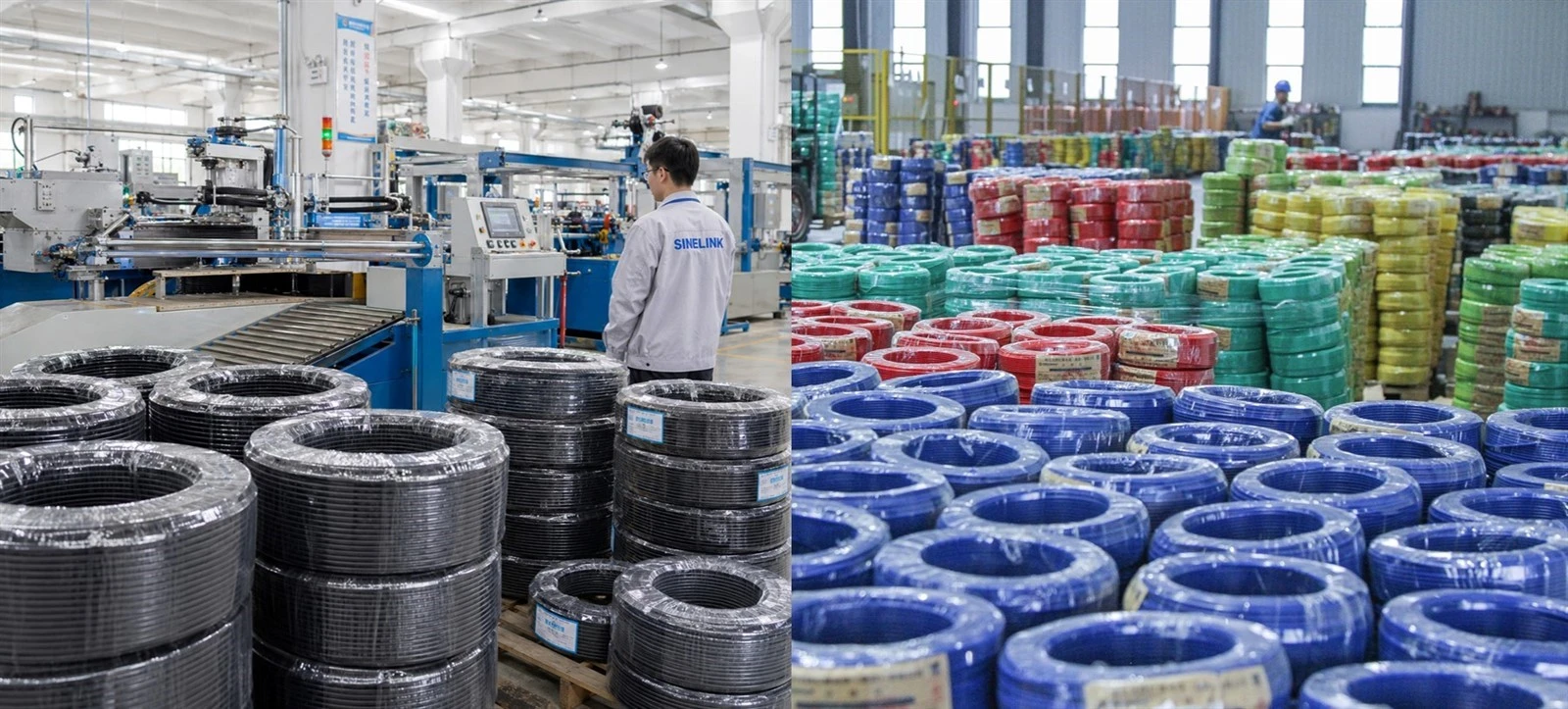
|
Decision factor |
Buying from China |
Buying from a local wholesaler |
|---|---|---|
|
Unit price |
May be lower at suitable volume |
Includes local inventory and distribution margin |
|
Minimum quantity |
Usually higher or production-based |
Usually lower |
|
Product range |
Broader configurations and OEM options |
Limited to stocked brands and models |
|
Lead time |
Production plus international transport |
Fast when in stock |
|
Import process |
Buyer or appointed agent manages it |
Normally completed before purchase |
|
Inventory |
Buyer may hold project or safety stock |
Wholesaler holds local stock |
|
Technical support |
Often remote and project-based |
Local support may be available |
|
Warranty |
Requires a defined cross-border process |
Usually handled in the local market |
|
Cash flow |
Deposit and pre-shipment payment are common |
Smaller purchases or credit may be available |
|
Best fit |
Planned, repeat, higher-volume or customized demand |
Small, urgent or support-intensive demand |
Neither channel is automatically cheaper. A direct order with incomplete compliance evidence, inefficient freight or slow replacement support can cost more than a locally stocked product. A local purchase can also become expensive when repeated volume, limited configuration choice or distributor margin outweighs the convenience.
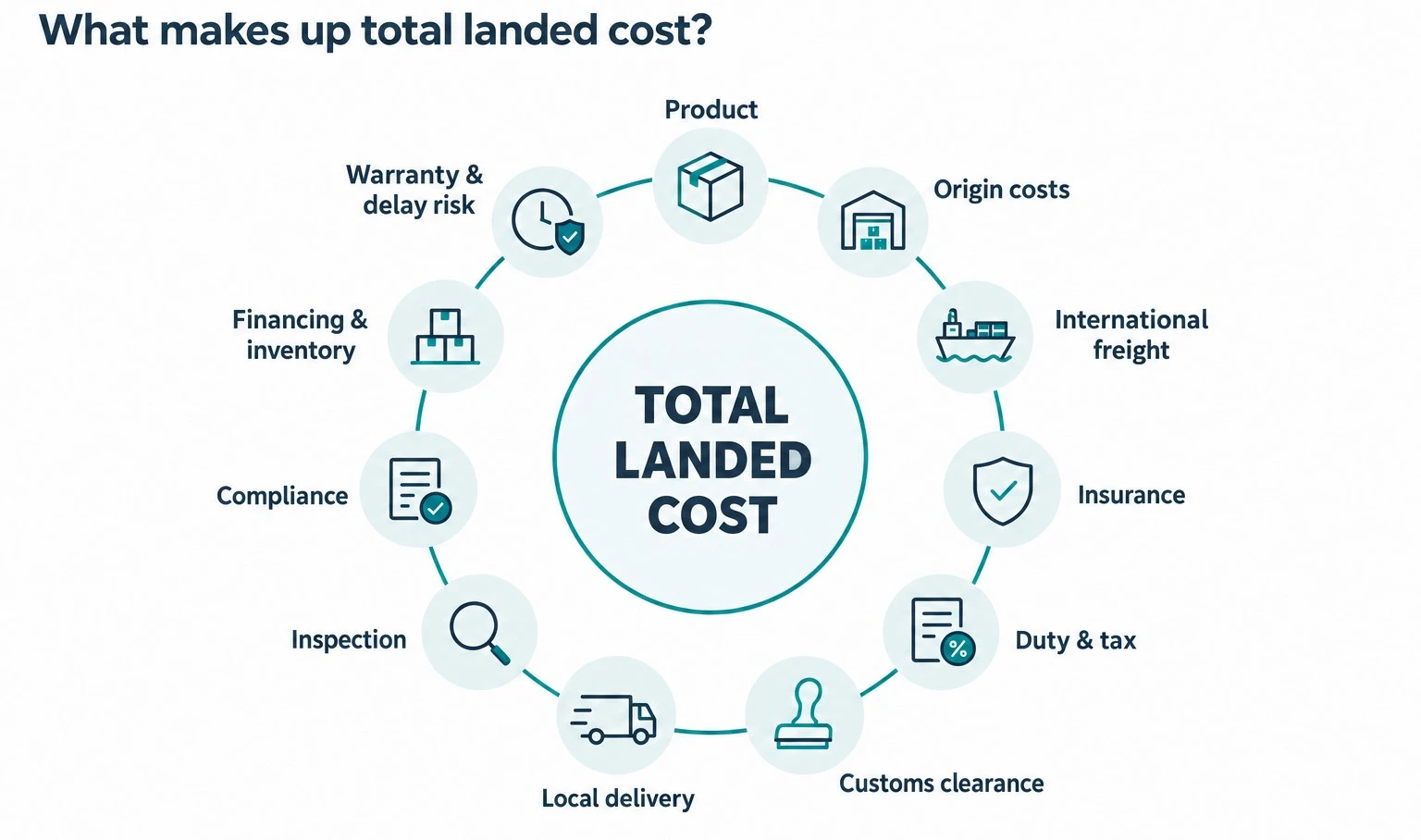
Total landed cost includes every expense needed to move the correct product from the supplier to the project site and keep it usable through commissioning and warranty support.
TOTAL LANDED COST = PRODUCT + ORIGIN COSTS + FREIGHT + INSURANCE + DUTY AND TAX + CLEARANCE + LOCAL DELIVERY + INSPECTION + COMPLIANCE + FINANCING AND INVENTORY + EXPECTED WARRANTY AND DELAY COST
Use a comparison unit that matches the purchase: cable per metre or kilometre, battery per usable kilowatt-hour, inverter per rated kilowatt, module per watt, or a complete system against the same defined project scope. Do not divide by nominal capacity when the usable capacity or included system scope differs.
Quoted prices are comparable only when the products and delivery scope are equivalent. A lower cable price may reflect a different conductor size or certification scope. A lower battery price may use a different usable-energy definition, power rating, accessory scope or warranty condition.
International freight varies by product density, volume, handling risk and transport classification. Solar modules use significant container space and need breakage controls. Cable is dense and heavy. Lithium batteries require product- and route-specific transport documentation and carrier acceptance.
Do not use a freight rate for ordinary electrical accessories to estimate an energy storage shipment. Ask the freight provider to quote the exact product, packaging, weight, dimensions, route and applicable transport classification.
For current lithium-battery air-transport guidance, consult the IATA lithium battery resources.
Import cost depends on destination country, HS classification, origin, customs value and any product-specific trade measure. The supplier may suggest a code, but the importer should confirm classification and import requirements with a licensed broker or the relevant authority.
State the Incoterm and named place in every quotation. EXW, FOB, CIF, DAP and DDP allocate different costs, risks and operational responsibilities. They do not by themselves define payment terms, title transfer, warranty or product compliance.
Check the current rules and definitions through the International Chamber of Commerce Incoterms resources.
Compliance can determine whether imported equipment can be installed, connected, insured or accepted by the project owner. Requirements differ by product and destination, so verify the exact model, rating, manufacturing entity, factory and document scope before ordering.
A certificate for a related model or product family may not cover the quoted item. The buyer should reconcile the quotation, datasheet, product marking, certificate or listing and sample before approval.
International procurement shifts more verification work to the buyer. The inspection plan should reflect product risk, order value and the ability to correct a problem before shipment.
|
Control point |
Possible evidence |
|---|---|
|
Before order |
Specification review, certificate check and approved sample |
|
During production |
Material records, process checks and agreed inspection points |
|
Before shipment |
Quantity, packaging, marking, functional or electrical test and photo record |
|
At receipt |
Damage check, document reconciliation, sampling and acceptance record |
|
For major orders |
Factory audit or independent inspection with a defined scope |
Review SINELINK capabilities and factory information before agreeing product-specific inspection and documentation requirements.
Factory-direct orders often commit cash earlier. A deposit may be paid before production and the balance before shipment, so financing continues through transport and clearance. Local wholesalers may charge more per unit but allow smaller purchases, faster stock turns or credit terms.
The stated warranty period does not reveal the cost of a claim. Define the diagnosis, evidence, response, freight, return and replacement process before ordering. Cross-border support can work well when responsibilities are clear; without an agreed process, labor and downtime can exceed the value of the component.
Late or incompatible equipment creates costs that rarely appear on the original quotation: idle installers, rescheduled lifting or electrical work, delayed commissioning, temporary power, repeated engineering review, liquidated damages and lost operating revenue.
Battery and inverter compatibility needs more than overlapping voltage ranges. Confirm the approved model combination, CAN or RS485 protocol, firmware version, charge and discharge limits, current limits, commissioning procedure and the party responsible for integration.
Direct sourcing works best as a managed supply-chain process, not as an emergency purchase.
A local wholesaler can also be the better source for urgent replacement parts even when the main project order is imported directly.
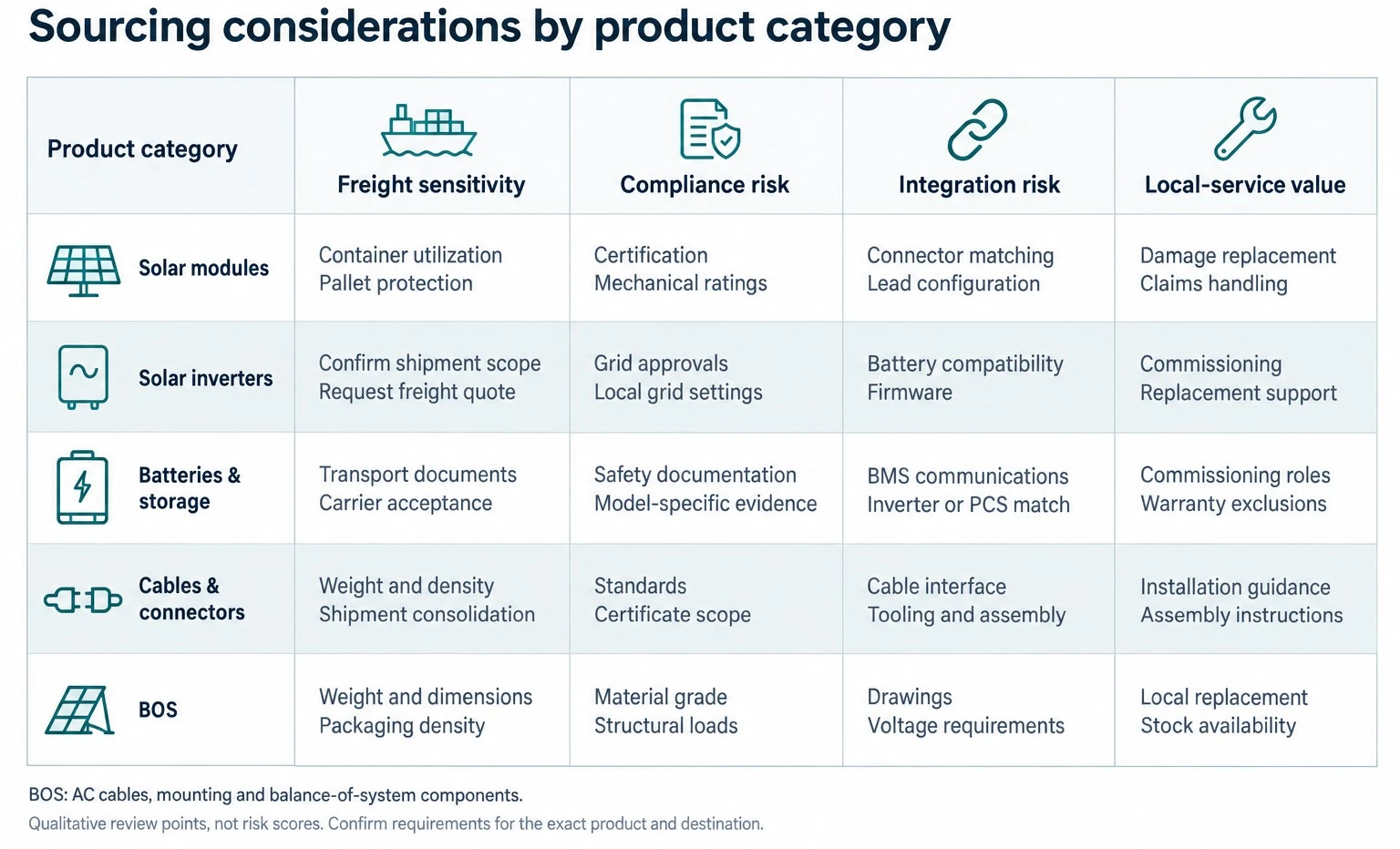
One sourcing rule does not fit every solar and battery product. Compare price, freight, compliance, integration and service according to the product's actual risk profile.
Direct import can suit container-scale demand, while small projects may benefit from local stock because partial-container freight, storage and damage replacement reduce the direct-price advantage. Confirm power, dimensions, technology, mechanical ratings, connector and lead configuration, warranties, certification, pallet layout and claims procedure.
Inverters carry high grid-compliance and support risk. Verify DC and AC ratings, MPPT design, monitoring, battery compatibility, firmware, local grid settings, commissioning responsibility and replacement support. Local technical service may be worth more than a small unit-price saving.
Battery systems require technical, transport and integration review. Compare chemistry, cell model, nominal and usable capacity, charge and discharge limits, BMS, communications, compatible inverter or PCS, cooling, safety design, enclosure, expansion, monitoring, documentation and warranty exclusions.
Use separate selection paths for residential energy storage systems and commercial and industrial energy storage systems. Larger systems require clearer responsibility for engineering, commissioning and after-sales support.
Cables and connectors can suit planned factory-direct procurement, but standard names do not remove the need for technical verification. Confirm standard, voltage, conductor, cross-section, construction, temperature and installation conditions, certificate scope, connector rating, cable interface, tooling and assembly instructions.
Compare solar DC cable families and PV connector options on the exact project requirements. Cable and connector compatibility should be documented for the selected models and assembly method.
AC cable, mounting and balance-of-system products can carry high freight because of weight or dimensions. Compare conductor and voltage requirements, material grade, surface treatment, structural loads, drawings, packaging density, container utilization and local replacement availability. Import specialized items when they add value and source bulky standard materials locally when that reduces total cost.
Review AC and project cable options separately from PV DC cable requirements.
|
Hidden cost |
Why it changes the decision |
|---|---|
|
Specification differences |
Quotes may use different cable sizes, usable-energy definitions, IP ratings or accessory scopes. |
|
Port storage and demurrage |
Document or collection delays create charges unrelated to product price. |
|
Communication mismatch |
Battery and inverter voltage may match while protocol or firmware does not. |
|
Spare parts |
Fans, fuses, control boards, connectors or modules may be needed to protect uptime. |
|
Packaging failure |
Damage to modules, cabinets, enclosures or cable drums can erase initial savings. |
|
Document gaps |
Missing certificates, reports, serial lists or transport documents can delay acceptance. |
|
Currency movement |
The exchange rate can change between quotation, deposit and balance payment. |
|
Emergency replenishment |
Air freight or local replacement can eliminate the original unit-price advantage. |
Place every quotation into the same comparison sheet. If a required cost is missing, add it to the comparison instead of treating that supplier as cheaper.
Many buyers should not use one channel for every product. A hybrid approach combines planned direct procurement with local flexibility.
|
Choose direct sourcing when |
Choose local supply when |
|---|---|
|
Demand is planned and repeatable |
Demand is small or urgent |
|
Specifications and compliance are confirmed |
The design or approval basis is still changing |
|
Order volume absorbs import costs |
Low MOQ and local stock matter most |
|
The buyer can manage import and verification |
The buyer needs local technical and warranty support |
|
Customization or consolidation adds value |
Downtime and replenishment speed dominate |
The cheapest quotation creates value only when the correct product arrives on time, passes inspection, meets destination-market requirements and can be supported after installation.
SINELINK supports international installers, EPC contractors, system integrators, distributors and procurement teams sourcing solar cable, PV connection products, AC and project cables, residential and C&I energy storage, and EV charging equipment. Product ratings, evidence, warranty terms, manufacturing scope and customization must be confirmed for the selected model and destination market.
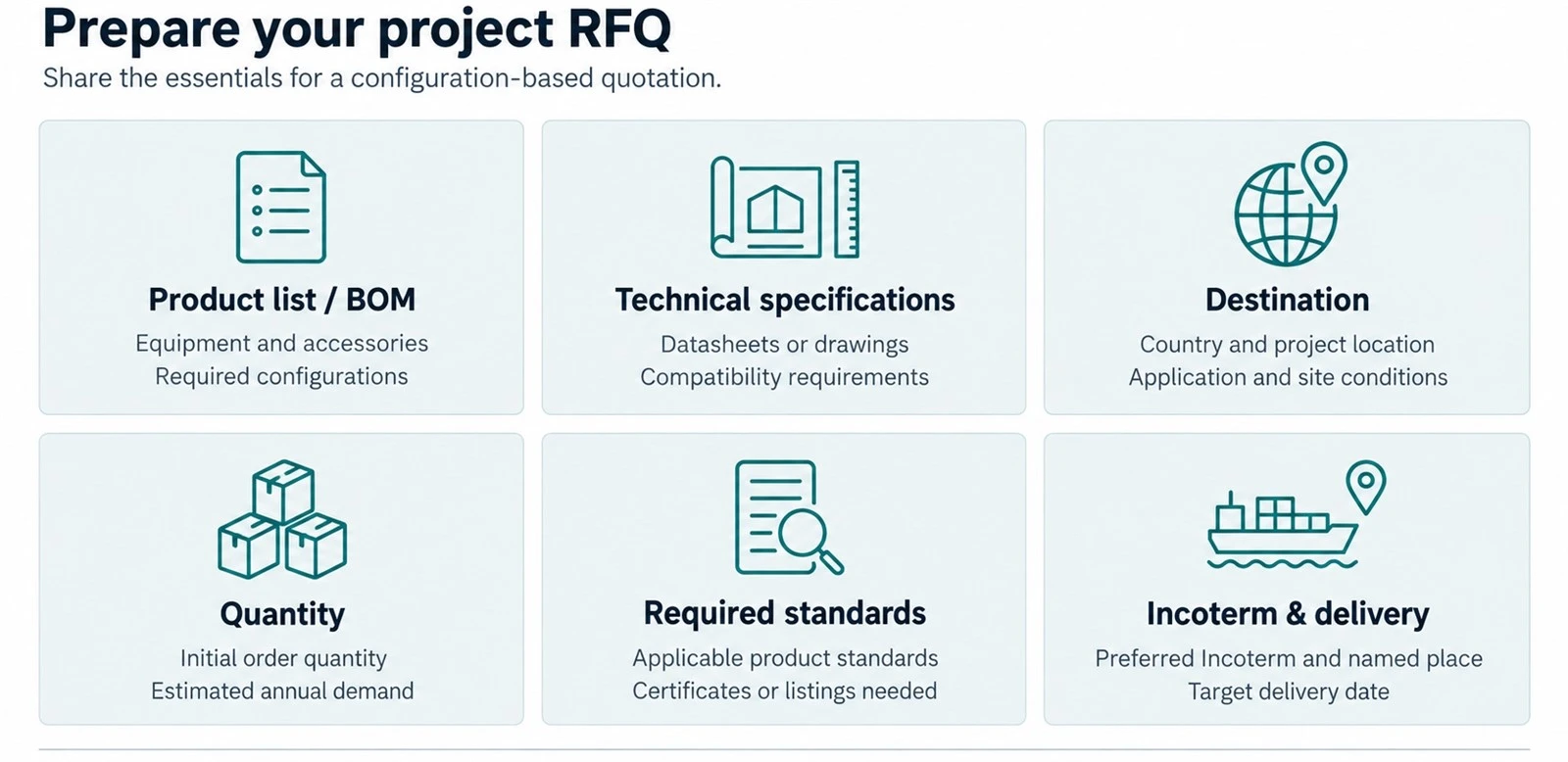
Send the following information so the team can review a defined configuration rather than issue a generic price:
It can be cheaper for planned and sufficiently large orders, but the comparison must include freight, duty, clearance, inspection, financing, inventory, warranty and delay costs. Local supply may cost less overall for small or urgent demand.
MOQ depends on the product, model, packing and customization. Ask for the standard MOQ, sample policy and quantity-price breaks for the exact configuration.
Requirements depend on the product and destination. Verify the exact model against applicable electrical, grid, safety, environmental, labeling and battery-transport requirements before ordering.
Yes, but the route, battery type, state of charge, packaging, labeling, documentation and carrier acceptance must meet the applicable transport requirements. Confirm the current shipment plan with a qualified freight provider.
Choose the Incoterm according to the buyer's logistics capability and the named place. Confirm exactly which origin, freight, insurance, clearance, tax and final-delivery costs are included; the Incoterm does not define every commercial obligation.
Check the legal entity, manufacturing scope, factory, product evidence, samples, quality controls, export documentation and warranty process. Use a scoped audit or independent inspection when order risk justifies it.
It may be, but low volume, freight allocation, MOQ, lead time and support can make local supply more economical. Combining multiple projects or compatible products can improve the direct-sourcing case.
Normalize every quotation to the same model, specification, evidence, accessories, quantity, Incoterm, payment timing, packaging, warranty and delivery scope, then add all omitted import and risk costs.
Incoterm terminology should be checked against the ICC Incoterms rules. Lithium battery transport planning should use the current rules and carrier requirements; the IATA lithium battery resources provide a starting point for air cargo. Destination-market customs, tax, grid and compliance requirements must be confirmed locally.