

SINELINK / CABLE TECHNICAL SERIES
EN 50618 vs IEC 62930
Which Solar Cable Standard Should EPC Projects Specify?
A market-, evidence- and specification-led guide for EPC standards decisions.
European / EN-oriented basis
International IEC basis
ARTICLE MAP
- Short Answer: Which Standard Should an EPC Specify?
- What Does EN 50618 Cover?
- What Does IEC 62930 Cover?
- EN 50618 vs IEC 62930: Practical Comparison
- Are EN 50618 and IEC 62930 Equivalent?
- Does a Dual-Standard Cable Automatically Solve the Decision?
- Which Standard Fits European Projects?
- Which Standard Fits International IEC Projects?
- What About North America and UL 4703?
- How Should EPCs Choose the Standards Basis?
- How to Write the Tender Requirement
- Common Specification Mistakes
- Frequently Asked Questions
- Engineering and Editorial Note
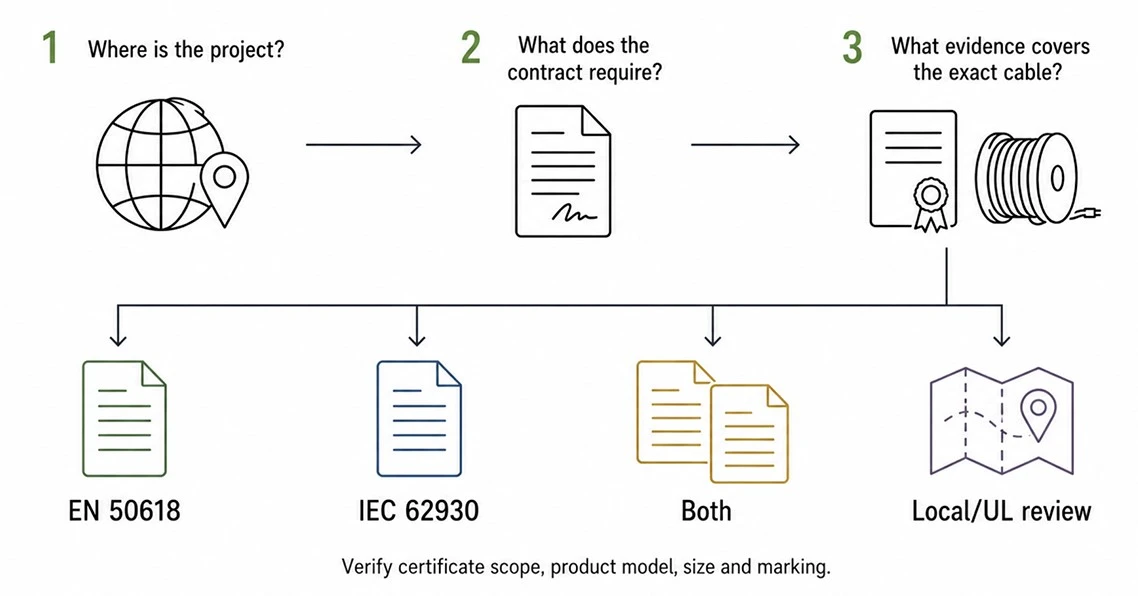
EN 50618 vs IEC 62930 Decision Map
The choice is rarely a contest over which document is "better." It is a compliance decision: what does the project require, what has the proposed cable actually been assessed against, and will the evidence be accepted where the plant is built?
That framing matters because a supplier may place both standard numbers on one datasheet while holding different evidence scopes, different certificates or only a statement of conformity for one of them. The purchase specification should make those distinctions visible before the cable reaches site.
For the full cable-selection workflow-voltage, current, route, temperature, voltage drop and connector fit-use the Solar DC Cable Selection Guide. This article focuses only on choosing and documenting the correct standards basis.
Short Answer: Which Standard Should an EPC Specify?
QUICK ANSWER
Specify EN 50618 when the project contract, European or national adoption, client requirement or H1Z2Z2-K product designation calls for it. Specify IEC 62930 when an IEC-based international project requires that standard. Specify both only when both are contractually necessary and the offered product has verifiable evidence for each. For North American projects, confirm UL 4703 PV Wire and locally adopted electrical-code requirements rather than assuming either IEC/EN standard is sufficient.
A project can also impose national deviations, additional fire classifications, local registrations or owner-specific tests. Therefore, the standard named in a global company catalogue should never overrule the project's approved cable schedule.
What Does EN 50618 Cover?
BSI describes EN 50618 as applying to low-smoke, halogen-free, flexible single-core power cables with cross-linked insulation and sheath for use on the DC side of photovoltaic systems at a nominal 1.5 kV DC rating. BSI's national adoption, BS EN 50618:2014, is identified as identical to EN 50618:2014. [1]
The designation H1Z2Z2-K is commonly used for this cable family. In practical terms, that gives European and EN-oriented project teams a recognizable combination of product designation, voltage context, conductor construction and halogen-free cross-linked layers. It does not, by itself, settle cable size, installed current capacity, voltage drop, connector fit, CPR class, burial method or water exposure.
The detailed test and procurement evidence workflow belongs in S2. After S2 is live, link the phrase "EN 50618 requirements EPCs should verify" to its final URL. Until then, use the live EN 50618 H1Z2Z2-K solar cable page as the commercial product entry and request controlled documentation.
What Does IEC 62930 Cover?
IEC 62930:2017 is an international standard for single-core power cables with cross-linked insulation and a cross-linked sheath on the DC side of photovoltaic systems. Its official scope covers rated DC voltage up to and including 1.5 kV between conductors and between conductor and earth. It includes halogen-free low-smoke cables and cables that may contain halogens. [2]
The IEC page also states a normal continuous maximum conductor temperature of 90°C and limits use at a maximum conductor temperature of 120°C to 20,000 hours. That thermal statement is a product boundary, not an installed ampacity calculation and not permission to use 120°C as the everyday design condition. [2]
Because IEC 62930 has broader international positioning, it may be written into specifications outside Europe. Yet "IEC project" is not a complete acceptance rule. Confirm the edition, national adoption, owner requirements, certification route and any additional local approvals.
EN 50618 vs IEC 62930: Practical Comparison
| Decision point | EN 50618 | IEC 62930 | EPC action |
| Framework | European standard | International IEC standard | Use the contract and destination-market basis |
| Application scope | DC-side PV cable | DC-side PV cable | Confirm the exact edition and certificate scope |
| Basic cable form | Flexible single-core; cross-linked insulation/sheath | Single-core; cross-linked insulation/sheath | Do not extend single-core evidence to a different assembly |
| Voltage context | Nominal 1.5 kV DC | Up to and including 1.5 kV DC | Coordinate with calculated system voltage and all components |
| Halogen scope | Low-smoke, halogen-free scope | Includes halogen-free low-smoke and halogen-containing scopes | Read the actual construction; do not infer LSZH from IEC number alone |
| Common designation | H1Z2Z2-K is commonly associated | No single universal commercial designation should be assumed | Match marking to certificate and datasheet |
| Geographic use | Europe and EN-oriented projects | IEC-based international projects | National adoption and client requirements still control |
| Evidence | EN certificate/record plus exact product documents | IEC certificate/report/declaration as required | If both are specified, verify both separately |
| What neither selects | Installed size, voltage drop, connector, route and local approval | Same | Complete the system design independently |
Comparison boundary: This table compares published scope and procurement context. It is not a clause-by-clause equivalence assessment of the purchased standards.
Are EN 50618 and IEC 62930 Equivalent?
They address closely related applications and share important construction and performance concepts, but "similar" is not the same as "interchangeable." Formal equivalence depends on the adopted documents, editions, amendments and certification basis. An EPC should not approve a substitution merely because a brochure shows both numbers in the same row.
- Check the standard and edition named in the employer's requirements and cable schedule.
- Check whether the destination country has adopted an EN, IEC or national version and whether deviations apply.
- Check whether the certificate or official evidence names the exact standard, product model and size range.
- Check whether one claim is third-party certification while the other is only a manufacturer declaration.
- Obtain written approval before substituting one standards basis for another.
Do not write "EN 50618 / IEC 62930 or equivalent" without defining who determines equivalence, which technical and documentary criteria apply, and what evidence must be submitted before approval.
Does a Dual-Standard Cable Automatically Solve the Decision?
A product can legitimately be assessed to both standards, and that can simplify multinational portfolios. It does not remove the review. The team must verify whether both claims cover the same commercial model, conductor construction, size, color, factory and production marking.
A dual-standard datasheet can otherwise hide several different situations: two current certificates; a certificate for one standard plus a declaration for another; different size ranges; different factories; or a combined marketing statement that is broader than the evidence. Ask the supplier to map each claim to its supporting record.
- Certificate body and searchable number for each claimed certification route.
- Exact standard title, edition and amendments.
- Certificate holder, factory where identified, product series and conductor-size scope.
- Controlled datasheet revision and approved marking string.
- Explanation of any construction or variant exclusions.
- Batch, reel and inspection traceability for the supplied order.
Which Standard Fits European Projects?
For a European or explicitly EN-oriented tender, EN 50618 and the H1Z2Z2-K designation are commonly the clearest product basis. The project may also require CE-related documentation, a CPR reaction-to-fire classification for particular installation locations, or national requirements. Those items are connected but separate.
If the cable enters a building or the tender names a Euroclass, consult Solar Cable Fire Performance Explained. EN 50618 compliance does not automatically establish the required CPR class or replace a Declaration of Performance.
The European decision should therefore read as a stack: cable product standard, project design, installation rules, reaction-to-fire requirement where applicable, client specification and accepted evidence. A single "TÜV approved" line is not the stack.
Which Standard Fits International IEC Projects?
IEC 62930 is the natural starting point when the project's technical specification is organized around IEC standards and the destination market accepts that basis. Confirm whether a national adoption is required and whether the owner adds low-smoke, halogen-free, UV, fire, water, burial or documentation conditions beyond the base product claim.
The published IEC scope includes cable constructions that may contain halogens, so an IEC 62930 claim should not be paraphrased automatically as "LSZH cable." If the project requires halogen-free low-smoke performance, state it and verify the offered construction and evidence explicitly.
What About North America and UL 4703?
Neither EN 50618 nor IEC 62930 should be assumed to replace the product listing and installation requirements applicable to a North American project. Where UL 4703 PV Wire and a locally adopted electrical code are required, specify and verify those requirements directly. An additional IEC or EN claim may be useful for a global product family, but it does not silently create local acceptance.
This is a good example of why product selection begins with the destination market. A technically capable 1.5 kV DC cable can still be the wrong procurement choice if its listing, marking or approval basis does not satisfy the authority reviewing the installation.
How Should EPCs Choose the Standards Basis?
- Read the owner's requirements, drawings, cable schedule and contract before using a supplier catalogue.
- Confirm the destination country, national adoption and approval authority.
- Identify the intended circuit, maximum calculated voltage and installation environment.
- Write the required product standard and edition; avoid unexplained slash-separated alternatives.
- Define any additional construction, fire, water, burial, color, marking and documentation requirements.
- Request evidence mapped to the exact product model, conductor size and factory.
- Resolve deviations and substitutions in writing before purchase.
- Match the delivered reels and batch records to the approved submission.
KEY TAKEAWAYS
- Choose by project requirement and market acceptance, not by which standard looks newer.
- EN 50618 is the European/H1Z2Z2-K route; IEC 62930 is the international IEC route.
- IEC 62930 does not automatically mean halogen-free cable.
- Similar scope does not make certificates interchangeable.
- A dual-standard claim needs two clearly mapped evidence paths.
- Cable size, voltage drop, connector fit, CPR, burial and local approval remain separate decisions.
How to Write the Tender Requirement
EN-oriented option: Provide flexible single-core H1Z2Z2-K photovoltaic cable assessed to the project-specified edition of EN 50618, with the scheduled size, color, marking and supporting certificate scope.
IEC-oriented option: Provide single-core photovoltaic cable assessed to the project-specified edition of IEC 62930, with the required conductor, halogen/fire characteristics, size, color, marking and supporting evidence.
Dual-standard option: Provide one defined commercial product with separate, current evidence showing that the exact model, construction, size range and production scope meet both specified standards. No substitution or change of material/factory is permitted without written approval.
Each option must be completed with the project's electrical calculations, installation conditions, connector schedule, packaging, inspection plan, traceability and destination-market requirements. The cable standard should be one row in a controlled compliance matrix, not the entire specification.
For multi-family PV cable, connector and accessory packages, use the photovoltaic power station cable solution as the commercial bridge while keeping the approved compliance matrix contractually controlling.
Common Specification Mistakes
Mistake 1: Writing "EN/IEC compliant" without standard numbers, editions or evidence type.
Mistake 2: Assuming an IEC 62930 product is necessarily halogen-free or marked H1Z2Z2-K.
Mistake 3: Accepting an EN certificate as automatic proof of IEC certification, or the reverse.
Mistake 4: Requiring both standards when the project needs only one, adding cost and document friction without a compliance reason.
Mistake 5: Assuming either standard determines the correct conductor size or installed ampacity.
Mistake 6: Treating EN 50618 as proof of CPR classification or direct-burial approval.
Mistake 7: Ignoring national adoption, client additions or the authority having jurisdiction.
Mistake 8: Approving a certificate family without matching model, size, marking, factory and delivered batch.
If the specification still uses an earlier product designation, compare PV1-F vs. H1Z2Z2-K and obtain formal project approval before changing the cable basis.
Frequently Asked Questions
Q: Are EN 50618 and IEC 62930 the same standard?
No. They address closely related PV cable applications, but they are separate standards with different regional frameworks and scope wording. Verify the exact editions and evidence rather than assuming equivalence.
Q: Which standard is used for H1Z2Z2-K cable?
H1Z2Z2-K is commonly associated with EN 50618. The marking must still be matched to valid documentation for the exact product and size.
Q: Is IEC 62930 accepted in Europe?
Acceptance depends on the contract, national adoption, client and authority. A European project that explicitly requires EN 50618 should not receive an IEC-only substitution without written approval.
Q: Does IEC 62930 require halogen-free cable?
Its published scope includes halogen-free low-smoke cables and cables that may contain halogens. Verify the actual construction and project requirement.
Q: Can one cable comply with both standards?
Yes, a product may have evidence for both. Confirm that both claims cover the same model, construction, size range and production scope.
Q: Do I need both EN 50618 and IEC 62930?
Only when the contract, market or portfolio requirement justifies both. Requiring two standards by default can add cost without improving acceptance.
Q: Can these standards replace UL 4703 in the United States?
Do not assume so. Confirm the required UL PV Wire listing and locally adopted electrical-code rules for the project.
Q: Which standard determines 4 mm² or 6 mm² cable size?
Neither standard alone selects the project size. Use design current, route length, voltage drop, temperature, grouping, installation method and connector compatibility.
Q: What documents should a buyer request?
Request the applicable certificate or official scope evidence, controlled datasheet, declaration where required, approved marking, size range, factory information where stated, batch test/inspection records and traceability.
Q: How should an EPC handle an "or equivalent" offer?
Define the equivalence criteria and approving party, require a clause-by-clause technical and documentary comparison, and obtain written approval before procurement.
Confirm the right standards route before requesting price
Send the destination country, employer's specification, required standards and editions, voltage, cable sizes, installation conditions, connector model, fire/burial requirements and documentation list. SINELINK can align the proposed product and evidence package with the requested basis. Request a solar cable compliance review and quotation
Engineering Note
This article compares published scope and procurement logic; it is not a substitute for the complete purchased standards or a formal equivalence assessment. The project engineer, contract documents, national rules, certification records and responsible approval authority remain controlling.
Authoritative Sources and Technical References
[1] BSI. BS EN 50618:2014 - Electric cables for photovoltaic systems - Official catalogue record and EN scope context.
[2] IEC. IEC 62930:2017 - Electric cables for photovoltaic systems - Official international scope, voltage and thermal statements.
[3] TÜV Rheinland. Photovoltaic Components Certification - Certification-body page listing EN 50618 and IEC 62930 among PV cable assessment routes.
[4] TÜV Rheinland. EN 50618 cable check routine - Primary overview of the EN 50618:2014 test program; used only for context, not to reproduce S2.
[5] Prysmian Group. Solar Cable Solutions - Manufacturer example of a product stated as compliant with EN 50618 and IEC 62930.