

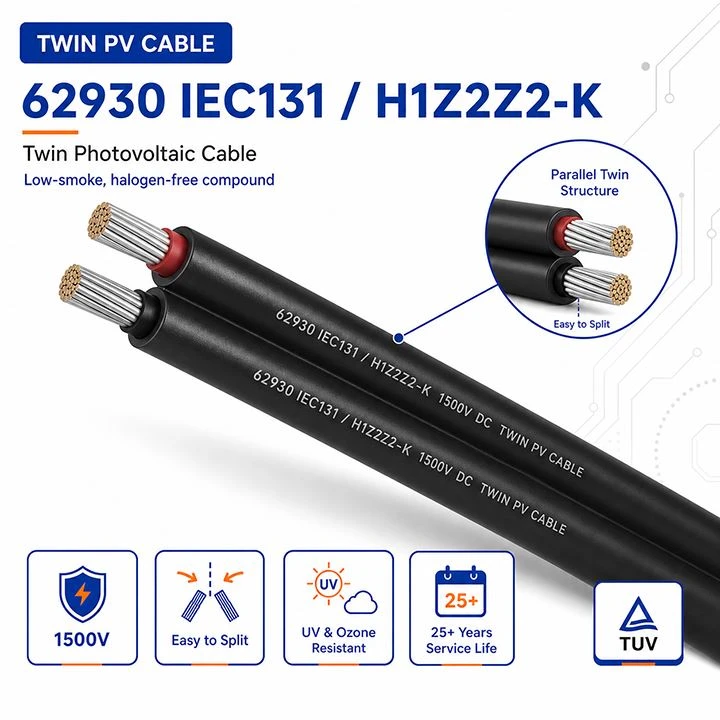
The cable is made with Class 5 tinned copper conductors, XLPO insulation, and XLPO sheath, providing good flexibility, UV resistance, ozone resistance, low-temperature performance, and long-term outdoor durability.
Key Features
Bonded Twin Structure
The twin design keeps two cables aligned during installation, making routing easier and neater than using two separate single-core cables. The cable can be split when needed for connection to PV modules, connectors, combiner boxes, or inverters.
Suitable for Outdoor PV Systems
PV cables need to withstand sunlight, temperature changes, humidity, and long-term outdoor exposure. The XLPO insulation and sheath provide reliable resistance to UV, ozone, heat, and cold conditions.
Flexible Tinned Copper Conductor
The cable uses Class 5 tinned copper conductors, offering good flexibility, stable conductivity, and improved corrosion resistance. This makes it suitable for both rooftop and ground-mounted PV installations.
Low Smoke and Halogen-Free
The cable is made with low-smoke, halogen-free materials, helping reduce smoke and corrosive gas release in case of fire. This is important for safer electrical installations, especially in rooftop and building-mounted solar systems.
Long Service Life
Under proper installation and operating conditions, the cable is designed for a service life of over 25 years below 90°C, matching the long operating cycle of photovoltaic systems.
FAQ
1. What is 62930 IEC 131 H1Z2Z2-K Twin Photovoltaic Cable?
62930 IEC 131 H1Z2Z2-K Twin Photovoltaic Cable is a dual-core solar DC cable designed for photovoltaic power systems. It combines two single-core PV cables in a parallel bonded structure, making installation, routing and cable management more convenient.
2. What is the difference between twin photovoltaic cable and single-core solar cable?
A twin photovoltaic cable consists of two bonded single-core cables, normally used for positive and negative DC connections. It can be easily separated when required. Compared with two independently installed cables, the twin design improves routing efficiency and keeps the installation neater.
3. What does H1Z2Z2-K mean?
H1Z2Z2-K is a harmonised photovoltaic cable designation. It generally refers to a flexible, halogen-free, cross-linked insulated and sheathed solar cable designed for permanent outdoor use in PV systems.
4. What is IEC 62930?
IEC 62930 is an international standard covering electric cables for photovoltaic systems with a rated voltage up to 1.5 kV DC. It specifies requirements for cable construction, electrical performance, mechanical properties, ageing resistance and environmental durability.
5. What applications is this twin solar cable suitable for?
It is commonly used for DC connections between solar modules, combiner boxes, inverters and other photovoltaic system components. It is suitable for rooftop, commercial, industrial and utility-scale solar installations.
6. Can the two cables be separated during installation?
Yes. The bonded twin structure is designed to be split easily without damaging the insulation or outer sheath, allowing installers to separate the positive and negative conductors where necessary.
7. Can the cable be customised?
Yes. Conductor size, cable colour, printing, packaging length, wooden drum size and private-label marking can usually be customised according to project or distributor requirements.
Construction and Ratings
| Item | Specification |
|---|---|
| Product Name | 62930 IEC131 / H1Z2Z2-K Twin Photovoltaic Cable |
| Conductor | Tinned Copper, Class 5 |
| Insulation | XLPO |
| Sheath | XLPO |
| Cable Structure | Bonded Twin Cable, Easy to Split |
| Rated Voltage | DC 1500V |
| Test Voltage | 6500V AC |
| Ambient Temperature | -40°C to +90°C |
| Max. Conductor Temperature | +120°C |
| Short-Circuit Temperature | +250°C |
| Smoke Density | Transmittance ≥60% according to EN50618 |
| Cold Bend Test | -40°C±2°C, no cracks according to EN60811-504 |
| Service Life | Over 25 years below 90°C |
| Color | Full color range available |
Technical Parameters
| Cable Name | Cross Section | Conductor Structure | Insulation OD | Max. Conductor Resistance at 20°C | Overall OD |
|---|---|---|---|---|---|
| 62930 IEC131 / H1Z2Z2-K Twin EN50618 | 2×1.5mm² | 30/0.25 | 3.05mm | 13.7 Ω/km | 4.70×9.60mm |
| 62930 IEC131 / H1Z2Z2-K Twin EN50618 | 2×2.5mm² | 49/0.25 | 3.50mm | 8.21 Ω/km | 5.20×10.60mm |
| 62930 IEC131 / H1Z2Z2-K Twin EN50618 | 2×4.0mm² | 56/0.285 | 3.85mm | 5.09 Ω/km | 5.50×11.20mm |
| 62930 IEC131 / H1Z2Z2-K Twin EN50618 | 2×6.0mm² | 84/0.285 | 4.45mm | 3.39 Ω/km | 6.10×12.40mm |
| 62930 IEC131 / H1Z2Z2-K Twin EN50618 | 2×10mm² | 77/0.40 | 5.50mm | 1.95 Ω/km | 7.20×14.70mm |
| 62930 IEC131 / H1Z2Z2-K Twin EN50618 | 2×16mm² | 126/0.40 | 6.90mm | 1.24 Ω/km | 8.80×17.90mm |
| 62930 IEC131 / H1Z2Z2-K Twin EN50618 | 2×25mm² | 196/0.40 | 8.70mm | 0.795 Ω/km | 10.80×21.90mm |
| 62930 IEC131 / H1Z2Z2-K Twin EN50618 | 2×35mm² | 276/0.40 | 10.00mm | 0.565 Ω/km | 12.40×25.10mm |


