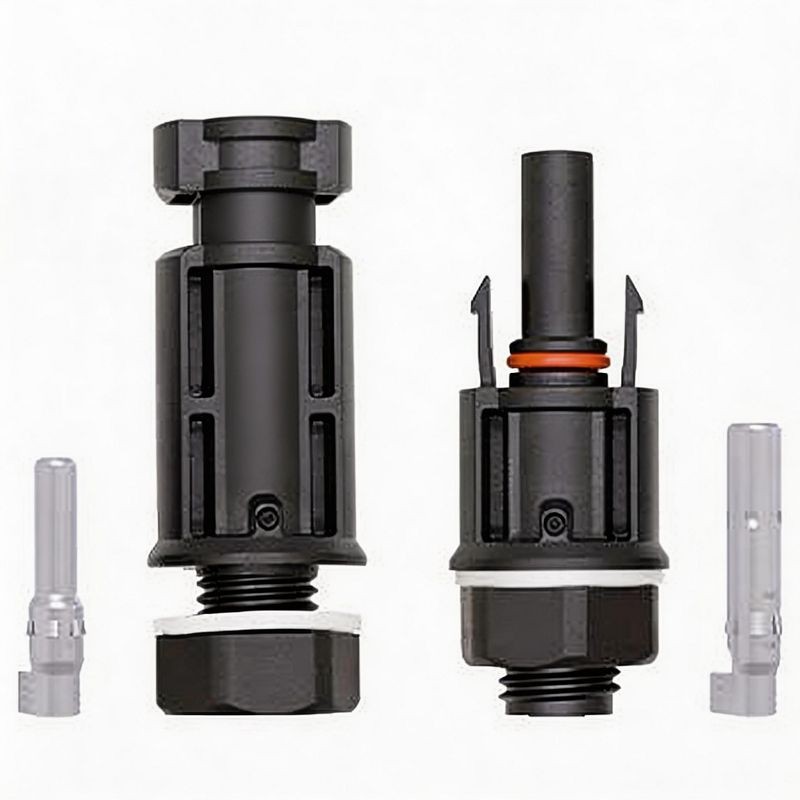
Photovoltaic connectors are designed to achieve safe, reliable, and efficient DC power transmission, and to withstand harsh outdoor environments over extended periods. The design of mainstream products (such as MC4 connectors) typically encompasses physical structure, electrical characteristics, material requirements, and application classifications.
The core structure of mainstream photovoltaic connectors like MC4 includes a plastic insulating shell, metal contacts, rubber sealing rings, sealing ring retainers, and clamping nuts for cable securing. They employ a positive locking mechanism: a plastic locking plate is located inside the socket. When the plug is inserted, the locking plate is pressed lightly; after full insertion, the locking plate springs into a groove on the side of the plug and then ejects, forming a secure connection and preventing accidental dislodgement.
The main electrical parameters of photovoltaic connectors include rated voltage. Newer generations of products have increased rated voltage to 1500V to accommodate higher system voltages. Contact resistance is a key parameter affecting efficiency; high-quality connectors must maintain extremely low contact resistance (e.g., less than 0.2 milliohms).
To adapt to outdoor environments, photovoltaic connectors generally have high protection ratings, such as IP67 (dustproof, short-term water immersion protection) or IP68. The outer casing insulation material must be resistant to ultraviolet radiation, high and low temperatures (the operating temperature range is usually -40℃ to +85℃), flame retardant, and have good mechanical and insulation properties to ensure stable operation during the system lifespan of at least 25 years.
According to the application scenario in photovoltaic systems, photovoltaic connectors can be mainly divided into three categories: wire-end connectors (installed at the output cable end of photovoltaic modules), branch connectors (used for on-site bus connections), and board-end connectors (installed at the input end of equipment such as inverters). Metal contacts are the main current-carrying path, and their design and materials directly affect the stability of contact resistance.
The market mainly offers "U"-shaped (stamped) and "O"-shaped (machined) metal cores. Reliable connections rely on standardized crimping processes, requiring the use of specialized crimping tools, and ensuring that the crimping height, pull-out force (e.g., greater than 310N for 4mm² cables) and resistance meet standards. Sealing design is crucial for waterproofing and dustproofing and must be matched to specific cable outer diameters. To ensure safety, it is strictly forbidden to interlock connectors of different brands or models, as dimensional tolerances and material differences may lead to poor contact, sealing failure, and in turn cause overheating or even fire.