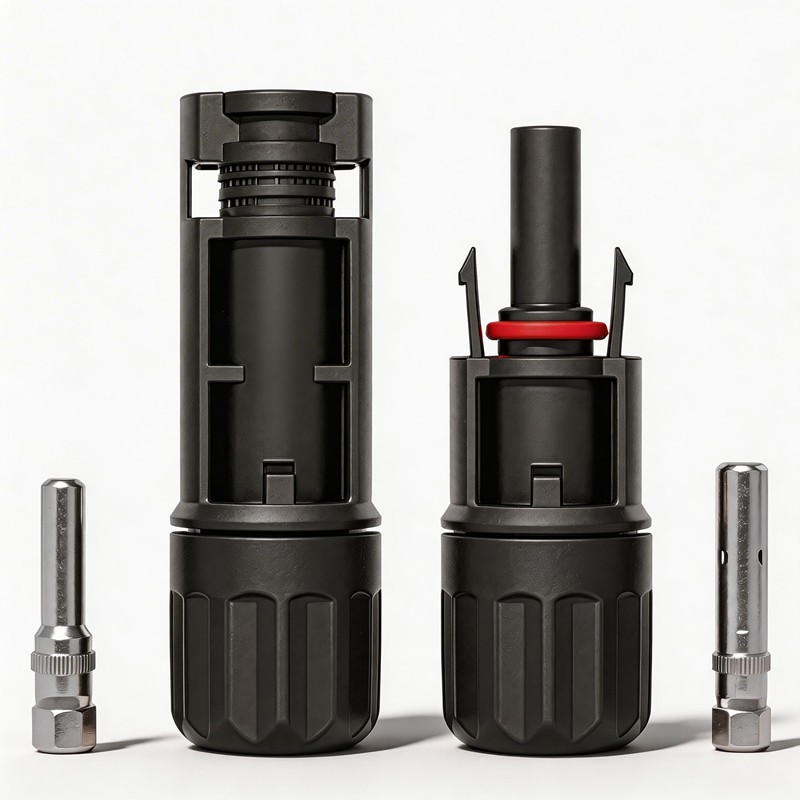
The future development of photovoltaic connectors will closely follow the advancements in photovoltaic module and system technologies. Technically, connectors need to adapt to higher system voltages, such as above 1500V, and larger current requirements to match the upgrades of high-efficiency modules and systems. In terms of applications, they need to improve adaptability and reliability in special environmental scenarios such as floating power plants on the sea, desert power plants, agricultural and livestock power plants, and BIPV (Building Integrated Photovoltaics).
The future development of photovoltaic connectors needs to keep pace with intelligent operation and maintenance.
Fundamentally, the development of photovoltaic connectors should focus on improving product reliability and consistency, reducing energy loss, and thus contributing to the reduction of the levelized cost of electricity (LCOE) throughout the entire lifecycle of photovoltaic power plants. [1-2] In terms of product form, high-quality and highly reliable connection solutions will be a key demand for photovoltaic manufacturers in the future. Connectors will meet the requirements of compactness and ease of installation; for example, 90° outgoing connectors can save installation space.
In addition, the adoption of tool-free or simple installation solutions such as Insulation Displacement Connection (IDC) technology and gel-filled sealing has also become an important development direction for improving installation efficiency and reliability. In terms of the market, photovoltaic connectors and cables account for approximately 3%-5% of the total system cost, and the market size of photovoltaic system connectors is expected to steadily increase in the future.